

Last Updated: November 10, 2026
Quick Summary
To learn how to prevent bloat in dogs naturally, feed two or three smaller meals a day, keep food and water bowls at floor level, and keep your dog calm before and after eating. Avoid vigorous exercise for 60 to 90 minutes after a meal, and reduce stress at feeding time.
- Feed two or three smaller meals a day instead of one large meal.
- Keep food and water bowls at floor level, since raised bowls increased GDV risk.
- Avoid moistening kibble that contains citric acid, which one study linked to higher risk.
- Keep your dog quiet for roughly 60 to 90 minutes after a meal.
- Go to an emergency veterinary clinic immediately if you see bloat signs.
Table of Contents
- What Canine Bloat (GDV) Is and Why It Is an Emergency
- Know Your Dog's Risk Factors, Including Breed and Build
- How to Feed a Dog to Prevent Bloat
- Choosing the Best Slow Feeder Bowls for Large Dogs
- Exercise, Rest and Water Habits Around Mealtime
- Calming Stress and Mealtime Competition
- Signs of Bloat in Dogs and What to Do Right Away
- Building Your Bloat-Prevention Routine at Home
- Frequently Asked Questions
Bloat in dogs is one of the most frightening emergencies a pet owner can face, and it can strike fast, so learning how to prevent bloat in dogs naturally is worth the effort. Paw Fit Gears put together this guide to help you lower your dog's risk at home. The good news: many of the steps that matter most are simple changes to daily routines, mealtimes and rest habits.
The most important thing to know right away is that the condition is serious. Gastric dilatation-volvulus, or GDV, is the medical name for the bloat-and-twist emergency that can kill a dog within hours. Prevention starts with understanding what raises the risk, so let's walk through it.
What Canine Bloat (GDV) Is and Why It Is an Emergency
Canine bloat is the common name for gastric dilatation-volvulus (GDV). The stomach fills with gas and can then twist on itself, which cuts off blood flow. This is why it is a medical emergency, not a minor stomach upset.
Veterinary sources describe GDV as a condition that can progress quickly, and prompt veterinary care gives the best chance of survival (A Protocol for Management of Acute Gastric Dilation-Volvulus Syndrome in the Dog...). The AKC Canine Health Foundation research on GDV funds ongoing work to understand how stomach torsion develops, which is why prevention advice keeps evolving.
Deep-chested breeds are most at risk, but any dog can be affected. Knowing this helps owners stay alert all year, not only during certain seasons.
Know Your Dog's Risk Factors, Including Breed and Build
Not every dog carries the same GDV risk, and sorting your dog into the right profile makes prevention easier to tailor. Large and giant breeds with a deep, narrow chest, sometimes called deep-chested dogs, are the group most consistently associated with the condition. Breeds commonly discussed in this category include Great Danes, standard Poodles, Weimaraners, Irish Setters and German Shepherds, among others. A deep-chested build means the chest extends well below the elbow, which gives the stomach more room to shift and twist.
Barrel-chested dogs form a related but different group. Their chests are broad and round rather than deep and narrow, and they are generally considered at lower risk than deep-chested dogs of similar size. Owners of barrel-chested dogs should still take the warning signs seriously, but the heaviest emphasis on slow feeding and post-meal rest usually belongs with the deep-chested profile.
Age and family history add to the picture. Middle-aged and older dogs are more often affected, and owners who have a relative or a dog that has previously had bloat should treat the risk as higher. A nervous or highly reactive temperament can also raise concern, because stress around meals is linked to rapid eating.
To place your dog, look at three things: chest depth compared with the elbow, overall size, and any family or personal history. A dog that is large, deep-chested and older with a nervous temperament sits at the top of the risk range, and that is the dog for whom the full routine of smaller meals, slow feeding, and post-meal rest should be followed without exception. Discuss this profile with your veterinarian, who can confirm the category and advise on any further steps.
Watch out: Do not assume a smaller or barrel-chested dog is immune. Bloat can occur in dogs outside the high-risk group, so keep the warning signs in mind regardless of breed.
How to Feed a Dog to Prevent Bloat
Feeding habits are one of the most useful levers you control when learning how to prevent bloat in dogs naturally. Research points to a few clear steps:
- Feed two or three smaller meals a day instead of one large meal
- Avoid moistening kibble that contains citric acid, since one study linked it to a sharp rise in bloat risk
- Keep food and water bowls at floor level
That last point is important. A VIN analysis of bloat risk factors found that raising food and water bowls increased the risk of GDV. Traditional advice to use raised bowls turned out to be counterproductive for many dogs.
Portion control also helps. Measure each meal with a cup rather than estimating, so you know how much your dog is actually eating.
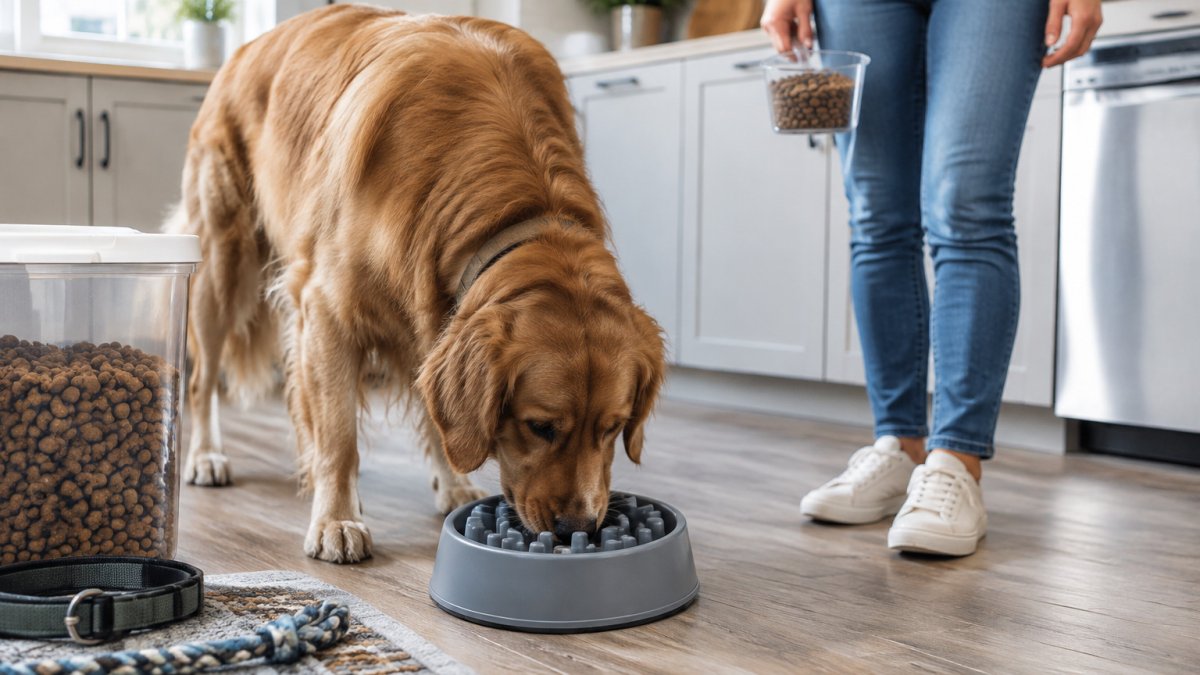
!Large dog eating calmly from a slow-feeder bowl
The article lists the feeding habits that research points to, so a quick reference makes them easy to scan.
| Feeding habit | Recommendation | Key point |
|---|---|---|
| Meal frequency | Two or three smaller meals a day | Avoid one large meal |
| Kibble moistening | Avoid moistening kibble with citric acid | One study linked it to a sharp rise in risk |
| Bowl height | Keep food and water at floor level | Raised bowls increased GDV risk |
| Portion size | Measure each meal with a cup | Know how much your dog actually eats |
Choosing the Best Slow Feeder Bowls for Large Dogs
Slow-feeder bowls slow down fast eaters. They use ridges, maze shapes or puzzle designs that make your dog work for each bite. Slower eating means less air swallowed with the food.
When you shop, look for a bowl with a wide base so it does not tip, and a size that fits your dog's muzzle comfortably. Large dogs need a bigger bowl with deeper channels so they can get a full scoop.
Slow feeders are not the whole answer. Pair one with smaller meals and calm mealtimes for the best effect. For a closer look at bowl design, see our guide on choosing the right bowl for flat-faced dogs.
Exercise, Rest and Water Habits Around Mealtime
Timing matters as much as what you feed. Most veterinary guidance treats the period after a meal as a window to keep your dog calm, because a stomach that is full and moving around during exertion is the setting in which gas accumulation and torsion are thought to be more likely. A commonly cited rule is to keep your dog quiet for roughly 60 to 90 minutes after a meal, with a longer quiet period after a large meal. Short walks to relieve a bathroom need are generally fine; running, jumping, fetch, rough play and hard trail work are not.
The same logic applies before meals. A dog that arrives at the bowl after an intense run is often breathing hard and gulping air, so it helps to let the heart rate settle for about 20 to 30 minutes before food is served. Build this into your daily schedule as a fixed sequence: walk, rest, feed, then a quiet period.
Water is where owners get the most conflicting advice. Restricting water entirely is not the goal, because dehydration carries its own risks, especially in hot weather or after exercise. The practical approach is to limit the volume a dog takes in one large gulp, not the total intake across the day. Offer water in several smaller portions, keep a bowl available, and avoid letting a dog drink heavily right after a meal or a hard run. If your dog drinks a lot and seems to gulp, a slow-drinking routine or a few ice cubes offered in place of a full bowl can help control intake.
Watch out: Do not swap a water restriction for a fluid-free period around exercise in hot conditions. Heat stress is a separate emergency, so if your dog is panting heavily and has limited access to water, contact your veterinarian rather than cutting fluids.
These habits are simple to repeat each day, and their value comes from consistency rather than any single rule.
Calming Stress and Mealtime Competition
Stress and competition at mealtimes can make a dog eat too fast. A dog who feels rushed, nervous or pressured to guard food may gulp air along with the food.
If you have more than one dog, feed them in separate spaces so neither feels pressure from the other. Give each dog a calm corner to eat in, away from foot traffic. If a dog steals food, learning how to stop food stealing can help you set up a calmer routine.
Signs of Bloat in Dogs and What to Do Right Away
Know the warning signs. A dog with bloat may show a swollen or hard belly, restlessness, pacing, drooling, dry heaving or non-productive retching. The dog may seem uncomfortable and unable to settle.
If you see these signs, go to an emergency veterinary clinic immediately. Do not wait to see whether the symptoms pass. Call ahead if you can so the team is ready when you arrive. Speed is the single most important factor.
Building Your Bloat-Prevention Routine at Home
Putting it all together is easier than it sounds. Start with the changes that are simplest for your household:
- Feed two or three smaller meals each day
- Use a slow-feeder bowl at floor level
- Keep exercise away from mealtimes
- Offer water in smaller amounts after activity
- Reduce stress and competition at feeding time
For feeding setups that fit your home, you can browse safe feeding solutions for dogs and ergonomic dog bowls for digestion.
Above all, keep your veterinarian in the loop. Ask about your dog's risk at each checkup, and act fast on any warning sign. Paw Fit Gears is here to help you find gear that supports a calmer mealtime routine for your dog at home.
Frequently Asked Questions
What is the best way to prevent bloat in dogs?
The most practical approach combines several habits: feed two or three smaller meals a day instead of one large meal, use a slow-feeder bowl to slow rapid eating, keep food and water bowls at floor level rather than raised, and avoid vigorous exercise for one to two hours before and after eating. Many veterinary sources suggest keeping bowls at floor level as a precaution, so this is a commonly recommended default. Keeping your dog at a healthy weight also reduces risk.
Can slow-feeder bowls actually help prevent bloat?
Slow-feeder bowls help by reducing how quickly a dog gulps food and swallows air, which can limit stomach volume at any one time. They are a useful part of prevention but not a complete solution on their own. Pair one with smaller, more frequent meals and rest periods after eating. Look for a sturdy, dishwasher-safe bowl sized for your dog, and supervise the first few meals to make sure the design suits how your dog eats.
What are the first signs of bloat in a dog?
Early signs include a swollen or tight abdomen, restlessness, pacing, drooling more than usual, and unproductive retching where the dog tries to vomit but brings up little or nothing. Your dog may also seem uncomfortable lying down or keep looking at its belly. Because bloat can progress quickly, any of these signs in a deep-chested dog warrants an immediate call to an emergency veterinarian.
Are there specific dietary changes that reduce bloat risk?
Some owners ask whether moistening kibble helps, but research suggests caution. Instead, feed measured portions at consistent times, avoid large meals right before or after exercise, and talk with your veterinarian before changing your dog's diet or adding supplements.
