

Table of Contents
- Why Dogs Steal Food in the First Place
- How to Stop Counter Surfing Before It Starts
- Using Crates and Enrichment to Prevent Food Stealing
- The Role of Mental Stimulation for Dogs Who Forage
- Training Consistency and Supervision Strategies
- Safety First: Toxic Foods and Emergency Protocols
- When Food Stealing Signals an Underlying Issue
- Why the Best Chew Proof Dog Beds Help Training
- Frequently Asked Questions
Last Updated: September 7, 2026
Why Dogs Steal Food in the First Place
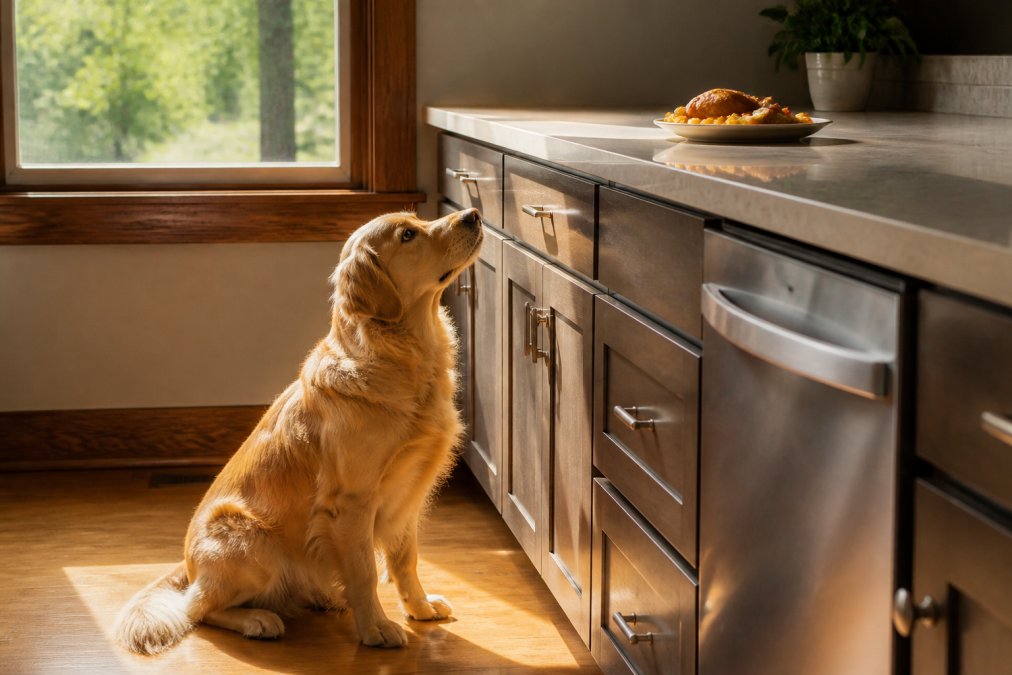
Preventing food stealing in dogs starts with understanding that this behavior is rarely about defiance, and addressing food stealing in dogs requires this foundational perspective. For a dog, snatching a sandwich off the counter is simply efficient foraging. When a high-value reward like roast chicken is left unattended, their instinct to grab it overrides any training cue.
This is not a moral failing on your dog's part, and it is not a sign that they are "bad." The behavior is self-reinforcing: every successful theft delivers a delicious payoff, which makes the next attempt more likely. According to the American Kennel Club's guide on counter surfing, dogs repeat behaviors that are rewarded, and food theft is one of the most potent natural rewards available.
You cannot punish away an instinct, but you can manage the environment and train a reliable alternative behavior. This guide walks through the steps that actually stop food stealing, from kitchen setup to impulse control training.
How to Stop Counter Surfing Before It Starts
The single most effective strategy for stopping counter surfing is to make it physically impossible. A dog cannot steal food that is out of reach, and every day without a successful "score" weakens the habit. This environmental management is the foundation upon which all training is built.
Set Up Your Kitchen for Success
Walk through your kitchen at dog-eye level. What looks tempting? Food left at the edge of counters, dirty plates in the sink, and trash cans without lids are all open invitations. Push food to the back of the counter, use a covered trash can, and never leave unattended food within reach of a jumping dog. The ASPCA's guidance on household management confirms that removing the opportunity is the most reliable preventative measure for scavenging behavior, especially in the early stages of training.
Teach a Rock-Solid Leave It and Place Command
Management alone will not fix the underlying impulse. The "leave it" command teaches your dog to disengage from an item on your cue, while "place" sends them to a designated mat or bed where they stay until released. Here is the exact progression that works, along with the mistakes that derail most owners.
Phase 1: The Closed Fist (Days 1-3)
Start with a treat in your closed fist and present it to your dog's nose. The moment they stop sniffing, licking, or pawing at it, even for a split second, mark with a clicker or "yes" and reward from your other hand. Repeat 10 times per session, twice daily. Reward the pause, not the eventual giving up; reward the first micro-second of disengagement.
Phase 2: The Open Palm (Days 4-7)
Once your dog reliably pauses when your fist is presented, repeat the exercise with the treat on your open palm. If your dog lunges, close your hand and wait. The instant they pull back, mark and reward from your other hand, teaching that restraint earns the treat.
Phase 3: The Drop (Days 8-14)
Place a low-value treat (like kibble) on the floor and say "leave it" before your dog moves toward it. If they go for it, cover it with your foot. When they back away, mark and reward with a higher-value treat from your pocket. Your dog learns that ignoring the item leads to something even better. Gradually increase the item's value and the distance.
Phase 4: Generalizing to the Counter (Weeks 3-6)
This is where most training falls apart: your dog has mastered "leave it" on the floor, but the counter is a different context. Place a plate of food on the counter while you are standing right there and practice with your dog on a leash. Progress to sitting at the table, then to being in another room. If your dog breaks the stay and grabs the food, you have moved too fast, go back a step.
The Place Command as a Management Tool
While you work on "leave it," the "place" command is your practical daily tool. Lure your dog onto a designated mat with a treat and say "place." Reward them for staying for 1 second, then 5, then 10, building up to a 30-minute stay, and use a release word like "free." During retraining, send your dog to "place" every time you prepare food in the kitchen. This is not punishment; it is a structured alternative behavior incompatible with counter surfing.
Troubleshooting Common Failures
- Dog only listens when you have treats: This is a fluency problem. You need to randomize your rewards. Sometimes reward with a treat, sometimes with praise, sometimes with a game of tug. The behavior should become a habit, not a transaction.
- Dog is fine in practice but steals when you are not looking: This means your management is not airtight. You cannot train an unsupervised dog. Use a crate or a closed door when you cannot actively supervise. The training only works when you are present to reinforce it.
- Dog regresses after a few weeks: This is normal. The habit of stealing is deeply ingrained. You may need to periodically refresh the training with a few sessions of "leave it" practice, especially after a lapse in supervision.
Using Crates and Enrichment to Prevent Food Stealing
Crate training is one of the most underused tools for preventing food stealing. A crate is not a punishment; it is a safe, den-like space where your dog can relax without the stress of constant temptation. When you cannot supervise directly, a brief, positive crate session removes the possibility of theft entirely.
Make the crate a wonderful place: feed your dog their meals inside, give them a durable chew toy, and never use it as a time-out. If you want a setup that blends into your home, the Rustic Dog Crate Furniture from Paw Fit Gears doubles as an end table, giving your dog a secure retreat without sacrificing your living room aesthetic. Its heavy-duty steel frame supports up to 200 lbs, making it a durable choice for larger breeds.

The Role of Mental Stimulation for Dogs Who Forage
A bored dog is far more likely to go looking for trouble. Many cases of persistent food stealing are driven not by hunger, but by a lack of mental and physical enrichment. A dog who has had a good walk and a challenging puzzle session is less motivated to scavenge for entertainment.
Food-dispensing puzzle toys, snuffle mats, and short training sessions all burn mental energy in ways a walk alone cannot. Redirecting your dog's natural scavenging drive into an appropriate outlet, like a snuffle mat where they "hunt" for their kibble, satisfies the urge without the risk of them eating something dangerous.
Training Consistency and Supervision Strategies
Behavioral modification only works when it is consistent. If you are diligent for five days and then leave a plate of burgers on the coffee table on Saturday, you have undone a week of progress. Every successful theft reinforces the behavior, so supervision must be airtight during retraining.
Use a house line, a lightweight leash attached to your dog's collar, so you can quickly redirect them if they creep toward the kitchen. Keep your dog in the same room as you when food is present; if you leave the room, take them with you or pop them in their crate. This vigilance only needs to last a few weeks until the new habit becomes the default.
Safety First: Toxic Foods and Emergency Protocols
Preventing food stealing is not just about protecting your lunch; it is about protecting your dog. Many common human foods are toxic to dogs, and a successful counter surf can have serious consequences. The Pet Poison Helpline's list of toxic foods highlights that items like grapes, raisins, xylitol, onions, and chocolate are dangerous even in small amounts. But knowing what is toxic is only half the battle. The real gap in most advice is what to do in the first 30 minutes after a theft. Here is a concrete action plan.
The Immediate Response Protocol
Step 1: Identify the Item and Quantity (0-2 minutes)
Figure out exactly what and how much your dog consumed. Check the packaging for ingredients. If it was chocolate, note the type and approximate weight; if gum or candy, check for xylitol; if grapes or raisins, estimate the number. This information is critical for the next step.
Step 2: Call Your Veterinarian or Pet Poison Helpline (2-5 minutes)
Do not wait for symptoms. Call your veterinarian immediately. If they are closed, call the Pet Poison Helpline at (855) 764-7661 (a fee applies) or the ASPCA Animal Poison Control Center at (888) 426-4435 (a consultation fee applies). Have your dog's approximate weight, the item consumed, the estimated quantity, and the time of ingestion ready. The professional will tell you whether to induce vomiting, go to an emergency clinic, or monitor at home.
Step 3: Do NOT Induce Vomiting Unless Instructed
This is the most common mistake owners make. Inducing vomiting with hydrogen peroxide is only appropriate in certain situations and is contraindicated for some toxins. If your dog has ingested something caustic or sharp, vomiting can cause more damage; if they are already showing neurological symptoms, it can lead to aspiration. Only induce vomiting if a veterinary professional explicitly instructs you to do so, and they will give you the correct dosage of 3% hydrogen peroxide (typically 1 teaspoon per 10 lbs of body weight, up to 3 tablespoons).
Understanding the Danger Windows
Different toxins act on different timelines. Here is what you need to know:
- Xylitol (artificial sweetener): Causes a rapid insulin spike and dangerous drop in blood sugar within 30-60 minutes. Symptoms include weakness, tremors, and collapse. This is a medical emergency that requires immediate veterinary intervention.
- Chocolate: Theobromine and caffeine toxicity typically appear within 6-12 hours. Symptoms include restlessness, vomiting, diarrhea, rapid heart rate, and seizures. Dark and baking chocolate are far more dangerous than milk chocolate due to higher theobromine content.
- Grapes and Raisins: Can cause acute kidney failure, but symptoms (vomiting, lethargy, loss of appetite) may not appear for 24-48 hours. Early intervention with IV fluids can significantly improve outcomes.
- Onions and Garlic: Cause damage to red blood cells, leading to anemia. Symptoms may not appear for several days. A single large ingestion is more dangerous than chronic small amounts.
The Age Factor: Why Puppies and Seniors Need Extra Caution
Age dramatically changes the risk profile. Puppies have lower body weight, so a smaller amount of toxin is more dangerous, and they are more likely to ingest non-food items like medication blister packs or nicotine gum. Senior dogs may have underlying kidney or liver disease that impairs toxin metabolism, and may be on medications that interact poorly with emergency treatments. If your dog is under 6 months or over 8 years, err on the side of calling your veterinarian even for borderline cases.
Building Your Emergency Kit Before You Need It
Preparation is the difference between a panic-stricken scramble and a calm, efficient response. Assemble a small kit and keep it near your phone:
- Your veterinarian's phone number and address
- The nearest 24-hour emergency veterinary clinic's phone number and address
- The Pet Poison Helpline number (855-764-7661)
- A bottle of 3% hydrogen peroxide (check the expiration date; it degrades over time)
- A turkey baster or syringe for administering liquids
- Your dog's medical records and proof of vaccination
The Unique Angle: Age-Specific Prevention
Prevention strategies should shift with your dog's life stage. Puppies need constant supervision, baby gates, and a rigorous management routine. Adolescent dogs (6-18 months) are testing boundaries and may need more intensive impulse control training. Senior dogs may develop cognitive decline that causes them to forget their training. If a previously well-behaved senior dog suddenly starts stealing food, this is a red flag for cognitive dysfunction syndrome (CDS), not a behavioral regression. Talk to your veterinarian about CDS screening and management options, which may include dietary changes, supplements, or medication. Adjusting your home setup, such as using baby gates to block off the kitchen, may be necessary as your dog ages.
When Food Stealing Signals an Underlying Issue
While most food stealing is simple opportunism, a sudden and intense increase in scavenging behavior can sometimes point to a medical problem. Conditions that cause increased appetite, such as diabetes, Cushing's disease, or certain thyroid issues, can make a dog compulsively seek out food. If your dog has always been polite around food and suddenly becomes obsessed, a veterinary check-up is a wise first step.
If food stealing is accompanied by resource guarding, where your dog growls or snaps when you approach while they have food, you are dealing with a more complex behavioral issue. This is not something to punish. Resource guarding is rooted in anxiety, and punishment typically makes it worse. Seek guidance from a certified professional dog trainer or a veterinary behaviorist who uses reward-based training methods.
Why the Best Chew Proof Dog Beds Help Training
A crucial and often overlooked piece of the puzzle is giving your dog a comfortable, durable place to relax that is not your kitchen floor. A designated bed serves as a clear "place" for your place command, giving your dog a physical spot that signals it is time to settle. The problem is that many dogs, particularly those with high prey drive or anxiety, will destroy a standard bed, undermining the entire training setup.
Investing in the best chew proof dog beds is a practical training decision, not just a furniture purchase. When a bed is durable enough to withstand digging and chewing, you can confidently use it as your dog's designated relaxation zone. We offer heavy-duty options designed to hold up to persistent chewers, so your training space remains intact and inviting. A secure, comfortable bed gives your dog a positive alternative to shadowing you in the kitchen, making it easier for them to choose calm behavior over counter surfing.
Frequently Asked Questions
How do I get my dog to stop stealing food?
Combine management with training. First, remove temptation by keeping counters clear and using crates or gates when you cook. Then, teach a strong leave it command and reward your dog for choosing to stay away from food. Practice impulse control with high-value treats and ensure your dog gets enough physical and mental exercise. Consistency across all family members is critical for preventing food stealing in dogs.
Is counter surfing a sign of a behavioral issue?
Usually not. Counter surfing is a learned scavenging behavior driven by food motivation and opportunity. Dogs repeat actions that earn them a reward, and finding unattended food is a powerful payoff. However, sudden changes in food obsession can sometimes indicate a medical issue like Cushing's disease or diabetes. If your dog's scavenging escalates rapidly or is paired with other symptoms, consult your veterinarian.
How can I use positive reinforcement to stop food stealing?
Positive reinforcement works by rewarding the behavior you want to see. Catch your dog ignoring food on the counter or choosing to lie on their bed during dinner, then give them a treat. Use the leave it command and reward with a high-value treat when they disengage. This reward-based training builds impulse control and strengthens your bond without the anxiety that punishment-based methods can create.
What should I do if my dog steals something toxic like chocolate or grapes?
Act fast. Remove any remaining food from your dog's reach, then call your veterinarian or the ASPCA Animal Poison Control Center at (888) 426-4435 immediately. Do not induce vomiting unless a professional tells you to. Keep packaging for reference and note how much your dog consumed. Time is critical with toxins like xylitol, raisins, and onions, so never wait for symptoms to appear before seeking help.
Food stealing is a natural canine behavior, but it does not have to rule your household. By combining environmental management, consistent impulse control training, and plenty of mental stimulation, you can teach your dog that good things come from their bed, not from your counter. For durable crates, enrichment-friendly beds, and training gear that supports your efforts, explore the Paw Fit Gears collection and give your dog a space they genuinely love.