

Table of Contents
- Why Dogs Pull on the Leash
- Best Harness for Dogs That Pull: Equipment That Actually Helps
- How to Stop Dog Pulling on Leash: Step-by-Step Training
- Loose Leash Walking Training Tips That Speed Up Progress
- Common Leash Training Mistakes to Avoid
- How Long to Train a Dog to Walk on Leash Without Pulling
- Physical Health Considerations for Pulling Dogs
- Conclusion
Last Updated: August 16, 2026
Why Dogs Pull on the Leash
Dogs pull because pulling works. From a dog's perspective, forward momentum equals reward: new smells, sights, and destinations. The leash has never taught them that tension is a problem, so they keep creating it.
Pulling is a self-reinforcing behavior: the dog pulls, moves forward, gets to sniff the fire hydrant, and files that strategy away as effective. The solution is to make pulling ineffective and loose-leash walking rewarding.
According to the American Kennel Club's training resources, pulling on leash is one of the top reasons dogs are surrendered to shelters. It's a training gap that costs dogs their homes.
Breed-Specific Pulling Behaviors
Not all pulling looks the same, and breed matters more than most guides admit.
Sled breeds like Siberian Huskies and Malamutes were literally bred to pull against resistance. Standard correction-based methods tend to backfire with these dogs. Reward-based training with high-value treats and frequent direction changes works far better.
Scent hounds like Beagles pull toward smells, not destinations. Managing distraction threshold is the priority, training in low-odor environments first, then gradually adding complexity.
Herding breeds pull from excitement and forward drive. Impulse control exercises address the root issue.
Brachycephalic breeds like French Bulldogs face real health risk from collar pressure on their compressed airways. A properly fitted harness is non-negotiable for these breeds.
Best Harness for Dogs That Pull: Equipment That Actually Helps
The right equipment creates the conditions where training can actually happen. A standard back-clip harness on a strong puller is like trying to stop a sled with a paper brake.
Here's what to look for when choosing a harness for a dog that pulls:
- Padded chest and belly straps to prevent chafing
- Adjustable fit across multiple points
- Durable hardware that won't bend under sustained tension
- Reflective stitching for low-light visibility
- A front attachment ring at the chest for directional control
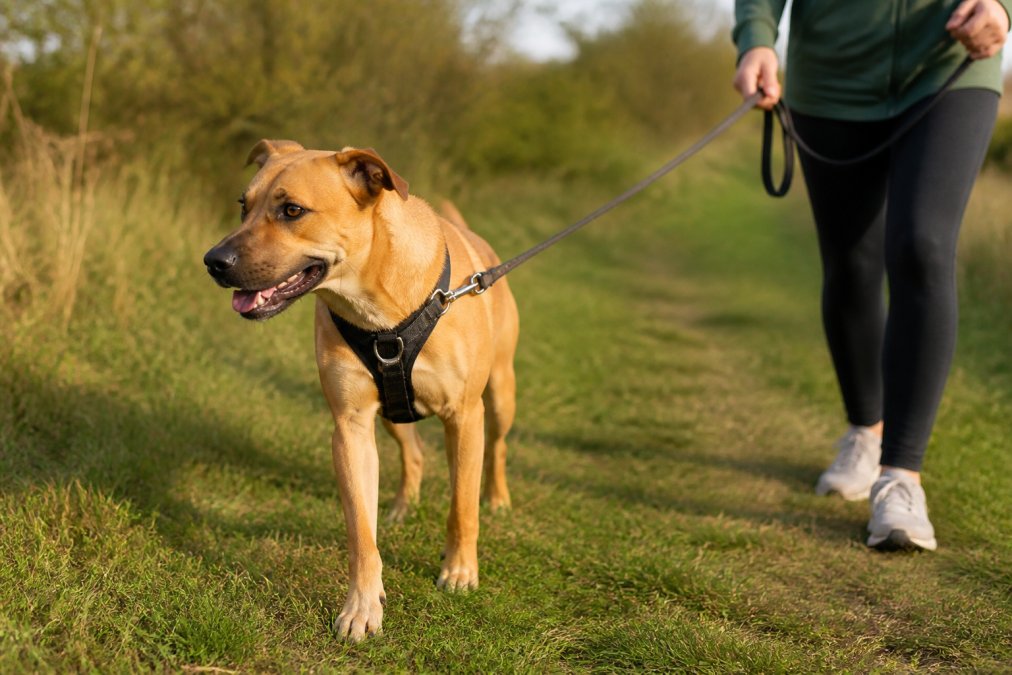
Paw Fit Gears offers harnesses designed with durability and daily use in mind.
Front-Clip vs. Back-Clip Harnesses
Front-clip harnesses attach the leash at the dog's chest. When the dog pulls forward, the attachment point redirects them to the side, naturally interrupting the pulling motion without pain or force. This is the most effective harness configuration for dogs that pull consistently.
Back-clip harnesses attach at the shoulders. They're comfortable for dogs that already walk well on leash, but they do nothing to discourage pulling. For a strong puller, a back-clip harness can actually make pulling easier.
Use a front-clip harness during the active training phase. Once your dog reliably walks with a loose leash, you can transition to a back-clip if you prefer.
| Harness Type | Best For | Pulling Control | Comfort Level |
|---|---|---|---|
| Front-clip | Dogs in active training | High | Moderate to high |
| Back-clip | Dogs already trained | Low | High |
| Dual-clip | Versatility across stages | High | High |
| No-pull vest style | Large, powerful breeds | High | Moderate |
When to Avoid Collars, Prong Collars, and Choke Chains
Standard flat collars are fine for ID tags but not training tools for dogs that pull. On a strong puller, collar pressure concentrates directly on the trachea and cervical spine, creating injury risk.
Prong collars and choke chains work through pain and discomfort. According to the American Veterinary Society of Animal Behavior's position statement on humane training, punishment-based methods increase fear, anxiety, and aggression in dogs over time. They may suppress pulling short-term but don't teach the dog what to do instead, and behavioral fallout often creates new problems.
Reward-based training with the right equipment gets better long-term results without the risk.
How to Stop Dog Pulling on Leash: Step-by-Step Training
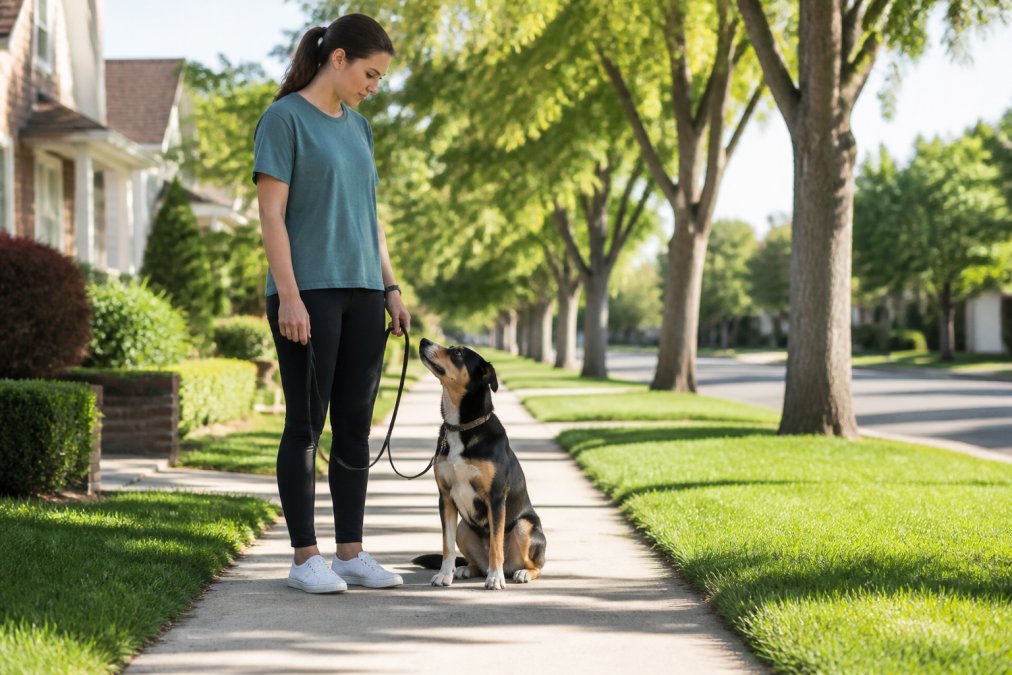
Stopping dog pulling comes down to three repeatable steps: set up correctly, stop when tension appears, and reward the behavior you actually want.
Step 1: Set Up for Success Before the Walk
Most people grab the leash and head out while the dog is spinning in excitement. That's starting at a disadvantage.
Before you leave:
- Wait for four paws on the floor before clipping the leash. If the dog jumps, turn away and wait.
- Practice a few sits or eye-contact cues inside before the door opens.
- Step outside and pause. If the dog surges forward, step back inside. Repeat until the dog exits calmly.
- Load your treat pouch with high-value treats, small, soft, and smelly.
- Keep the initial walk short (10-15 minutes) during training. Fatigue drops engagement fast.
Step 2: Use the Stop-and-Wait Method
The stop-and-wait method is the most effective technique for loose-leash walking training. The moment you feel leash tension, stop walking completely.
Do not jerk the leash. Do not say "no." Just stop.
Stand still and wait. Most dogs will eventually turn back toward you from curiosity or to figure out why forward progress stopped. The instant there is slack in the leash, mark that moment with a marker word ("yes") or a clicker, then move forward again as the reward.
Repeat every single time the leash goes taut. The dog learns quickly that a tight leash means the walk stops, and a loose leash means the walk continues.
Step 3: Reward Engagement and Loose-Leash Walking
Stopping when the dog pulls is half the equation. The other half is actively rewarding the dog for walking with slack in the leash and for checking in with you.
Every few steps of loose-leash walking, deliver a treat. Every time the dog glances up at you voluntarily, mark and reward. This builds engagement: the dog starts choosing to pay attention to you rather than fixating on the environment.
Loose Leash Walking Training Tips That Speed Up Progress
The stop-and-wait method works. The reason it takes longer for some dogs is almost always inconsistency, not a training flaw.
Here's what actually accelerates progress:
- Shorten the leash slightly during training sessions to reduce momentum buildup.
- Change direction frequently every 20-30 seconds to keep the dog focused on your movement.
- Vary your pace. Speed up, slow down, stop randomly to build attention.
- Train in shorter, more frequent sessions. Two 10-minute walks beat one 40-minute walk for behavioral modification.
- End on a good rep. Finish every training session with a successful loose-leash moment.
Managing Excitement and Distractions
Distraction threshold is the point at which the dog's environment overrides their ability to respond to training cues. Start training in the lowest-distraction environment available: a quiet street, parking lot, or driveway. Once the dog walks reliably there, move to a slightly busier area. Gradually increase distraction over multiple sessions.
When a high-value distraction appears, increase your treat rate dramatically. Rapid-fire small treats keep the dog's attention on you rather than on the trigger. This counter-conditions the dog to look at you when they see the distraction, rather than lunge.
Environmental Desensitization
Environmental desensitization is gradually exposing a dog to stimuli that trigger pulling, at an intensity low enough that the dog remains calm and responsive.
For dogs that go into overdrive near traffic or other dogs, work at the dog's threshold distance from the trigger. If your dog starts pulling 30 feet from other dogs, begin training at 40 feet. Reward calm behavior heavily. Close the gap only when the dog is consistently relaxed at the current distance.
This process takes time. Skipping steps creates setbacks.
Common Leash Training Mistakes to Avoid
The biggest mistake is using the leash as a correction tool. Yanking or jerking teaches the dog to associate the walk with discomfort, not to walk differently. It also risks injury to the dog's neck and spine.
Other common errors:
- Letting the dog pull "just this once." Every exception resets the learning.
- Using too long a leash. Retractable leashes teach the dog that pulling extends their range.
- Training only in familiar environments. Skills learned at home don't automatically transfer to new locations.
- Rewarding with food only. Some dogs are more motivated by play or sniffing.
- Expecting too much too fast. A dog that has pulled for three years won't walk perfectly after three sessions.
How Long to Train a Dog to Walk on Leash Without Pulling
Most dogs show clear improvement within two to four weeks of consistent daily training. A dog that walks well in a quiet neighborhood may still pull at the dog park. Generalization takes additional time.
The honest timeline:
- Week 1-2: The dog begins to understand that pulling stops the walk
- Week 3-4: Loose-leash walking becomes the default in familiar environments
- Month 2-3: The behavior generalizes to new environments with continued practice
- Ongoing: Maintenance sessions prevent regression
As documented in the Association of Professional Dog Trainers' training guidelines, reward-based training produces durable behavioral change that holds up across contexts, but only when practiced consistently.
Puppies can start leash training as early as 8 weeks old with very short sessions. Older dogs take longer to unlearn established habits, but they absolutely can learn.
Troubleshooting Regression
Regression is normal and usually signals one of three things:
- A new distraction or environment that exceeds the dog's current training level. Drop back to basics in a lower-distraction setting.
- Inconsistency crept in. Someone in the household let the dog pull. Regroup and get everyone on the same protocol.
- The dog is under-exercised. Increase mental stimulation and physical exercise before walks.
Regression is information, not a setback.
Physical Health Considerations for Pulling Dogs
Repeated pulling against a collar creates cumulative stress on the cervical vertebrae and trachea. In small breeds and brachycephalic dogs, this risk is acute. Even in large, healthy dogs, chronic leash tension can contribute to neck soreness that makes training harder.
If your dog pulls despite consistent training, consider having a veterinarian assess for pain. A dog pulling toward one side, reluctant to walk, or showing stiffness after walks may have an underlying musculoskeletal issue.
For dogs with existing neck or spine conditions, a properly fitted harness is non-negotiable. For dogs recovering from injury, check with your vet before increasing walk duration or intensity.
Short, frequent walks with training built in are far more effective than one long walk where the dog spends most of the time pulling. Mental stimulation from training exercises tires a dog faster than physical distance alone.
Frequently Asked Questions
What is the number one trick to stop your dog from pulling on the leash?
The most consistently effective technique is the stop-and-wait method: the moment your dog creates leash tension, you stop completely and wait for slack before moving again. Paired with high-value treats and a marker word or clicker when the leash goes loose, this teaches your dog that pulling ends the walk while a relaxed leash keeps it going. Consistency across every single outing is what makes the difference.
Should I use a harness or collar for a dog that pulls?
A front-clip harness is generally the better choice for dogs that pull on the leash. When the leash attaches at the chest, forward momentum redirects the dog sideways rather than letting them lean into the pull. Standard flat collars concentrate leash pressure on the throat, which can stress the trachea and cervical spine over time. Prong collars and choke chains use aversive methods that research links to increased anxiety and reactivity, so reward-based gear is the safer starting point.
How long does it take to train a dog to stop pulling on the leash?
Most dogs show noticeable improvement in loose-leash walking within two to four weeks of daily, consistent training sessions. Puppies and dogs with no prior leash habits often progress faster. High-energy breeds or dogs that have been pulling for years may take two to three months of structured behavioral modification. Short, focused sessions of five to ten minutes work better than long walks where pulling gets accidentally reinforced.
Why does my dog keep regressing after making progress?
Regression usually happens when the dog encounters a new, high-distraction environment before their impulse control is solid enough to handle it. A new route, off-leash dogs nearby, or a break in your training routine can all reset progress temporarily. Return to a low-distraction setting, shorten the training session, and rebuild the behavior with high-value treats before raising the distraction threshold again. Consistency from everyone who walks the dog also matters significantly.
Dog pulling on leash is a solvable problem, but it requires the right gear, consistent technique, and patience with the timeline. Paw Fit Gears offers harnesses and leashes built for the demands of active dogs and owners who take training seriously, with durable construction designed to hold up across daily use. Explore the Paw Fit Gears catalog to find gear that supports your training goals and keeps every walk safer and more enjoyable for both of you.
This article was written using GrandRanker