

Last Updated: October 25, 2026
Quick Summary
Portion control dog strategies using measuring tools like kitchen scales ensure consistent, accurate feeding that directly controls your dog's calorie intake and supports healthy weight management. Weighing food in grams rather than eyeballing portions removes guesswork and prevents the 15-30% variance that occurs with measuring cups.
- A kitchen scale costs $15-40 and produces less than 5% variance between meals, compared to 15-30% variance with measuring cups.
- Calculate your dog's daily calorie needs using the resting energy requirement formula, then apply an activity factor between 1.2 and 3.0 depending on lifestyle.
- For weight loss, veterinarians typically aim for roughly 80% of maintenance calories, with a safe target of 1-2% body weight loss per week.
- Automatic feeders work best for single dogs with predictable schedules and require calibration with a scale to verify actual portion output.
- Track treats as calories, a single dog biscuit can be 10% of a small dog's daily allowance and undermines weight loss if not counted.
Table of Contents
- Why Portion Control Matters for Your Dog's Health
- How Much Food Should I Feed My Dog
- Measuring Your Dog's Food: Using a Dog Food Scale Versus Eyeballing
- Setting Up Automatic Pet Feeder Portion Control
- Building Your Dog Weight Loss Plan with Measured Meals
- Creating a Consistent Feeding Schedule and Tracking Progress
- Common Mistakes to Avoid When Using Portion Control Tools
- Starting Your Dog's Portion Control Routine
- Frequently Asked Questions
Why Portion Control Matters for Your Dog's Health
Managing your dog's weight with a portion control dog strategy using the right tools is one of the most effective ways to keep your pet healthy.
Research shows that portion size significantly affects how much dogs eat, meaning what you put in the bowl directly impacts your dog's calorie intake.
Here's what makes portion control different from just feeding less:
- It's consistent, same amount every day, no guesswork
- It's measurable, you track exactly what your dog eats
- It's sustainable, your dog stays satisfied while losing weight
The key insight most owners miss: portion control isn't about starving your dog. It's about feeding the right amount for their age, size, and activity level.
How Much Food Should I Feed My Dog
The amount your dog needs depends on current weight, target weight, age, activity level, and the calorie density of the food. There's no single "right" answer, so the most useful skill is translating a calorie target into a measured serving.
Step 1: Estimate resting energy needs
A common starting formula for resting energy requirement (RER) in dogs is:
- RER = 70 × (body weight in kilograms)^0.75
Convert pounds first: kilograms = pounds ÷ 2.2. For a 60-pound dog (about 27.3 kg), 27.3^0.75 is roughly 11.9, and 70 × 11.9 is about 833 calories per day at rest.
Step 2: Apply an activity factor
Multiply RER by a factor that reflects the dog's lifestyle. Common ranges practitioners use:
- Sedentary or senior: 1.2 to 1.4
- Neutered adult with normal activity: 1.4 to 1.6
- Intact adult or moderately active: 1.6 to 1.8
The 60-pound example at a 1.5 factor gives about 1,250 calories per day for maintenance. For weight loss, many veterinarians aim for roughly 80% of that, about 1,000 calories per day, but the exact target should come from your vet, especially for dogs with medical conditions.
Step 3: Read the label and convert calories to cups or grams
Dog food labels report calorie content as metabolizable energy (ME), usually in one of two formats:
- kcal per cup (common for dry kibble)
- kcal per kilogram or kcal per gram (common for canned, raw, and some dry foods)
Look for the "Calorie Content" line, often stated like "3,600 kcal/kg (350 kcal/cup)", one 8-ounce cup of that kibble delivers about 350 calories.
To turn a calorie target into a serving, divide the target by the kcal-per-cup figure:
- 1,000 calories ÷ 350 kcal/cup ≈ 2.9 cups per day
- Split across two meals, that is about 1.45 cups per meal
If the label only gives kcal/kg, convert: kcal per gram = kcal/kg ÷ 1,000. A food listed at 3,600 kcal/kg is 3.6 kcal per gram. To deliver 1,000 calories, you would weigh out about 278 grams per day (1,000 ÷ 3.6).
Step 4: Sanity-check against the feeding guide
The bag's feeding chart is a starting point, not a guarantee, it's usually built around active, intact dogs and can overestimate needs for a sedentary pet. If your serving diverges from the bag by more than about 25%, recheck your math and ask your vet.
Step 5: Adjust based on results, not the bag
Weigh your dog weekly under the same conditions. A safe target is roughly 1% to 2% of body weight per week. If your dog is losing faster, add back about 10% of the daily target; if weight is flat for two to three weeks, reduce by about 10% and recheck. This feedback loop, not a static chart, makes portion control work.
Measuring Your Dog's Food: Using a Dog Food Scale Versus Eyeballing
Measuring cups are convenient. They're also wildly inaccurate.
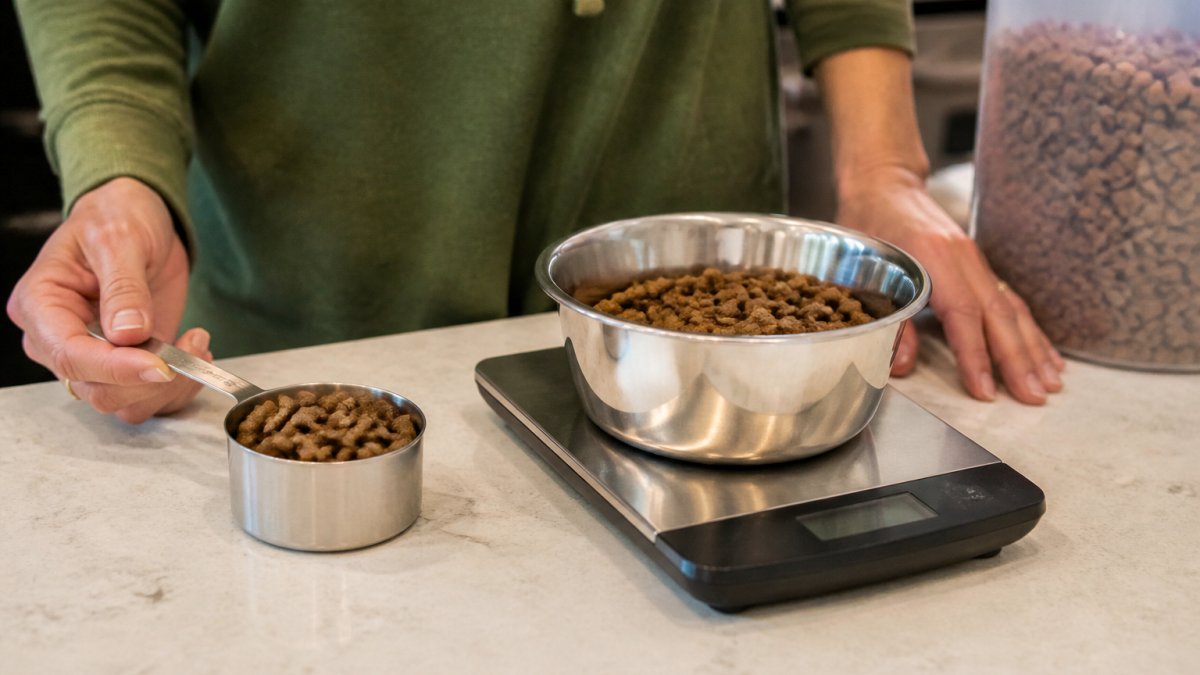
Scooping into a cup measures volume, not weight. Kibble settles differently depending on humidity, size, and how hard you pack it, one cup can vary by 50 grams or more, adding calories your dog doesn't need.
A kitchen scale removes the guesswork: place the bowl on it, zero it out, and add kibble until you hit your target weight in grams, the same amount every time.
Why Weighing Kibble Beats Guessing
Research on portion-control tools shows that weighing food improves awareness of appropriate portion sizes. Owners who weigh their dog's food make better decisions because they see the actual amount.
The difference is stark:
- Measuring cups: 15-30% variance between meals
- Kitchen scale: Less than 5% variance
- Digital scale: Accurate to the gram
For a dog losing weight, consistency matters: metabolism responds to predictable calorie intake, and fluctuating portions slow results.
Wet food and raw diets need weighing too. Don't assume canned food portions are accurate by volume, they're not.
Choosing the Right Measuring Tool
A basic digital kitchen scale costs $15-40 and lasts years. Look for gram and pound markings, a "tare" button, a flat surface large enough for a dog bowl, and a water-resistant design.
A dedicated pet food scoop with portion markings works if your dog's food is consistent, but it's less accurate than a scale, use it as a backup, not your primary method.
Different measuring methods produce vastly different accuracy levels in portion control.
| Measuring Method | Variance | Best For |
|---|---|---|
| Measuring cups | 15-30% variance between meals | Backup method only |
| Kitchen scale | Less than 5% variance | Primary method for all diets |
| Digital scale | Accurate to the gram | Precise weight loss tracking |
| Pet food scoop with markings | Less accurate than scale | Backup, not primary method |
Setting Up Automatic Pet Feeder Portion Control
Automatic feeders solve a real problem for portion control dog owners: consistent portions even when you're busy or traveling. Learn about safe feeding solutions that complement your feeder setup. They dispense a programmed amount at a set time, removing the human guesswork that undermines portion control. But a feeder is only as accurate as its setup, so calibration and testing are part of the job.
Petory Automatic Cat Feeder – 4L Timed Dispenser with Voice & Battery Backup →
How automatic feeders measure portions
Most consumer feeders use one of two mechanisms:
- Auger or screw drive: a rotating auger moves kibble from the hopper to the bowl. Portion size is set in grams or "cups" per meal, but actual output varies with kibble size, shape, and how full the hopper is.
- Rotating portion wheel or compartment drum: a wheel with fixed compartments rotates to drop a set volume per meal. These are simple and reliable but less flexible for fine-tuning gram-level portions.
Gravity and puzzle feeders control access, not amount. For weight loss, an automatic feeder with programmable gram or cup settings is the relevant category.
Setup checklist
- Confirm the feeder's portion unit. Many feeders program in "portions" equal to a fixed number of grams or a fraction of a cup. Read the manual for the conversion, then verify it with a scale.
- Calibrate with a kitchen scale. Tare a bowl on a digital scale and run a single test portion. Weigh the output and repeat three times. If the feeder is consistently off by more than about 10%, adjust the programmed portion or contact the manufacturer.
- Match kibble to the feeder. Very small kibble can jam an auger; very large kibble can bridge in the hopper. Check the manufacturer's recommended kibble diameter range before buying.
- Test the schedule. Program meal times, then watch one full dispense cycle with an empty bowl to confirm the feeder drops food at the right time and does not over-dispense.
- Set a conservative starting portion. Program slightly under your calculated target for the first week, then adjust upward after weighing your dog. It's easier to add food than to take it back once a dog expects more.
Common failure points
- Hopper level affects output. As the hopper empties, some auger feeders dispense slightly less per portion. Refill before the hopper gets low, or weigh output periodically.
- Kibble settling and humidity. Kibble can absorb moisture and change flow. Keep the hopper sealed and store food in a cool, dry place.
- Power interruptions. Battery backup keeps the schedule running during outages; check batteries monthly.
When a feeder is the right tool
Automatic feeders shine in households with predictable schedules, single dogs that eat promptly, and caregivers who need a handoff-proof way to keep portions identical. They're less useful for wet or raw diets (most are dry-kibble only), dogs needing medication mixed into meals, and multi-dog homes without separate feeding areas.
Browse Paw Fit Gears automatic feeder collection to compare models by portion unit, kibble compatibility, and backup power.
Building Your Dog Weight Loss Plan with Measured Meals
A weight loss plan needs three components: measured portions, consistent schedule, and progress tracking.
Calculate the daily calorie reduction needed:
- Current weight × daily calories = current intake
- Target weight × daily calories = goal intake
- Divide the difference by 7 = daily calorie reduction
Example: A 65-pound dog eating 1,500 calories daily, targeting 55 pounds at 1,350 calories, needs a 150-calorie daily reduction.
Aggressive calorie cuts lead to hunger, food-seeking behavior, and failure; slow, steady reduction works because your dog adapts.
Protein-rich foods keep dogs fuller longer than carb-heavy kibble.
Track treats too. A single dog biscuit might be 50 calories, 10% of a small dog's daily allowance.
Creating a Consistent Feeding Schedule and Tracking Progress
Feeding at the same times every day trains your dog's metabolism and makes portion control easier.
A consistent schedule also helps behavior: your dog knows when food arrives, so they're less likely to beg, steal, or show anxiety around mealtimes.
Tracking progress keeps you motivated:
- Weigh your dog weekly
- Take photos from the side every two weeks
- Note energy level and behavior changes
Weight loss plateaus are normal. When they happen, reduce calories by another 50-100 per day rather than making a drastic cut.
Most dogs reach their target weight in 3-6 months. Once there, you'll need to adjust portions upward slightly to maintain weight, not return to old portions. Maintenance portions are usually 10-15% higher than weight-loss portions.
Common Mistakes to Avoid When Using Portion Control Tools
The biggest mistake is inconsistency: measuring perfectly for a week, then eyeballing for three days. Your dog's body just sees chaotic calorie intake. Stick to your system every day.
Another common error: counting treats as "free food." They're not. Treats are calories. If your dog gets 200 calories in treats, reduce meals by 200 calories that day.
Feeding multiple dogs in the same home creates chaos. The solution: feed them in separate rooms, pick up bowls after 15 minutes, or use individual feeders. Learn how to prevent food stealing in multi-dog homes for detailed strategies.
Don't skip veterinary guidance, especially if your dog has health conditions. A portion-control tool is not a substitute for an individualized veterinary weight-loss plan.
One more: don't reduce portions too aggressively. A dog losing more than 2% of body weight per week is losing too fast.
Starting Your Dog's Portion Control Routine
Begin this week. Weigh your dog, calculate their calorie needs, and get a kitchen scale if you don't have one.
Pick a feeding schedule: morning and evening works for most dogs. Set those times in your phone as a reminder.
If you're using an automatic feeder, set it up this weekend. Program it conservatively at first.
Track your dog's weight weekly. After two weeks, you'll see if portions are right.
Frequently Asked Questions
How much food should I feed my dog daily?
The amount depends on your dog's age, weight, activity level, and the calorie content of your food. Start with your dog food's feeding guide as a baseline, then adjust based on body condition. Most adult dogs need 1-2 percent of their body weight in food daily, but this varies. Consult your veterinarian for a personalized recommendation, especially if your dog needs to lose weight.
Is weighing food on a dog food scale more accurate than using a measuring cup?
Yes. Kitchen scales measure kibble by weight in grams, eliminating the inconsistency of how tightly you pack a cup. Pet owners who weigh dry food on a kitchen scale report it as the most accurate method for portion control. This precision is especially important when managing weight or following a veterinary diet plan.
Can an automatic pet feeder help with portion control?
Automatic feeders with portion control features help enforce consistent meal sizes and feeding schedules, which supports weight management. The Petory Automatic Pet Feeder ($53.90) allows you to schedule up to 6 meals daily with customizable portions and includes a patented airtight design to prevent accidental overfeeding. However, a portion-control tool is not a substitute for an individualized veterinary weight-loss plan when significant calorie restriction is needed.
What's the best way to track my dog's weight-loss progress?
Weigh your dog weekly at the same time of day using a consistent scale. Record the weight and body condition score (a 1-9 scale your vet can teach you). Combine weekly weigh-ins with measured meals and a consistent feeding schedule. If progress stalls after 2-3 weeks, adjust portions downward by 10 percent or consult your veterinarian to rule out health issues.
Portion control works because it's simple, measurable, and sustainable. Your dog doesn't need fancy diets or expensive supplements, they need the right amount of quality food, measured consistently. Paw Fit Gears offers the tools to make this happen: scales, feeders, and quality nutrition options that support your dog's weight loss journey. Start today with measured meals and watch your dog transform.
