

Table of Contents
- Why Food Stealing Happens in Multi-Dog Homes
- Set Up Separate Feeding Stations for Dogs
- Structured Mealtimes and Supervision Protocols
- Dog Resource Guarding Training Basics
- How to Stop Counter Surfing in a Multi-Dog Home
- Managing Multi-Dog Household Dynamics
- When Food Stealing Points to Separation Anxiety
- Conclusion
- Frequently Asked Questions
Last Updated: September 16, 2026
Why Food Stealing Happens in Multi-Dog Homes
Food stealing in a multi-dog home is rarely about hunger. It's about competition, opportunity, and instinct. When two or more dogs share a space, the fastest eater often learns that the other dog's bowl is an easier target than waiting for their own meal to finish. This guide from Paw Fit Gears breaks down why it happens and how to stop it.
Dogs are opportunistic scavengers by nature. In a group setting, that instinct intensifies. One dog finishes first, notices the other is still eating, and moves in. The behavior gets rewarded with extra food, so it repeats.
Set Up Separate Feeding Stations for Dogs
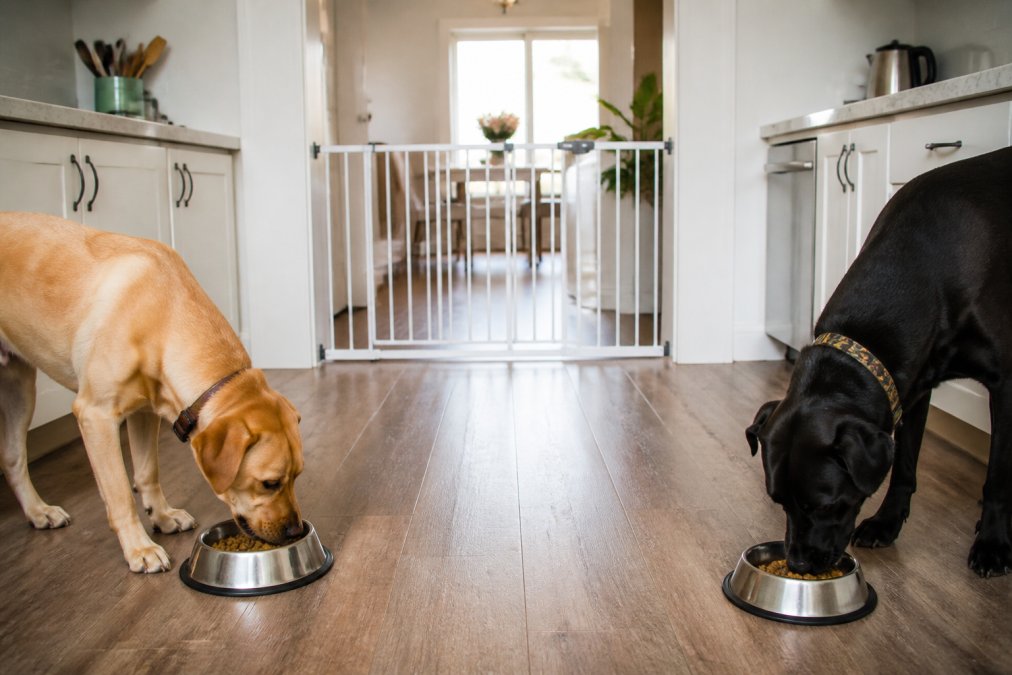
The single most effective way to prevent food stealing in multi dog homes is physical separation at mealtime. Put distance between the bowls so no dog can reach another's food without a deliberate effort.
Where to Place Each Station
Place bowls in separate rooms, on opposite sides of a hallway, or at least several feet apart with a visual barrier between them. The goal is simple: no dog should be able to see and reach another dog's food at the same time.
- Use a different room for each dog when possible
- If space is tight, use a baby gate or crate to divide the feeding area
- Keep water bowls shared, but food bowls strictly individual
- Feed at the same time every day so dogs learn the routine
Microchip Feeders and Individualized Bowls
For households where separation isn't practical, open-plan homes, small apartments, or a dog that panics when gated away from the group, a microchip feeder solves the problem at the source. These units read the RFID chip already implanted in your dog (the same chip your vet scans) or a tag on the collar, and the lid opens only for the registered animal. When that dog steps away, the lid closes.
How the mechanism actually behaves in a multi-dog home:
- Registration limits. Most units store a small number of chips, commonly two to four per feeder, so a four-dog household may need two feeders rather than one.
- Battery or cord. Cordless models run on batteries and can be placed anywhere; corded models never need a battery change but tether you to an outlet.
- Wet food trays. Many feeders ship with a stainless or removable tray for wet food, but the lid seal is designed around dry kibble. Wet food left under a closed lid in a warm room is a spoilage risk, so pick the bowl up after the meal either way.
- The training window. A dog has to learn that the lid opens for them. Most manufacturers suggest a short acclimation period where the lid stays open, then closes progressively. Budget a few days, not a few minutes.
- Failure mode. If the battery dies or the chip reads intermittently, the lid stays shut and the wrong dog eats nothing. Check the feeder daily during the first two weeks.
Building Individualized Stations Without Buying Anything
Individualized feeding stations work on the same principle as a microchip feeder: each dog gets a designated bowl in a designated spot, and the routine itself becomes the boundary. Over time, dogs stop checking each other's bowls because the payoff disappears.
- Anchor each station with a mat. A bath mat or towel under the bowl gives the dog a visual and tactile cue, "this square is mine." Dogs read location cues far better than they read verbal ones.
- Use a different bowl color or shape per dog. This is for you as much as for them. In a four-dog home, mismatched bowls are how food gets swapped by accident.
- Add a sightline break. A gate, a flipped laundry basket, a sofa arm, or a doorway jamb is enough. The dog doesn't need a wall; they need to not see the other bowl while eating.
- Feed in the same order every time. Same dog, same station, same sequence. Predictability is what converts a temporary setup into a habit.
- Pick bowls up on a timer. Set a phone timer for 10 minutes. When it goes off, every bowl comes up, whether or not the dog finished.
Structured Mealtimes and Supervision Protocols
Structured mealtimes beat free feeding every time in a multi-dog home. Free feeding means food is available all day, which gives a food-motivated dog endless chances to steal. Scheduled meals create clear windows: food goes down, dogs eat, bowls come up.
A practical schedule looks like this:
- Put every dog in a separate space or station
- Set all bowls down at the same moment
- Supervise until every dog finishes
- Pick up all bowls immediately, even if food remains
Dog Resource Guarding Training Basics
Resource guarding is the behavior behind most food stealing escalations. It's when a dog defends food, toys, or space from another dog or a person. The fix isn't punishment. It's positive reinforcement and building trust around food.
The 'Leave It' Command and Impulse Control
The leave it command is the most valuable cue for a multi-dog household. It tells a dog to disengage from whatever they're focused on, including another dog's bowl.
Training steps:
- Hold a treat in a closed fist. Let the dog sniff, but don't open it.
- The moment the dog backs off, mark with "yes" and reward from your other hand.
- Add the verbal cue "leave it" once the dog reliably backs off.
- Practice near a bowl on the floor, then near another dog's bowl, increasing difficulty slowly.
How to Stop Counter Surfing in a Multi-Dog Home
Counter surfing is food stealing at height. A dog who jumps up to grab food off a counter is using the same opportunistic logic as a bowl thief, just with a bigger reward. Stopping it means removing the reward and blocking the access.
- Clear counters completely before leaving the kitchen
- Store food in sealed, dog-proof containers, not open bags
- Use a gate to keep dogs out of the kitchen during meal prep
- Never leave plates or leftovers within reach
- Reward dogs for settling on a mat away from the kitchen
Managing Multi-Dog Household Dynamics
Multi-dog dynamics add a layer that single-dog advice ignores. Two dogs create competition, and competition creates behavioral triggers you won't see with one dog. A calm pair can turn tense the moment food appears.
Watch for these signs that dynamics need adjusting:
- One dog always finishes first and hovers near the other
- A dog refuses to eat until the other has finished
- Growling, stiffening, or blocking near bowls
- One dog losing weight while the other gains
When Food Stealing Points to Separation Anxiety
Not every food thief is just opportunistic. Sometimes the behavior signals separation anxiety or general anxiety that surfaces around mealtime. A dog who steals frantically, guards obsessively, or can't settle even with their own full bowl may be anxious rather than hungry.
Signs worth noting:
- Pacing, whining, or drooling around mealtime
- Eating so fast the dog nearly chokes
- Stealing even when not hungry
- Destructive behavior when left alone with food nearby
Nutritional Needs Across Life Stages
Nutritional needs change with age, and that affects feeding strategy. Puppies eat more frequently than adults. Seniors may need softer food or smaller portions. When dogs in the same home are at different life stages, feeding them identical meals at identical times creates friction.
Match the feeding plan to each dog:
- Puppies: three to four small meals daily
- Adults: two meals daily
- Seniors: two meals, adjusted portions and texture
Conclusion
Food stealing in a multi-dog home comes down to access, competition, and routine. Control all three and the behavior fades. Separate feeding stations, structured mealtimes, and consistent supervision do the heavy lifting, while training like the leave it command builds the impulse control that makes it stick.
Frequently Asked Questions
How do I stop one dog from eating another dog's food?
Feed dogs in separate rooms or use a baby gate to divide the space. Place bowls at least 6 feet apart and pick them up as soon as each dog finishes. For faster eaters, try a puzzle feeder or snuffle mat to slow them down. If one dog still guards food, work on dog resource guarding training with a certified trainer.
Is food stealing a sign of resource guarding?
Not always. Food stealing can be simple opportunism, especially in multi-dog homes where one dog finishes first. Resource guarding is different: it involves growling, stiffening, or snapping when another dog or person approaches the food. If you see those warning signs, separate feeding stations for dogs and professional help are the safest next steps.
How can I train my dogs to wait for their own food bowls?
Teach a solid 'leave it' command and a 'wait' cue before mealtime. Put both bowls down, ask each dog to wait, then release them one at a time to their assigned bowl. Practice for 5 minutes daily with high-value treats. Consistent boundaries and positive reinforcement make this reliable within a few weeks for most dogs.
How do I prevent counter surfing in a multi-dog home?
Remove food from counters entirely, use dog-proof containers with locking lids, and never leave dishes in the sink. Add a physical barrier like a baby gate at the kitchen entrance when you cannot supervise. If counter surfing persists, teach the 'leave it' command and reward dogs for staying on a mat outside the kitchen.
Two dogs and one food bowl is a recipe for tension, weight problems, and a lot of cleanup. Paw Fit Gears builds gear that solves it: spacious dual crates with individual entry doors, chew-resistant construction, and furniture-style designs that fit your home instead of dominating it. Visit Paw Fit Gears to find feeding and crate solutions made for multi-dog households, and give every dog their own space to eat in peace.