

Table of Contents
- Why Standard Leashes Fail in Rain
- Material Comparison: Biothane vs. PVC vs. Rope for Non-Slip Leashes
- How to Stop Dog Pulling on Leash in Wet Conditions
- Choosing a Waterproof Dog Leash for Rainy Weather
- Maintaining Your Gear: Cleaning and Corrosion Prevention
- Frequently Asked Questions
Last Updated: September 14, 2026
Why Standard Leashes Fail in Rain
A wet leash is a different piece of equipment than a dry one. When nylon webbing absorbs water, it becomes slick on the outside and heavier in the hand, so the grip you rely on during a pull simply isn't there. This guide from Paw Fit Gears breaks down what fails in wet conditions and how to choose non-slip leashes for rainy weather.
The problem isn't just discomfort. A leash that slips through your fingers or corrodes at the hardware is a safety failure waiting to happen, especially with a strong dog on the other end.
The Grip Problem: Wet Hands and Slick Webbing
Standard nylon webbing absorbs moisture and turns slick, reducing friction between your hand and the leash exactly when you need control most. A common mistake is assuming a thicker leash means a better grip; thickness without texture just gives water more surface area to sit on. Grip depends on two things: the material's surface texture and how it behaves once saturated. Flat, smooth webbing fails on both counts.
Hardware Corrosion: The Hidden Failure Point
The clasp and D-ring are where most leashes fail first in wet weather. Standard zinc-plated hardware corrodes over repeated exposure, weakening the metal at the exact point bearing the most load, and a swivel that seizes mid-walk turns a manageable pull into a sudden jolt. Look for corrosion-resistant hardware, and check the swivel after every wet walk.
Material Comparison: Biothane vs. PVC vs. Rope for Non-Slip Leashes
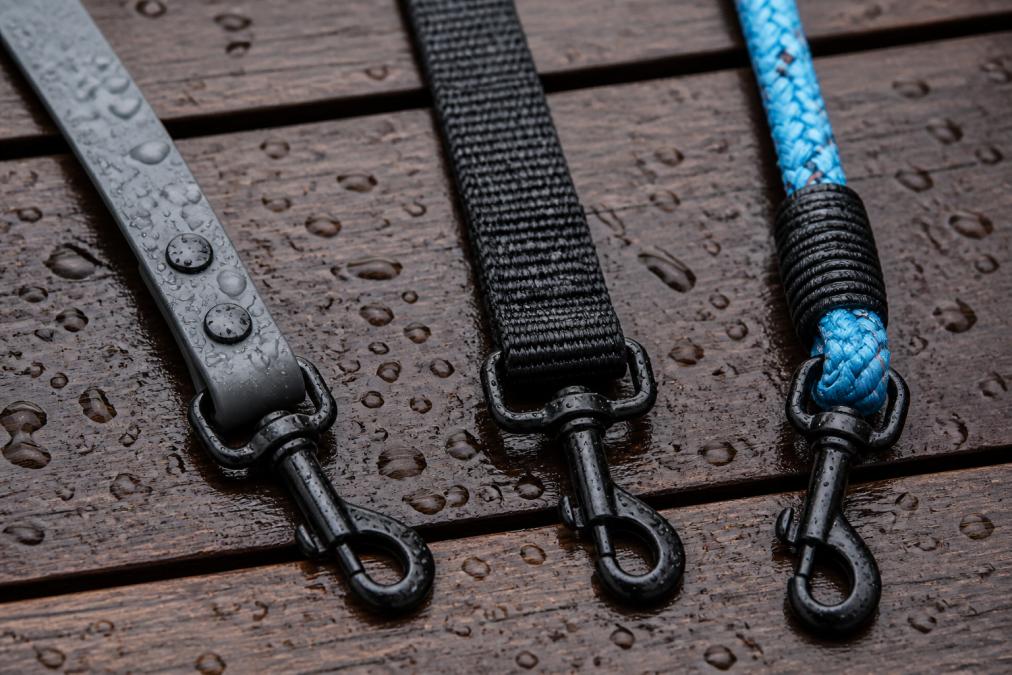
Three materials dominate the waterproof leash market, each trading off differently between wet grip, cold-weather flexibility, weight, and hardware compatibility. The mechanism behind grip is what most comparisons skip: friction depends on surface texture, water displacement, and how the material behaves once saturated. A material that sheds water keeps its texture; one that absorbs it changes shape, weight, and friction all at once.
| Material | Wet Grip | Cold-Weather Flexibility | Weight | Hardware Compatibility | Best For |
|---|---|---|---|---|---|
| Biothane (coated webbing) | Excellent, texture unchanged when wet | Stays flexible well below freezing | Moderate | Accepts standard bolt snaps and D-rings | Daily rainy walks, strong pullers |
| PVC-coated webbing | Good, slightly tacky, but slickens with mud | Stiffens noticeably in freezing rain | Heavier | Standard hardware; coating can crack at stress points | Budget-friendly wet-weather use |
| Polypropylene rope | Fair, round profile reduces hand contact | Stiffens noticeably; becomes wiry | Lightest | Requires rope-specific hardware or spliced eye | Small dogs, short walks |
Biothane: Waterproof and Flexible in Cold Weather
Biothane is a polyester webbing core encased in a polymer coating. Because the coating is non-porous, water beads and runs off rather than soaking in, so the texture you grip in dry conditions is the same one you grip in a downpour, the biggest reason biothane dominates the non-slip category for cold, wet conditions.
The coating also stays pliable at low temperatures, so the leash doesn't stiffen into an unmanageable loop. Handlers who walk in freezing rain report biothane stays workable while PVC-coated webbing turns rigid and rope becomes wiry. The trade-offs are cost, biothane sits at the higher end of the waterproof category, and moderate rather than ultralight weight.
PVC-Coated Webbing: Grip and Traction
PVC-coated webbing offers reliable traction at a lower price than biothane, and its slightly tacky surface gives good tactile feedback. It's heavier, which some handlers prefer for the extra heft during a pull.
Where it falls short is cold-weather performance and durability. In freezing temperatures the PVC coating stiffens, reducing flexibility and grip, and it can crack at high-stress points, near the handle loop and where the leash meets the clasp, after repeated flexing. Once cracked, water reaches the webbing core and the leash behaves like plain nylon: slick outside, heavier in the hand.
Polypropylene Rope: Lightweight but Limited
Polypropylene rope is the lightest option and floats, making it popular for water-adjacent activities. The tradeoff is grip: rope's round profile offers less hand contact than flat webbing, and wet polypropylene becomes noticeably slicker. Fine for a small, calm dog on a short walk; the wrong tool for a strong puller in heavy rain.
Rope also requires different hardware: standard bolt snaps are designed for flat webbing, so a rope leash needs a spliced eye or rope-specific clasp, an extra failure point to inspect and one more place corrosion can start.
The Saturated-Handle Test: What Actually Matters in Rain
Most material comparisons evaluate the leash body and ignore the handle, yet the handle is where grip fails first, since it stays in contact with a wet hand for the entire walk. Soak each material, grip it with a wet hand, and pull: biothane and PVC-coated webbing hold texture, polypropylene rope loses it. Padded or rubberized handles add grip only if the padding is non-absorbent, open-cell foam soaks up water and becomes a slick sponge.
How to Stop Dog Pulling on Leash in Wet Conditions
Wet weather amplifies pulling because dogs pick up on your reduced grip and the leash's changed feel. The fix combines the right equipment with pressure-based training that works regardless of surface.
Leash Pressure and Tactile Feedback
Leash pressure training teaches a dog to yield to gentle tension rather than fight it. Start with light, steady pressure and release the instant your dog gives even slightly, reward the release, not the pull. A leash with consistent tactile feedback makes this easier, since you can feel exactly how much tension you're applying. Non-slip leashes with textured surfaces give you that feedback even when wet.
Safety Protocols for High-Reactivity Dogs in Rain
For reactive or high-drive dogs, rain adds two risks: reduced visibility and a slicker grip during a sudden lunge. Use a two-point connection when possible, attaching the leash to both a collar and a harness, and keep it shortened in high-traffic areas. Practice your emergency stop, planting your feet, lowering your center of gravity, on dry ground first so it's automatic when the pavement is wet.
Choosing a Waterproof Dog Leash for Rainy Weather
A waterproof dog leash for rainy weather must solve four problems at once: it must not absorb water, it must maintain grip when both leash and hand are soaked, its hardware must survive repeated wet exposure, and it must stay flexible across the temperature range you actually walk in. Most buying guides stop at the first requirement; the other three are where leashes fail.
Wet-Grip Ergonomics: Testing the Handle, Not the Body
The handle stays in contact with your hand for the entire walk, yet it's the part most guides ignore. The test is simple: soak the leash in a bucket, wet your hand, and pull. If the handle slides through your grip, the material is wrong for rainy weather regardless of what the product page claims.
Three handle features matter most in rain:
- Closed-cell padding. Open-cell foam absorbs water and becomes a slick sponge (pubmed.ncbi.nlm.nih.gov). Closed-cell rubber or EVA keeps its texture when saturated.
- Textured surface. A smooth handle offers less friction than a ribbed or dimpled one, and the difference is most noticeable during a sudden pull.
- Handle circumference. A handle that's too thick forces your fingers open and reduces grip strength. A handle that's too thin concentrates pressure and fatigues your hand faster. The right size lets you close your fist comfortably around it.
Handlers who walk in heavy rain often add a secondary traffic handle near the clasp, a second grip point for close control, and the handle you'll actually use when a dog lunges.
Cold-Weather Flexibility: Why Stiffness Is a Safety Issue
Many waterproof materials stiffen in freezing rain, and stiffness is not just a comfort problem. A stiff leash doesn't coil, absorb a sudden pull, or feed smoothly through your hand; when a dog lunges, it transmits the full force to your wrist and shoulder instead of flexing to absorb some of it.
Biothane stays flexible well below freezing; PVC-coated webbing stiffens noticeably and can crack at stress points after repeated flexing; polypropylene rope becomes wiry and loses what little hand contact it had. If you walk in winter conditions, flexibility is a safety feature, not a luxury.
Hardware Corrosion Resistance: The Longevity Question
Hardware is where most leashes fail first in wet weather, and the component most buyers overlook. Standard zinc-plated hardware corrodes over repeated exposure, weakening the metal at the exact point bearing the most load, and a swivel that seizes mid-walk turns a manageable pull into a sudden jolt.
What to look for:
- Stainless steel or brass hardware. Both resist corrosion far better than zinc plating. Stainless is the stronger choice for salt exposure; brass is common on lighter-duty leashes.
- A swivel that moves freely under load. Test it in the store by hanging a weight from the clasp and rotating it. If it binds, it will bind worse once wet.
- A clasp rated for your dog's pull. A bolt snap rated for a strong dog is only as strong as its weakest component, and corroded hardware fails well below the rated figure.
Break Strength and Durability
Break strength is the load a leash can handle before failing, and it matters most with large, strong dogs. The rating assumes intact hardware, corroded or worn clasps and D-rings fail well below it, so inspect them regularly. Stitching is the other weak point: look for bar-tacked or box-X stitching at the handle and clasp, since a single row frays first in wet conditions.
Proper Fit and Adjustment for Slip Leads
Slip leads need correct adjustment or they become a hazard. The loop should tighten enough to prevent escape but release immediately when pressure drops; if it stays tight after your dog stops pulling, it's too small (General Dog Care). Check the fit before every walk, and recheck in wet conditions since wet fur changes how the leash sits against your dog's neck.
Safety Protocols for High-Reactivity Dogs in Rain
For reactive or high-drive dogs, rain adds two risks: reduced visibility and a slicker grip during a sudden lunge. The intersection of wet gear and reactive behavior is where most accidents happen, and the scenario most guides skip.
- Use a two-point connection. Attach the leash to both a collar and a harness. If one attachment fails, the other holds.
- Shorten the leash in high-traffic areas. A shorter leash gives you faster reaction time and less slack for a lunge to build momentum.
- Practice your emergency stop on dry ground. Plant your feet, lower your center of gravity, and brace. Rehearse it until it's automatic, because you won't have time to think when the pavement is wet.
- Carry a backup slip lead. If your primary clasp corrodes or your collar slips on wet fur, a backup connection prevents the worst-case scenario.
ASPCA dog walking and leash safety guidance
Maintaining Your Gear: Cleaning and Corrosion Prevention
Routine maintenance extends the life of any waterproof leash and prevents the slow corrosion that causes sudden failures. Rinse hardware with fresh water after rain, road salt, or mud, then dry it thoroughly before storage, and add a drop of lubricant to the swivel. Wipe coated materials with a damp cloth and mild soap, and let rope air-dry completely to prevent mildew.
| Task | Frequency | Why It Matters |
|---|---|---|
| Rinse hardware with fresh water | After every wet walk | Removes salt and grit that accelerate corrosion |
| Lubricate the swivel | Weekly | Prevents seizing under load |
| Inspect clasp and stitching | Monthly | Catches wear before it becomes a failure |
| Deep-clean the leash body | Monthly | Removes buildup that reduces grip |
Frequently Asked Questions
What material is best for a non-slip leash in the rain?
Biothane and PVC-coated webbing perform best in wet conditions. Biothane stays flexible in cold weather and resists moisture absorption, while PVC-coated webbing offers excellent grip and traction when wet. Polypropylene rope is lightweight but can become slick and may absorb water over time. Look for leashes with corrosion-resistant hardware like stainless steel or brass to prevent rust. The best choice depends on your dog's size, pulling habits, and how often you walk in rain.
How do I stop my dog from pulling on a leash in wet weather?
Start with a non-slip leash that gives you secure grip and tactile feedback, even with wet hands. Practice loose leash walking in short sessions, rewarding your dog for staying near you. If your dog pulls, stop walking immediately and wait for the leash to slacken before moving forward. Consistency and patience matter more than any single tool.
Are slip leads safe for dogs that pull?
Slip leads can be safe when used correctly. Never leave a slip lead on an unattended dog.
How do I clean a waterproof dog leash after a muddy walk?
Rinse your waterproof leash with fresh water to remove mud and debris. For biothane or PVC-coated leashes, wipe with a damp cloth and mild soap, then dry with a towel. Avoid harsh chemicals that can degrade the weatherproof coating. Check the hardware for dirt or corrosion and wipe it clean. Hang the leash to dry completely before storing. Regular cleaning extends the life of your gear and keeps it ready for the next rainy walk.
Rain turns a routine walk into a test of your gear, and a standard leash often fails that test right when your dog needs you most. Paw Fit Gears builds gear for exactly these moments, with durable leashes, harnesses, and collars designed to keep their grip and hold up to daily wear. Explore the full catalog to find gear built for your dog's lifestyle, and get started with Paw Fit Gears for walks that stay under control in any weather.