

Table of Contents
- What You'll Need Before You Start
- How to Measure a Dog for a Bed: Step-by-Step
- Why Sleeping Position Changes the Size You Need
- Dog Bed Size Chart: Match Weight and Breed to Bed Dimensions
- How Much Extra Space Should You Add?
- Best Orthopedic Dog Beds for Joint Support and Mobility
- When to Buy Chew Proof Dog Beds and What to Look For
- Frequently Asked Questions
Last Updated: September 24, 2026
What You'll Need Before You Start
Measuring your dog for a bed takes about five minutes and one tool. Get it right and you avoid the most common mistake we see: buying a bed that looks roomy in the photo but leaves your dog hanging over the edge.
Here's what to grab before you start:
- A flexible fabric tape measure, the kind used for sewing. A stiff metal tape won't wrap around your dog's body.
- A few treats, to keep your dog standing still.
- A helper, one person holds, one person measures.
- A notepad or your phone, write down every number. You will forget them.
The single biggest reason a bed gets returned isn't quality. It's size.
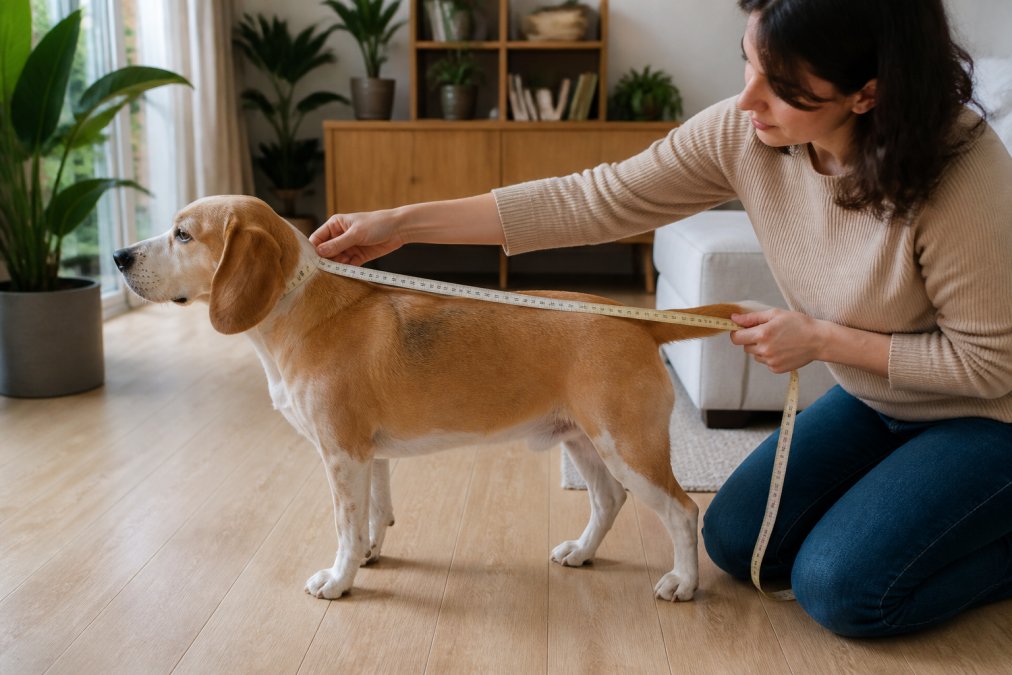
How to Measure a Dog for a Bed: Step-by-Step
Learning how to measure a dog for a bed comes down to three numbers: length, width, and height. Skip one and you risk a bed that's too tight, too tall, or too short.
Step 1: Measure Length from Nose to Tail
Have your dog stand on all fours. Place the end of the tape at the tip of the nose. Run it along the spine to the base of the tail. Write down that number in inches.
This is your dog's full body length. It's the most important measurement for a flat bed.
A common mistake is measuring a curled-up dog. You'll get a number that's too small. Always measure while your dog stands.
Step 2: Measure Width at the Shoulders
Wrap the tape around the widest part of the chest, just behind the front legs. This gives you shoulder width, for most dogs, the chest is wider than the hips. Some owners also measure paw to shoulder for height, which helps with bolster beds.
Step 3: Measure Height for Bolster Beds
A bolster is the raised, cushioned edge around a bed that gives head and neck support. Measure from the floor to the top of your dog's shoulder, then from the floor to the base of the tail, and use the taller number so your dog can rest its head without straining. For a flat bed, height doesn't matter much; for a bolstered bed, it's the difference between cozy and cramped.
Why Sleeping Position Changes the Size You Need
Sleeping position is the measurement nobody talks about, and it decides whether your dog actually uses the bed. Two dogs can measure the same nose-to-tail and need completely different beds, because sleep style drives shape and depth, not just length and width.
Watch your dog for a few nights. Most dogs fall into one of four patterns, and each one points to a different bed geometry:
- Curling up. Dogs who tuck into a tight ball want a snug, round bed with raised edges. The bolster gives them something to press their back against, which is what makes the curl feel secure. A curler in an oversized flat mat will often pace instead of settling.
- Sprawling. Dogs who stretch out flat, often on their side with legs extended, need a long, rectangular surface with room to spare. Length matters more than width here. A sprawler in a small donut bed hangs over the sides and wakes up stiff.
- Nesting. Dogs who paw and circle before lying down want a bed with a soft, deep surface they can push into. A flat mat with no loft defeats the ritual. Look for a bed with a few inches of loose fill or a channeled top they can dig into.
- Belly-up or frog-leg. Some dogs sleep on their back or with rear legs splayed out behind them. These sleepers need a wide, flat surface with no raised edges on the long sides, because a bolster blocks the leg splay.
Breed tendencies give you a shortcut. Sighthounds like Greyhounds and Whippets are almost always sprawlers with thin skin over bony hips, so they need a long flat bed with real cushioning rather than a tight cuddler. Brachycephalic breeds, including Pugs, French Bulldogs, and Boston Terriers, tend to sleep on their backs or with the head propped, making a low bolster or raised headrest a better fit than a deep donut. Terriers and many herding breeds are nesters and will shred a bed that doesn't let them dig. Northern breeds like Huskies and Malamutes often sleep curled with the tail over the nose, even in a warm room, and do best in a round bed with a tall rim.

Here's the part most guides skip: sleep style changes the shape you buy, not just the size. A 30-inch curler and a 30-inch sprawler need the same footprint but opposite bed designs. Match only the number and you still end up with the wrong bed.
A practical test before you buy: lay a blanket on the floor and watch where your dog settles. If they curl into a corner, buy round and snug.
Dog Bed Size Chart: Match Weight and Breed to Bed Dimensions
A dog bed size chart is a starting point, not a final answer. Weight and breed size give you a range. Your tape measure gives you the truth.
| Weight Range | Breed Size | Typical Bed Length | Bed Style That Fits |
|---|---|---|---|
| Under 20 lbs | Small | 20-24 in | Round cuddler, flat mat |
| 20-50 lbs | Medium | 30-36 in | Donut bed, low bolster |
| 50-90 lbs | Large | 40-48 in | Orthopedic bolster, flat |
| 90+ lbs | Extra large | 50+ in | XL orthopedic, flat |
How Much Extra Space Should You Add?
Add 6 to 12 inches of clearance to your dog's length measurement. A bed that's exactly your dog's length leaves no room to stretch, and dogs shift, roll, and rearrange during sleep, without clearance, they end up on the floor.
Use this simple rule:
- Curler: add 6 inches
- Sprawler: add 10-12 inches
- Senior dog: add 12 inches for easy movement
Best Orthopedic Dog Beds for Joint Support and Mobility
Look for these features:
- CertiPUR-US certified foam, tested for content, emissions, and durability
- A waterproof, washable cover, accidents happen, especially with seniors
- A non-slip base, keeps the bed steady on tile and wood when a dog pushes up
- A removable, machine-washable cover with a hidden zipper, so the foam doesn't get chewed or wet
When to Buy Chew Proof Dog Beds and What to Look For
Chew proof dog beds exist for one reason: some dogs destroy everything. If your dog digs, shreds, or chews, a standard bed won't survive a month.
Strong chewers need beds with:
- Reinforced stitching at every seam
- Tough, rip-resistant fabric on the cover
- No loose stuffing that can be pulled out
- A zipper cover hidden or protected
Frequently Asked Questions
What size bed does a 20 lb dog need?
A 20 lb dog typically needs a bed that is at least 24 to 30 inches long and 18 to 24 inches wide. Measure your dog from nose to tail and add 6 to 12 inches of buffer room. A 30-inch round bed, like the Washable Donut Dog Bed from Paw Fit Gears, works well for medium dogs in the 20 to 50 lb range who like to curl up.
How much extra space should a dog have in their bed?
Add 6 to 12 inches of clearance to your dog's nose-to-tail measurement. Dogs who curl up need closer to 6 inches of buffer, while sprawlers and stretchers need 12 inches or more. If your dog likes to stretch out fully, measure their full extended length and add at least 10 inches so they can lie flat without hanging over the edge.
Should I measure my dog while they are sleeping or standing?
Measure while your dog is standing on all fours for the most accurate length and width. A sleeping dog may be curled or stretched in ways that do not reflect their true body size. If your dog will not stand still, measure them while lying flat on their side with legs extended, then add a few inches to account for standing height.
What is the size chart for dog beds?
Dog bed size charts typically group beds by weight range and breed size. Small beds fit dogs up to 20 lbs, medium beds fit 20 to 50 lbs, large beds fit 50 to 90 lbs, and extra-large beds fit dogs over 90 lbs. Always cross-check the chart against your dog's actual nose-to-tail measurement, since weight alone can be misleading for long-bodied or tall breeds.
Picking the wrong bed size wastes money and leaves your dog sleeping on the floor. Paw Fit Gears builds gear that fits real dogs, from calming donut beds for curlers to orthopedic memory foam beds for seniors and large breeds. Every bed ships with washable covers and non-slip bases, so comfort holds up night after night. Get started with Paw Fit Gears and give your dog a bed that actually fits.