

Table of Contents
- Do Labradors Actually Need Orthopedic Beds?
- Key Features to Look For in Orthopedic Beds for Labs
- Memory Foam Dog Bed Benefits: Why Your Lab Needs One
- Our Top Pick: Orthopedic Memory Foam Dog Bed with Bolsters
- Best Dog Bed for Senior Labs: Managing Arthritis and Mobility
- Chew Proof Dog Beds: Do They Hold Up to a Lab's Jaw?
- What to Avoid When Buying a Bed for Your Lab
- Final Verdict: Choosing the Right Support for Your Lab
- Frequently Asked Questions
Last Updated: September 4, 2026
Do Labradors Actually Need Orthopedic Beds?
The short answer is yes, and the reason comes down to physics. A healthy adult Labrador can weigh 55 to 80 pounds, and that weight lands on four joints already prone to hip dysplasia and arthritis (akc.org). On a flat, thin mat, those pressure points take the full brunt of their body weight with no cushioning to distribute it.
Orthopedic beds solve this problem with high-density foam that contours to your dog's frame, reducing pressure on elbows, hips, and shoulders while keeping the spine aligned. For a breed predisposed to joint problems, supportive sleep surfaces function as a low-cost, daily form of joint protection.
The reality is that most dog beds marketed as "orthopedic" don't contain foam dense enough to support a heavy dog. A 70-pound Lab will sink straight through low-density foam, defeating the entire purpose.
You don't need to spend hundreds of dollars to get genuine support, you need to know what to look for, and that's what this guide breaks down.
Key Features to Look For in Orthopedic Beds for Labs
Check these six specifications before you buy. They separate a real orthopedic bed from a marketing gimmick.
Foam density and ILD rating. Foam density is measured in pounds per cubic foot (PCF), and firmness by Indentation Load Deflection (ILD), the force required to compress the foam by 25%. For a 55 to 80-pound Lab, the foam core should have a density of at least 2.5 PCF and an ILD between 30 and 40. Low-density foam (under 1.8 PCF) with an ILD below 25 compresses too easily, letting hips and elbows sink toward the floor, negating the orthopedic benefit. Look for CertiPUR-US certification, which verifies the foam is free of heavy metals, phthalates, and ozone depleters, and has low VOC emissions.
Weight distribution mechanics. A Lab's chest and shoulders carry approximately 60% of the weight, the hindquarters 40%. On a flat surface, pressure concentrates at the elbow joints and the greater trochanter of the hip. A quality bed uses a multi-layer foam system, a firm base layer (ILD 40-50) to prevent bottoming out, a transition layer, and a top memory foam layer (ILD 12-18) that conforms to the dog's contours. This graduated support keeps the spine in neutral alignment while preventing elbow pressure sores.

Waterproof lining with a specific construction. Labs drool, track in mud, and have the occasional accident. The most durable beds use a TPU (thermoplastic polyurethane) laminate bonded directly to the inner fabric, not a spray-on repellent that wears off after a few washes. The lining should extend up the sides of the bolsters, Labs rest their heads on raised edges, and drool will soak through a non-protected bolster. Check that the waterproof layer sits between the outer cover and the foam core, not just on the bottom.
Washable, removable cover with zipper quality. The cover must come off completely and survive at least 50 machine washes without pilling or losing shape. Look for a zipper running at least 75% of the cover's perimeter, short zippers make removing the foam core difficult without tearing the fabric. The cover fabric should be a minimum 600-denier polyester or canvas blend; lower-denier fabrics (under 300) wear thin at the corners where a Lab circles.
Non-slip base with a rubberized grip pattern. Labs circle before lying down and often launch themselves onto beds. A non-slip bottom needs more than a few silicone dots, the most effective bases use a full-surface rubberized coating or a grid of raised grips covering at least 70% of the underside. This prevents sliding on hardwood, tile, or laminate, and stops the bed from bunching against a wall.
Size and bolster design with weight-rated dimensions. Measure your Lab from nose to tail in a full sprawl and add 6 to 12 inches for the bed's length. For width, measure across the widest point of the shoulders and add 8 inches. A standard Lab (55-70 pounds) typically needs a bed at least 40 by 30 inches; a large Lab (70-80 pounds) needs 48 by 36 inches. The bed's weight rating should be at least 1.5 times your dog's current weight. Bolsters should be at least 6 inches tall for head and neck support, but not so tall they block your Lab's view, which can cause anxiety.
Foam warranty as a quality signal. A manufacturer that stands behind its foam offers a warranty of at least 3 years against sagging or loss of support. A 1-year warranty signals the foam will break down quickly under heavy use. Read the terms carefully, some exclude "normal compression," a loophole that voids coverage when the foam flattens.
Memory Foam Dog Bed Benefits: Why Your Lab Needs One
Memory foam dog bed benefits go beyond simple cushioning. The material responds to body heat and pressure, molding to your dog's shape, for a Lab, cradling the heavy chest and shoulders while supporting the lower back and hips.
The primary benefit is pressure point relief. On a hard surface, blood flow constricts at contact points, leading over time to soreness, stiffness, and elbow calluses. High-density memory foam distributes weight evenly, maintaining healthy circulation during sleep.
Temperature matters too. Many memory foam beds trap body heat, making a Lab uncomfortable in warmer months. Look for breathable foam or a moisture-wicking cover. Some newer beds use gel-infused foam to regulate temperature, though this is less critical than foam density.
The deeper benefit is long-term joint health. Consistent support during sleep lets inflamed joints and tired muscles recover overnight, for an active breed like a Lab, that nightly recovery keeps them moving comfortably into their senior years.
Our Top Pick: Orthopedic Memory Foam Dog Bed with Bolsters
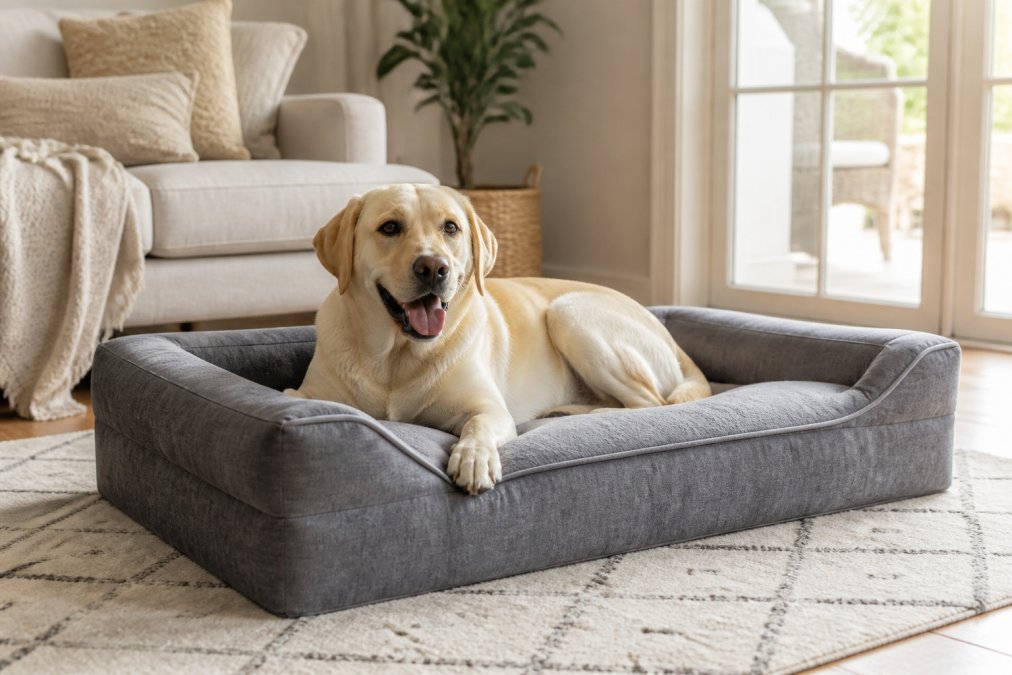
Our top pick for most Lab owners is the Orthopedic Memory Foam Dog Bed from Paw Fit Gears, priced at $48.54. It checks every box on the list above, and it adds two features that matter specifically for Labs.
The first is the 360-degree bolster design. Labs are "leaners" who love resting their heads on something solid. The raised edges provide head and neck support and a sense of security, especially valuable for anxious dogs. The bolsters are cushioned but firm enough to hold their shape under a heavy head.
The second is the CertiPUR-US certified egg-crate foam core, which provides the same pressure relief as solid memory foam but with better air circulation to keep your Lab cooler. The high-density foam will not collapse after months of use by a 70-pound dog.
The waterproof, removable cover protects the foam from accidents and drool. The fleece surface stays soft after repeated washing, and the non-slip bottom keeps the bed anchored on hardwood floors.
Best Dog Bed for Senior Labs: Managing Arthritis and Mobility
As Labs age, the bed becomes a component of their daily joint management plan. Arthritis in senior Labs typically affects the hips, elbows, and stifles (knees), with radiographic evidence of hip dysplasia appearing in over 50% of Labs by age 8 (PubMed). The right bed reduces pressure on inflamed joints, but you also need to consider how your dog gets in and out of the bed, especially after procedures like TPLO (tibial plateau leveling osteotomy) or hip replacement.
Bed height and entry considerations. The ideal bed height depends on mobility. For mild stiffness, a bed 4 to 6 inches off the ground allows stepping in with minimal joint flexion. For a dog recovering from TPLO surgery, where the affected leg cannot bear full weight for 8 to 12 weeks, a height of 2 to 3 inches is safer, allowing stepping rather than jumping (acvs.org). Too high forces the dog to hike their leg, stressing the surgical site; too low makes rising difficult without leverage. Measure from your dog's carpus (wrist) to the floor, the bed height should not exceed this. For most senior Labs, that means 3 to 5 inches.
Post-surgical recovery protocols. After orthopedic surgery, veterinarians typically recommend strict crate rest for the first 2 weeks, then gradual reintroduction to normal sleeping surfaces. During initial recovery, a flat orthopedic bed without bolsters is preferable, bolsters can encourage leaning, shifting weight onto the surgical leg. Place the bed on a non-slip surface to prevent sliding when the dog stands. After the incision heals (typically 10-14 days), you can reintroduce a bolster bed for head support.
The self-heating pet mat from Paw Fit Gears at $49.99 is an excellent addition for senior Labs, particularly during the post-surgical phase. The mat reflects your dog's own body heat back toward them, providing gentle warmth that soothes stiff joints without the risk of burns from electric heating pads. Heat therapy increases blood flow to the affected area, which can reduce morning stiffness, a common complaint in arthritic dogs. The mat is also portable, so you can move it to wherever your dog is resting during recovery.
The role of joint supplements and bed selection. While a bed cannot replace medical treatment, the combination of a supportive sleep surface and joint supplements (glucosamine, chondroitin, and omega-3 fatty acids) is a common recommendation from veterinary practitioners. A bed with thick, supportive foam reduces the pressure on inflamed joints, allowing the supplements to work more effectively by reducing the mechanical stress on the cartilage. For a senior Lab that prefers to curl up, the Washable Donut Dog Bed at $53.89 offers a different type of support. The raised edges cradle the body, and the plush poly-fill provides warmth. This bed suits dogs who feel secure when nestled, though it offers less firm support than a flat orthopedic mattress, so it is best used as a secondary bed for daytime naps rather than the primary overnight sleeping surface.
Monitoring for pressure sores. Senior Labs with reduced mobility may lie in one position longer, increasing the risk of pressure sores (decubitus ulcers) on elbows and hips. Check these areas weekly for redness, hair loss, or thickened skin. If you notice any signs, increase foam thickness or add a sheepskin-style pad. A 4-inch foam core generally suffices, but dogs with significant muscle wasting may need 5 to 6 inches to keep bony prominences off the bed base.
When to replace a senior Lab's bed. A bed in use for 3 or more years may have lost its supportive properties even if the cover looks fine. Press your hand into the center, if the foam does not spring back within 30 seconds, it has broken down. Senior Labs need more support, not less, as they age. Replacing a worn bed is one of the most cost-effective interventions for managing arthritis at home.
Chew Proof Dog Beds: Do They Hold Up to a Lab's Jaw?
No fabric is truly indestructible against a determined Lab. A dog with separation anxiety or a strong prey drive can tear through most materials given enough time. However, some beds are significantly more resistant, and the difference comes down to fabric construction.
Chew proof dog beds typically use tightly woven ballistic nylon or canvas, the same materials used in military-grade luggage, which resist punctures and tears far better than fleece or cotton. The tradeoff is less softness, so you may need to add a separate blanket or mat on top for comfort.
A more practical approach is addressing the root cause. Many Labs chew out of boredom or anxiety rather than malice. Increasing daily exercise, providing durable chew toys, and using a calming bed design can reduce the urge to destroy the bed.
The waterproof lining in the Paw Fit Gears orthopedic bed also helps here. Even if your Lab punctures the outer cover, the waterproof layer protects the foam core from being shredded and ingested, a critical safety feature, since ingesting foam can cause intestinal blockages requiring surgery.
What to Avoid When Buying a Bed for Your Lab
Several common bed features sound good in theory but fail in practice with a Labrador.
Low-density polyfill beds. These are the cheapest option but flatten within weeks under a heavy dog, leaving your Lab sleeping on the floor with a thin blanket on top.
Beds without removable covers. If you cannot wash the entire cover, the bed retains odors and bacteria. Labs are active, outdoorsy dogs, and their beds take a beating.
Beds that are too small. A Lab needs room to stretch out. A bed that forces curling up will not provide proper spinal alignment and can worsen joint stiffness.
Electric heating pads without supervision. While warmth helps arthritic joints, electric pads pose a burn and chewing risk. Self-heating mats using reflective material are safer because they require no electricity.
Overly expensive "designer" beds. You can pay $200 or more for a designer cover, but the foam inside is often the same quality as a $50 bed. Focus on foam certification and density, not the brand name.
Final Verdict: Choosing the Right Support for Your Lab
| Bed Type | Best For | Key Feature | Price |
|---|---|---|---|
| Orthopedic Memory Foam with Bolsters | Most Labs, all ages | Waterproof, CertiPUR-US foam, 360-degree bolsters | $48.54 |
| Washable Donut Bed | Curlers, anxious dogs | Raised edges, machine washable | $53.89 |
| Self-Heating Mat | Senior Labs with arthritis | No-electricity warmth, portable | $49.99 |
The right orthopedic bed for your Lab depends on their age, health status, and sleeping style. For most owners, the Orthopedic Memory Foam Dog Bed is the best starting point because it combines genuine joint support with the waterproof and washable features that make it last. Senior Labs benefit from adding a self-heating mat for targeted arthritis relief.

Prioritize foam density and certification over marketing claims. A bed with high-density, CertiPUR-US certified foam will support your Lab's joints for years; a bed with low-density foam will not, regardless of how plush it feels in the store.
Frequently Asked Questions
Do Labradors need orthopedic beds?
Yes, especially as they age. Labradors are prone to hip dysplasia, arthritis, and joint inflammation due to their size and active nature. An orthopedic bed with high-density memory foam provides pressure point relief and supports spinal alignment, reducing pain and stiffness. Even young Labs benefit from proper support to prevent future joint issues. If your Lab is over five years old or shows signs of slowing down, an orthopedic bed is a worthwhile investment for their long-term comfort.
What is the best bed for a Labrador that chews?
Look for beds marketed as chew proof dog beds with tear-resistant fabrics like ballistic nylon or heavy-duty canvas. However, no bed is truly indestructible. The Orthopedic Memory Foam Dog Bed from Paw Fit Gears features a durable, waterproof cover that is removable and washable. For aggressive chewers, pair the bed with chew toys and train your Lab to use the bed. A waterproof lining also protects the foam if your dog damages the outer cover.
What is the best dog bed for a senior Labrador?
The best dog bed for senior labs prioritizes joint relief and easy access. Choose a bed with thick, high-density memory foam (at least 3-4 inches) for pressure point relief. Look for a low profile or a bed with an orthopedic base that is easy for stiff joints to step onto. A waterproof, washable cover is essential for older dogs with incontinence issues. The Paw Fit Gears Orthopedic Memory Foam bed with bolsters offers head and neck support, helping seniors with arthritis sleep more soundly.
How thick should an orthopedic dog bed be for a large breed like a Lab?
For a Labrador, the foam core should be at least 4 inches thick. Labs typically weigh between 55 and 80 pounds, and their weight can compress thin foam down to the floor, negating any joint support. High-density, mattress-grade foam is critical because it resists compression and maintains its shape. If your Lab is heavier or prefers to sprawl, look for a bed with a thicker core or one that is specifically rated for extra-large breeds.
Choosing the right bed for your Labrador is one of the most impactful health decisions you can make for them, especially as they age. At Paw Fit Gears, we design our beds with the specific needs of large breeds in mind, combining waterproof protection, washable covers, and certified foam in products priced for everyday owners. Get started with Paw Fit Gears and give your Lab the joint support they deserve tonight.
This article was written using GrandRanker