

Table of Contents
- Why Dogs Bark and How Training Tools Help
- Best Anti-Barking Training Tools and How They Work
- Positive Reinforcement for Barking Control
- Teaching the 'Quiet' Command: Dog Training Commands for Quiet
- Clicker Training and Operant Conditioning for Barking
- Consistency, Environmental Management, and Troubleshooting Failed Training
- Ethical Considerations When Using Aversive Tools
- Conclusion
Last Updated: August 20, 2026
Why Dogs Bark and How Training Tools Help
Dogs bark for varied reasons: alert barking warns of strangers, territorial behavior marks boundaries, separation anxiety triggers panic, and nuisance barking stems from boredom or learned habits. Understanding the root cause is essential because one-size-fits-all approaches fail consistently.
This guide from Paw Fit Gears covers how to stop dog barking with training tools effectively by combining the right equipment with behavioral modification strategies. The key insight: tools alone don't work. They're only effective when paired with consistent training and environmental management. A vibration collar without quiet command training becomes just an annoying stimulus. An ultrasonic deterrent without positive reinforcement teaches nothing. The best results come from layering tools, commands, and rewards into a coherent system.
Training tools serve two purposes: they interrupt unwanted behavior in the moment and create opportunities for teaching better responses. An audible training tool like a clicker marks the exact second your dog does something right, making it easier to connect the action to the reward. An ultrasonic device redirects attention without causing pain or stress. Both become powerful when combined with the quiet command, consistent sessions, and reward-based training.
The framework most professionals use involves identifying the barking trigger, selecting the appropriate tool, teaching an alternative behavior, and reinforcing it repeatedly. Breed-specific barking triggers matter too, a German Shepherd's alert barking serves a different purpose than a small terrier's nuisance barking, and training should reflect that difference.
Best Anti-Barking Training Tools and How They Work
The market offers several categories of tools, each suited to different situations and barking triggers. Choosing the right one depends on your dog's sensitivity, the barking context, and your training philosophy.
Ultrasonic Deterrent Devices
Ultrasonic sound operates above human hearing range, capturing dog attention while remaining imperceptible to people. The Paw Fit Gears Ultrasonic Dog Training Device combines three functions: ultrasonic deterrent, audible clicker, and flashlight, working at distances up to 35 feet. This device is available for $49.99.

When your dog barks, you activate the device. The ultrasonic frequency interrupts the behavior and redirects focus toward you, creating a window where you can reward quiet behavior or teach an alternative response. The device includes multiple modes: ultrasonic only, audible sound (clicker function), or combined ultrasonic plus flashlight.
Ultrasonic deterrents work best for dogs with noise sensitivity. The tool is most effective when paired with positive reinforcement the moment barking stops.
Vibration and Static Correction Collars
Vibration collars deliver a gentle vibration when activated; static correction collars produce a mild static pulse. Both operate on behavioral correction through mild aversive stimulus. Vibration collars are gentler and preferred by many trainers for initial training phases.
These collars activate automatically when your dog barks (sensor-based) or manually via remote control. Manual control offers precision, you correct the exact moment barking occurs, creating a clear cause-and-effect connection. Sensor-based collars work when you're not watching but may trigger on ambient noise.
Static correction collars carry more controversy. While the stimulation is mild, they're considered aversive and may cause anxiety in sensitive dogs. Vibration collars achieve similar results with less psychological impact, which is why they're increasingly preferred. Many professional trainers now recommend starting with positive reinforcement and ultrasonic deterrents before moving to vibration-based tools.
Citronella Spray Collars
Citronella spray collars release a burst of citronella scent when your dog barks, interrupting behavior without physical stimulation. Most dogs find the scent unpleasant and learn to avoid triggering it.
Citronella collars are sensor-activated, requiring no remote control but activating on any bark, including alert or play barking. Over-correction can suppress all vocalizations. The spray dissipates quickly, preventing prolonged discomfort, but the collar doesn't teach an alternative behavior on its own. Effectiveness varies by dog, and the collar requires regular refilling.
Positive Reinforcement for Barking Control
Positive reinforcement training builds new behaviors by rewarding desired outcomes. When your dog stays quiet instead of barking, you reward immediately. The reward strengthens the quiet behavior, making it more likely to occur again and creating lasting behavioral change rather than temporary suppression.
The reward must come within 1-2 seconds of the desired behavior so your dog connects the action to the outcome. Many trainers use a clicker to mark the exact moment of correct behavior, then deliver the reward immediately after.
The advantages are significant: dogs don't develop anxiety or fear around training, they actively participate rather than avoid correction, and the quiet behavior becomes something they choose because it produces good outcomes.
The challenge is consistency. Every family member must reward quiet behavior the same way. If one person gives treats for quiet while another allows barking, your dog receives mixed signals and learning slows dramatically. Environmental management complements positive reinforcement, remove or reduce barking triggers when possible, then gradually introduce them at lower intensity once the quiet behavior is established.
Teaching the 'Quiet' Command: Dog Training Commands for Quiet
The quiet command is the cornerstone of behavioral modification. It gives your dog a specific, repeatable instruction that replaces barking.
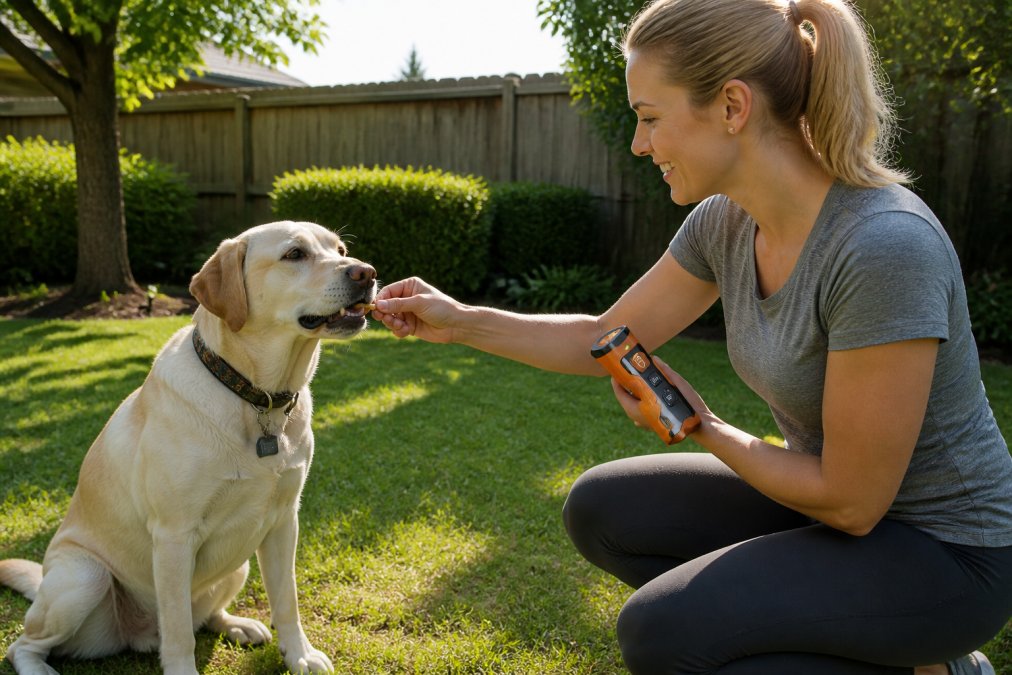
Start by waiting for a natural pause in barking. The moment your dog stops, say "quiet" clearly, then immediately reward with a treat. Repeat this 10-15 times per training session. Your dog learns to associate the word with the reward.
Next, introduce the command before the pause. Say "quiet" while your dog is still barking, then immediately use an ultrasonic deterrent to interrupt the barking. The moment barking stops, reward. Over multiple sessions, your dog learns that "quiet" is an instruction to stop barking and receive a reward.
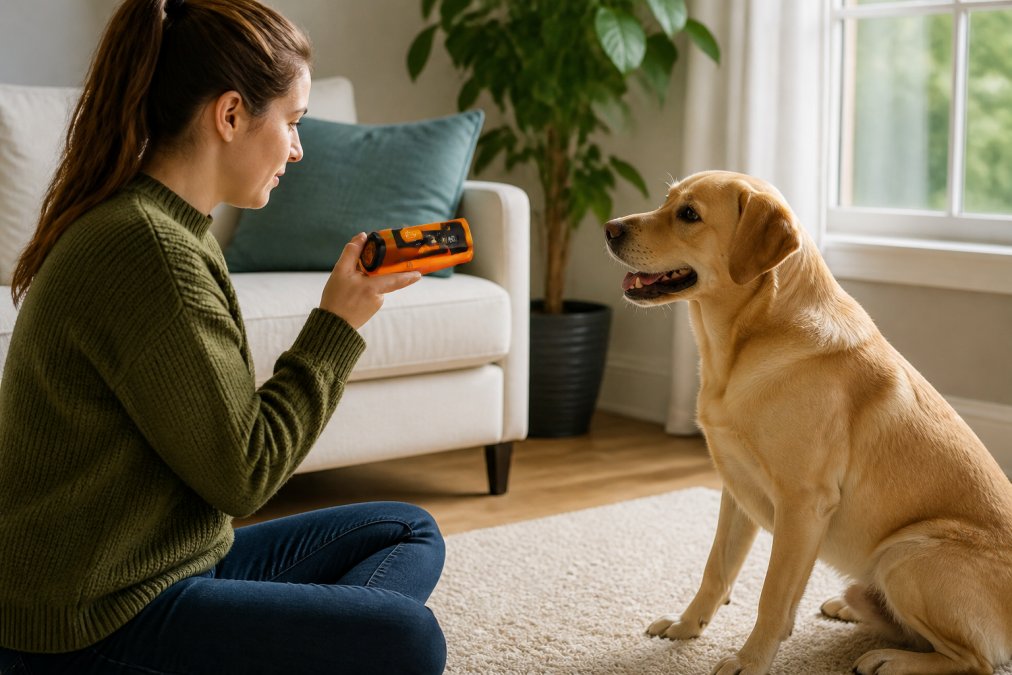
This process typically takes 2-4 weeks of consistent daily practice. Consistency matters more than speed. Five minutes of focused training daily outperforms one long session weekly.
Common mistakes include using the quiet command inconsistently, rewarding too late, or giving the command in a questioning tone instead of a clear instruction. Dogs respond better to confident, consistent commands. The quiet command works best when paired with a training tool: the tool interrupts barking, the command gives your dog something to do instead, and the reward reinforces the choice.
Clicker Training and Operant Conditioning for Barking
Clicker training uses a small handheld device that produces a distinct clicking sound, marking the exact moment your dog performs the desired behavior. This precision accelerates learning because your dog knows exactly which action earned the reward.
Operant conditioning is the framework underlying clicker training. Your dog learns through consequences: behaviors followed by rewards increase in frequency; behaviors followed by neutral consequences decrease. The clicker bridges the gap between behavior and reward, making the connection unmistakable.
Start by charging the clicker. Click the device 10-20 times, immediately followed by a treat each time. Your dog learns that the click sound predicts a reward. Once your dog anticipates the treat at the sound of the click, you're ready to use it during training.
When your dog exhibits quiet behavior, click immediately and deliver a treat. The click tells your dog exactly which behavior earned the reward. Clicker training works for teaching the quiet command, reinforcing calm behavior around triggers, and building duration. The Paw Fit Gears Ultrasonic Dog Training Device includes a clicker function, combining the interrupt tool and reward marker in one device.
Most dogs show noticeable improvement within 2-3 weeks of daily 5-10 minute sessions. The key is consistency and patience.
Consistency, Environmental Management, and Troubleshooting Failed Training
Consistency is non-negotiable. If your dog learns that barking sometimes brings attention and sometimes doesn't, they'll bark more frequently. Every family member must follow the same training protocol, and every training session must reinforce the same rules.
Environmental management reduces barking triggers before training begins. If your dog barks at passing cars, close the curtains or train in a quieter room. If separation anxiety triggers barking, gradually increase alone time. If your dog barks during feeding time, feed dogs separately. These adjustments prevent practicing unwanted behavior while you're building the quiet command.
Most training failures result from inconsistency, not flawed methods. If one family member isn't following the protocol, progress stalls. If you skip sessions, your dog regresses. If you reward barking by giving attention, barking increases.
Another common issue is selecting the wrong tool for your dog's temperament. A sensitive dog may become anxious with static correction when a vibration collar would work better. An insensitive dog may ignore ultrasonic frequencies entirely. If your dog shows no response after a week of consistent use, switch tools rather than increasing intensity.
Breed-specific barking triggers affect training success. A herding dog bred to bark at movement may need more intensive desensitization than a companion breed. Address underlying health or anxiety issues first. A dog on pheromone collar therapy (like the Paw Fit Gears Natural Pheromone Calming Collar) may respond better to training because anxiety is reduced. This collar is available for $49.99.

Ethical Considerations When Using Aversive Tools
Aversive tools suppress behavior through discomfort or mild pain. Vibration collars, static correction collars, and citronella sprays all fall into this category. They work, but they carry ethical implications worth understanding.
Research suggests that aversive training can increase anxiety and aggression in some dogs, particularly those already prone to anxiety. A dog that barks from fear may become more fearful when corrected with an aversive tool, worsening the underlying problem.
Positive reinforcement training avoids these risks. Your dog learns new behaviors because they produce good outcomes, not because they avoid bad ones. Dogs trained with positive reinforcement show lower stress markers and fewer behavioral problems long-term.
The practical reality is that many dog owners use aversive tools successfully without causing harm. Key variables are intensity, consistency, and the dog's temperament. A mild vibration correction applied consistently by a calm handler is less harmful than an intense static shock applied inconsistently by a frustrated owner.
The ethical hierarchy most modern trainers follow prioritizes positive reinforcement first, then ultrasonic deterrents (non-aversive), then vibration collars, and static correction as a last resort. This approach maximizes effectiveness while minimizing potential psychological harm.
The strongest argument for positive reinforcement is that it works as well as aversive methods without the risks. If two approaches produce similar results, the one without potential harm is obviously preferable.
Conclusion
Stop dog barking with training tools by combining the right equipment with consistent behavioral training. The most effective approach layers ultrasonic deterrents or clicker training with positive reinforcement and clear commands like "quiet." Paw Fit Gears provides the tools you need: the Ultrasonic Dog Training Device ($49.99) handles interruption and marking, while the Natural Pheromone Calming Collar ($49.99) reduces underlying anxiety that fuels excessive barking. Consistency across all family members and realistic timelines (2-4 weeks for measurable progress) separate successful training from failed attempts. Start with positive reinforcement and ultrasonic deterrents, add the quiet command and clicker training, and adjust environmental triggers. Your dog will learn that quiet behavior pays off far better than barking ever did.
Frequently Asked Questions
What is the best training tool to stop my dog from barking?
The best anti-barking training tool depends on your dog's triggers and temperament. Ultrasonic devices work well for dogs sensitive to sound, while clicker training with positive reinforcement suits most breeds. The Ultrasonic Dog Training Device ($49.99) combines three tools in one: ultrasonic deterrent, clicker, and whistle, making it effective for indoor and outdoor use up to 35 feet away. Pair any tool with reward-based training for lasting results.
How long does it take to train a dog to stop barking?
Training timelines vary based on the dog's age, breed, and barking triggers. Most dogs show improvement in 2-4 weeks with consistent daily sessions of 10-15 minutes. Alert barking and territorial behavior may take longer than nuisance barking. Success depends on consistency in training sessions, proper tool use, and combining behavioral correction with positive reinforcement. Patience and repetition are essential.
Are anti-barking devices safe for all dog breeds?
Most modern anti-barking devices are safe when used correctly, but breed-specific factors matter. Small breeds and dogs with anxiety may respond better to ultrasonic or clicker methods rather than aversive tools. Always start at the lowest setting and monitor your dog's response. The Natural Pheromone Calming Collar ($49.99) works well for anxious dogs, while the no-pull harnesses help manage leash aggression that triggers barking. Consult a veterinarian if your dog has health concerns.
Can positive reinforcement alone stop excessive barking?
Positive reinforcement is highly effective for barking control when combined with environmental management and the 'quiet' command. Reward your dog when calm, redirect attention to toys like the 18-inch Herding Ball ($67.31), and remove barking triggers when possible. This reward-based training approach builds lasting behavioral change without stress. For severe cases, combine it with ultrasonic deterrents or professional guidance for best results.
This article was written using GrandRanker