

Table of Contents
- Why Girth Is the Most Important Measurement for Dog Harness Size
- Tools You Need Before Measuring Your Dog
- How to Measure Dog Chest for Harness: Step-by-Step
- How to Fit a Dog Harness Correctly: The Two-Finger Rule
- Signs a Dog Harness Is Too Small (or Too Big)
- What to Do If Your Dog Is Between Harness Sizes
- Breed-Specific Sizing Challenges and Harness Types
- Conclusion: Getting the Right Fit for Your Dog
- Frequently Asked Questions
Last Updated: September 13, 2026
Why Girth Is the Most Important Measurement for Dog Harness Size
Girth is the single most important measurement for dog harness size because it determines whether the harness sits securely around your dog's ribcage without restricting movement or slipping loose. Neck measurement matters, but it's secondary. A harness that's too tight around the chest causes chafing and limits range of motion; one that's too loose lets your dog back out of it entirely (akc.org). That's why every sizing chart you'll encounter leads with girth. The American Kennel Club's dog harness buying guide makes the same point: measure the widest part of the chest first, then check the manufacturer's chart.
Tools You Need Before Measuring Your Dog
You need three things to measure dog chest for a harness: a soft measuring tape, a flat surface, and a helper if your dog won't stand still. A cloth tape wraps around curves without cutting into the fur; if you don't have one, use string and lay it flat against a ruler. Skip the retractable metal tape, it won't follow your dog's contours and the metal edge can pinch.
- Soft measuring tape (cloth or flexible plastic)
- A non-slip surface or rug
- Treats for rewarding a standing position
- A notebook or phone for recording numbers
How to Measure Dog Chest for Harness: Step-by-Step
Total time: 5-10 minutes Difficulty: Easy
Measuring the chest is a two-step process: wrap the tape around the widest part of the ribcage, then measure the neck at its base.
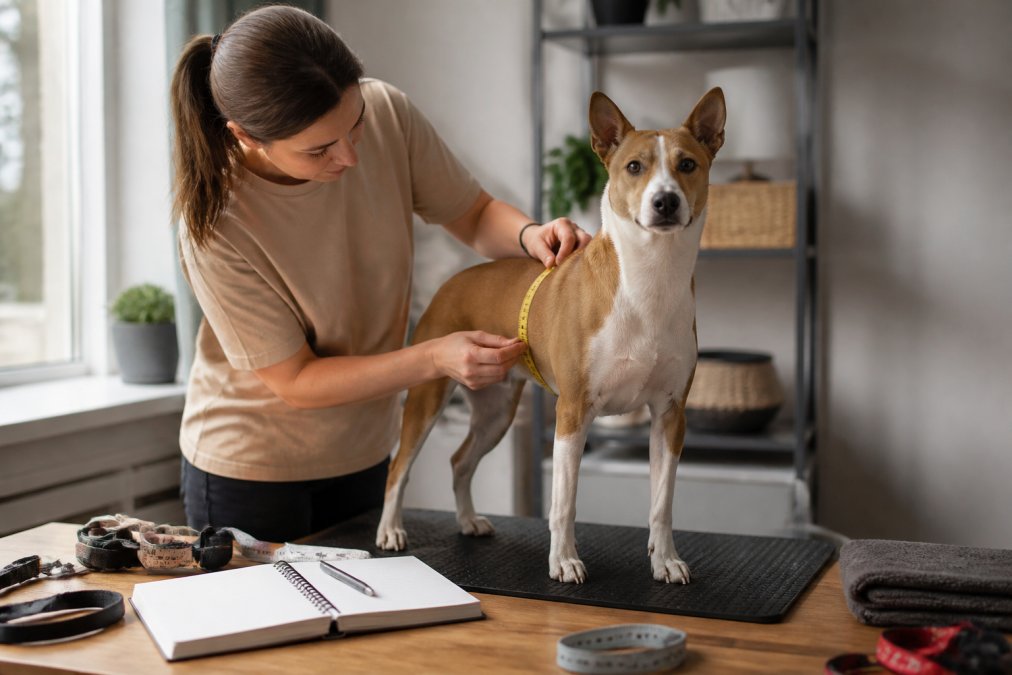
Measuring the Neck and Chest
- Stand your dog on all fours. A standing position keeps the chest expanded naturally.
- Find the widest part of the chest. This is usually right behind the front legs, at the deepest point of the ribcage.
- Wrap the tape around the ribcage. Keep it snug against the fur but not tight enough to compress the body.
- Record the chest circumference. Write it down immediately. Dogs wiggle.
- Measure the neck. Wrap the tape around the base of the neck, where a collar would sit.
- Check the manufacturer's sizing chart. Match your girth number to the range, not the breed label.
Tips for Measuring a Wiggly Dog
A common mistake is measuring a dog mid-wiggle and settling for a rough guess. Measure in short bursts and reward stillness: use a non-slip surface, and have a helper hold a treat at nose level while you wrap the tape. If you're alone, do the chest first. Measure twice and take the larger number.
How to Fit a Dog Harness Correctly: The Two-Finger Rule
The two-finger rule says you should be able to slide two fingers flat between the harness strap and your dog's body at every adjustment point (akc.org). If you can't fit two fingers, the harness is too tight and will rub; if you can fit four or more, it's loose enough that your dog can back out. Check the chest strap, neck opening, and belly strap. A harness with four adjustment points gives you far more room to dial in a snug fit than a two-point model.

Signs a Dog Harness Is Too Small (or Too Big)
Fit problems show up as behavior before they show up as marks on the skin. A dog that plants its feet at the door or walks with a shortened stride is often telling you the harness is binding at the shoulder; chafing, hair loss, and twisting are the late stage.
Signs the harness is too small
Chafing or bald patches at the armpits. This almost always traces to a chest strap that sits too far forward or a size one step too small. Check the strap position first: it should sit behind the front legs, not across them. If rubbing continues, size up.
Restricted shoulder movement. Watch your dog walk away from you: the front legs should swing freely, with the elbow extending past the ribcage on each stride. If the stride is shortened or the elbows are pinned to the body, the chest loop is too tight. This is the sign most owners miss because it leaves no mark.
Freezing, refusing to walk, or backing up. A dog that stops mid-walk or backs out at the door is often responding to pressure at the throat or chest. Check the neck opening first, if it sits high on the throat, the dog feels pressure with every step.
Red marks that fade within an hour. Some redness is normal on a new harness. Redness that persists, or appears at the same spot every time, is a fit problem, not a break-in problem.
Signs the harness is too big
Twisting to one side. A harness that rotates is too loose at the belly strap, even if the chest fits. The D-ring ends up off-center and the leash pulls it sideways.
Your dog can pull a leg out. This is the most dangerous sign: a dog that slips a leg out can back out entirely, a real risk near traffic. If your dog can pull a leg free while standing still, the harness is too big.
The D-ring sits off-center or the harness slides forward onto the throat. A harness that migrates forward is usually too large at the neck opening. The chest strap may fit, but the neck opening is wide enough that the whole harness slides forward under tension.
The two-finger rule fails at any strap. If you can fit four or more fingers under a strap, that strap is too loose. Tighten it before you consider sizing down.
Troubleshooting the three most common fit problems
Chafing that will not stop after sizing up. The problem is usually strap width, not size: a narrow strap concentrates pressure, while a wider, padded strap spreads the same load.
Slipping out of the harness. This is almost always a belly-strap problem: a dog backs out by pulling its elbows together and sliding the chest loop forward. The fix is a snug belly strap and, for strong pullers, a front-clip design that uses forward motion to keep the harness seated. If your dog has slipped out more than once, stop using that harness until you have refitted it.
Restricted shoulder movement that persists after loosening the chest. Check the chest strap position: if it crosses the point of the shoulder, it will bind no matter how loose it is. The strap needs to sit behind the shoulder blade, over the ribcage. If the design puts it forward of that point, no adjustment will fix it.
What to Do If Your Dog Is Between Harness Sizes
If your dog falls between sizes, size up and use the adjustable straps to tighten the fit. Most quality harnesses have enough adjustment range to cover the gap between two sizes; size down only if the next size up cannot be tightened enough at the chest. A deep-chested dog may need a larger size than their girth alone suggests, while a narrow-chested dog may need to size down and rely on the neck adjustment. When in doubt, choose the size whose upper girth range sits just above your dog's measurement.
| Situation | Recommended Action | Why |
|---|---|---|
| Girth falls at top of size M | Size up to L | Room to tighten without strain |
| Girth falls at bottom of size L | Stay in L, tighten straps | Avoids a too-small chest strap |
| Deep-chested breed | Size up one | Ribcage depth exceeds girth chart |
| Narrow-chested breed | Size down, adjust neck | Prevents slipping out |
Breed-Specific Sizing Challenges and Harness Types
A girth number tells you how big the loop needs to be, not the shape of the loop. Two dogs can both measure 28 inches around the chest and need completely different harness geometry, because girth is a single circumference while a dog's torso has depth, width, and length. This is the gap most sizing charts never address.
The four body shapes that break generic sizing charts
Deep-chested, narrow-waisted (sighthound type). Greyhounds, whippets, salukis, and Italian greyhounds have a ribcage that drops well below the elbow line and a waist that tucks up sharply behind it. A harness sized to the chest will gap at the belly strap, and one sized to the belly will not close around the chest. The fix is independent chest and belly adjustment, not a single strap running the length of the torso, so you can cinch the chest to the ribcage and take up slack at the waist.
Broad, shallow-chested (brachycephalic type). Bulldogs, pugs, Boston terriers, and French bulldogs have a chest that is wide side-to-side but short front-to-back, with a neck nearly as thick as the chest. A standard vest harness rides up into the throat because the neck opening cannot sit low. The fix is a wide, low neck opening and a chest strap that sits behind the front legs rather than across them. Step-in styles often work better than over-the-head styles here.
Long-backed, short-legged (dachshund type). Dachshunds, corgis, and basset hounds have a spine that extends well past the ribcage. A harness sized only by girth will be too short, and the rear strap will land on the lumbar spine instead of the ribcage. The fix is a longer back panel or adjustable back bridge, so the load-bearing strap sits over the ribs.
Narrow-chested, heavy (working and giant breeds). Dobermans, boxers, and Great Danes have a deep chest but a relatively narrow ribcage for their weight. A harness that fits the chest may still slip because there is no belly to anchor it. The fix is a front-clip no-pull design with a snug belly strap, which uses forward motion to keep the harness seated.
How to translate your measurement into a size for a non-standard shape
Start with the manufacturer's girth range, then apply one adjustment rule based on shape:
- Deep-chested: if your girth lands in the top third of a size range, size up. The chest loop needs the extra length even though the belly strap will be tightened well past the chart's midpoint.
- Broad-chested: if your girth lands in the bottom third of a size range, stay in that size and check the neck opening. Sizing up will make the neck opening too wide and the harness will slide forward onto the throat.
- Long-backed: ignore the girth range's upper limit and check the back-panel length against your dog's ribcage-to-tail measurement. A harness that is long enough in the body but slightly loose in the chest is safer than one that is tight in the chest but short in the back.
- Narrow-chested: size to the girth and rely on the belly strap. If the harness has only two adjustment points, it will not hold.
Harness types and which shape they suit
| Harness type | Best for | Watch out for |
|---|---|---|
| Step-in vest | Broad, shallow-chested breeds | Can ride up on deep-chested dogs |
| Over-the-head vest | Deep-chested, narrow-waisted breeds | Neck opening must clear the head |
| Front-clip no-pull | Narrow-chested, strong pullers | Needs a snug belly strap to stay seated |
| Back-clip only | Calm dogs with standard proportions | No front control for pullers |
| Long-back / extended panel | Long-backed breeds | Adds weight; check padding at the spine |
Weight distribution matters as much as size: a heavy harness on a small dog adds load to the shoulders and changes gait, while a light harness on a strong puller may not hold up to tension. For large dogs who pull, a front-clip no-pull design redirects forward motion and takes pressure off the throat. Paw Fit Gears carries a no-pull harness with dual leash clips built for large breeds, with padded, reflective straps and four adjustment points. For heavier pullers, the heavy-duty front-clip harness adds a control handle and two metal leash clips.

Conclusion: Getting the Right Fit for Your Dog
Getting the right dog harness size comes down to one number: girth. Measure the widest part of the chest, check the two-finger rule at every strap, and size up when your dog lands between sizes. It takes five minutes and prevents months of chafing, slipping, and refused walks. If you'd rather skip the guesswork, Paw Fit Gears offers quality harnesses designed for comfort and safety. Browse the full harness collection and find the size that keeps your dog comfortable on every walk.
Frequently Asked Questions
Why are Y-shaped harnesses better?
Y-shaped harnesses keep the straps away from the dog's throat and shoulders, allowing a full range of motion. They distribute pressure across the chest rather than the neck, which reduces chafing and discomfort. For dogs who pull, a Y-shaped no-pull harness with a front clip redirects forward motion without choking. Look for padded straps and adjustable buckles to get a snug fit around the widest part of the chest.
What should I do if my dog is between harness sizes?
Size up if your dog's measurements fall between two sizes, especially for breeds with deep chests. A harness that is too small restricts range of motion and causes chafing. Choose a harness with adjustable straps at the chest and neck so you can fine-tune the fit. If the larger size still feels loose around the belly, tighten the straps using the two-finger rule: you should fit two fingers under each strap.
How tight should a dog harness be?
A properly fitted harness should be snug but not restrictive. Use the two-finger rule: slide two fingers under each strap. If you can't fit two fingers, the harness is too tight and may cause chafing. If you can fit more than two, it's too loose and your dog could slip out. Check the fit after adjusting straps, and re-measure your dog every few months, especially during growth or weight changes.
Can a harness that is too big cause chafing?
Yes. A harness that is too big slides around during walks, creating friction against the skin and fur. This leads to chafing, hair loss, and discomfort, especially under the front legs and across the chest. A loose harness also lets your dog back out of it, which is a safety risk. Always measure your dog's girth and neck, then adjust the straps for a snug fit before every walk.