

Table of Contents
- Why Active Puppies Need a Different Collar Standard
- Durable Collars for Active Puppies: Quick Comparison
- How to Measure Puppy for Collar: A Step-by-Step Guide
- Best Materials for Puppies That Chew and Swim
- When to Switch From Puppy Collar to Harness
- Common Mistakes That Ruin Puppy Collars Fast
- Final Verdict: Choosing the Right Durable Collar for Your Pup
- Frequently Asked Questions
Last Updated: September 5, 2026
Puppies test everything with their teeth, including the collar you just bought. A standard nylon strap rarely survives the first month of zoomies, crate chewing, and puddle rolling. Durable collars for active puppies require a different standard than adult dog gear, built around growth, teething, and high-energy play.
Why Active Puppies Need a Different Collar Standard
Most puppy collars fail because they are built for decoration, not for the daily punishment an active puppy delivers. A puppy exploring the yard, tugging on a leash, or wrestling with a sibling puts repeated stress on the webbing, the stitching, and the buckle. The American Kennel Club notes that puppies go through distinct growth stages where their neck size changes rapidly, which means a collar that fits today may be dangerously tight in three weeks American Kennel Club puppy growth guidance.
Standard collars use thin webbing and lightweight plastic buckles that cannot handle sudden jerks. Active puppies also spend more time outdoors, exposed to mud, water, and UV rays that degrade cheap materials quickly.
Durable Collars for Active Puppies: Quick Comparison
Not all heavy-duty collars are created equal, and the right choice depends on your puppy's size, activity level, and specific habits. The table below summarizes what to look for based on your primary concern.
| Collar Priority | Best Material | Key Feature | Best For |
|---|---|---|---|
| Chew resistance | Biothane or coated nylon | Smooth surface resists teeth | Teething puppies under 6 months |
| All-weather use | Nylon with waterproof coating | Dries fast, resists odor | Puppies who swim or play in rain |
| Night visibility | Reflective stitching | High-visibility in low light | Evening walks and trail runs |
| Strength-to-weight | Lightweight polypropylene | Strong but not bulky | Small breeds under 20 lbs |
| Training control | Martingale style | Gentle correction without choking | Puppies learning loose-leash walking |
How to Measure Puppy for Collar: A Step-by-Step Guide
Measuring your puppy correctly is the single most important step in choosing a collar, and you will repeat it often as your pup grows. Use a flexible measuring tape and follow these steps.
- Have your puppy stand with her head up and neck relaxed.
- Wrap the tape measure around the middle of her neck, where the collar will naturally sit.
- Keep the tape snug but not tight, allowing it to touch the fur without pressing in.
- Record the measurement in inches, then add two fingers' width of space for comfort.
- Re-measure every two to three weeks during the rapid growth phase.
The Two-Finger Rule for a Secure Fit
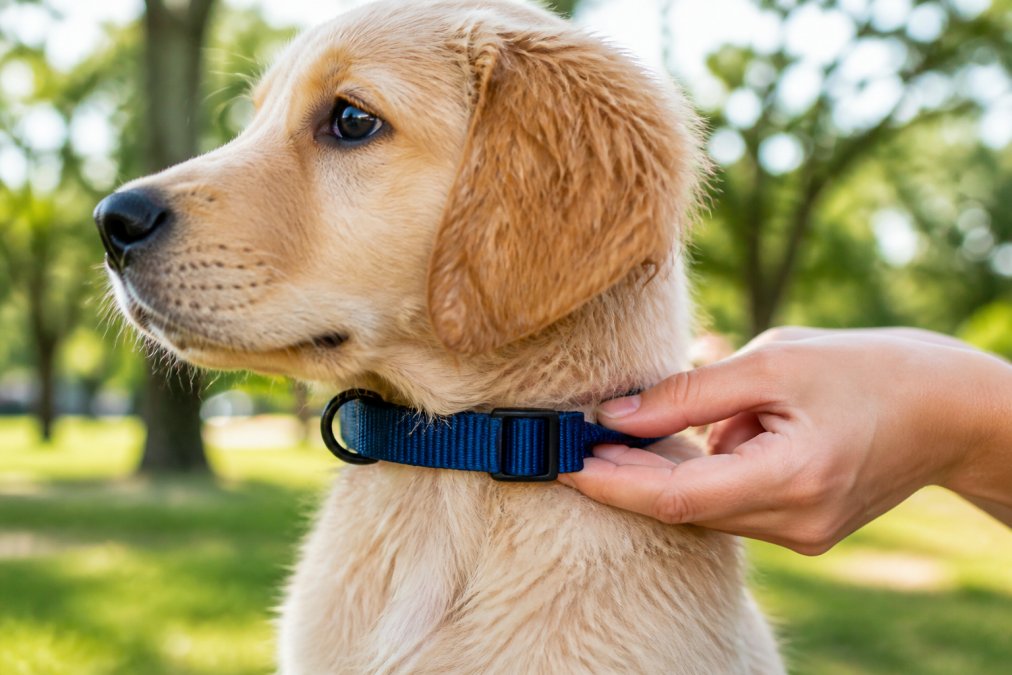
The two-finger rule is the standard safety check used by veterinarians and trainers (avma.org). After fastening, you should be able to slip two flat fingers between the collar and your puppy's neck. More than two fingers means it is too loose and could slip over her head; fewer means it is too tight and can cause discomfort or breathing issues.
A secure fit also means the collar does not rotate freely; you should not be able to twist it more than a quarter turn. This prevents chafing and keeps the D-ring positioned correctly for leash attachment.

Best Materials for Puppies That Chew and Swim
Material choice determines whether your collar survives the puppy phase, and the decision gets more nuanced with teething. Most guides recommend a single material, but active puppies rarely present a single problem. The real-world choice is a trade-off between chew resistance, water behavior, and weight on a small neck.
Biothane and Coated Nylon for Chewers
Biothane, a polyester webbing core wrapped in a smooth PVC coating, is the current front-runner for teething puppies. The smooth surface gives teeth nothing to grip, unlike woven nylon where a puppy can sink her incisors between the fibers. A better option for small breeds is a thinner coated nylon, which offers similar smooth-surface resistance with more flexibility.
Heavy-Duty Nylon for Swimmers and All-Weather Play
Heavy-duty nylon webbing remains the most versatile choice for active puppies. It offers high tensile strength, dries reasonably fast, and holds up to abrasion. The key is width and weave density: a 1-inch wide, 1,000-denier strap with a tight basket weave resists fraying far better than a 3/4-inch, loosely woven alternative. For large breeds expected to grow past 50 pounds, choose webbing at least one inch wide; for small breeds, a narrower strap keeps the weight-to-strength ratio appropriate.
The problem with nylon is that it absorbs water. A puppy who swims daily will carry a wet collar for hours, and moisture weakens the fibers over time. A waterproof coating helps but wears off at friction points. For a serious swimmer, look for a nylon collar with a sealed, fused edge rather than a stitched edge, because stitching creates channels where water and bacteria accumulate.
The Chew-Proof Testing Reality
No collar is truly chew-proof. A determined puppy with adult teeth can eventually damage any material. What separates durable collars is how they fail: a good collar fails slowly with surface damage that does not compromise structural integrity; a poor collar fails suddenly, with the buckle cracking or the D-ring pulling free. When evaluating a collar for a chewer, inspect the buckle and D-ring attachment points first, these are the weakest links, regardless of webbing material.
Material Comparison at a Glance
| Material | Chew Resistance | Water Behavior | Weight | Best For |
|---|---|---|---|---|
| Biothane | High (smooth surface) | Excellent (non-porous) | Heavy for width | Teething puppies over 15 lbs |
| Coated nylon | High | Good (coating helps) | Moderate | Small breeds that chew |
| Heavy-duty nylon | Moderate (woven fibers) | Fair (absorbs water) | Light for strength | All-around active play |
| Polypropylene | Low-moderate | Excellent (does not absorb) | Lightest | Swimmers who do not chew |
| Leather | Low (teeth can grip) | Poor (absorbs and cracks) | Heavy | Adult dogs, not puppies |
The Allergy Factor Most Guides Miss
A less obvious durability issue is skin sensitivity. A puppy with contact dermatitis will scratch at her collar, accelerating wear and leading to raw, infected skin. Nickel in cheap metal buckles and D-rings is a common irritant; look for stainless steel or coated hardware labeled nickel-free (peer-reviewed research). Biothane and polypropylene are generally hypoallergenic, while some nylon webbing contains chemical treatments that can irritate sensitive skin. If your puppy develops redness or hair loss around the neck, switch to stainless steel hardware with a plain, untreated polypropylene strap.
The Weight-to-Strength Trade-Off
For puppies under 20 pounds, the heaviest duty material is not always the best choice. A thick Biothane collar that would stop a German Shepherd chewer can be too heavy for a 12-pound Miniature Pinscher, causing neck strain. The right approach for small breeds is to prioritize hardware quality over webbing thickness: a 3/4-inch polypropylene strap with a solid stainless steel buckle and welded D-ring will outperform a 1-inch nylon strap with a plastic buckle, while weighing significantly less.
When to Switch From Puppy Collar to Harness
The question of when to switch from puppy collar to harness is not a single date on the calendar. It is driven by three factors: growth stage, pulling behavior, and breed anatomy. Most puppies transition between six and twelve months, but the more useful question is how to recognize the signals that the switch is needed.
Growth Stage Milestones
Puppies go through rapid growth phases that change both neck size and body proportions. The American Kennel Club notes that small breeds typically reach adult size by 9 to 12 months, while large and giant breeds continue growing until 18 to 24 months. A collar fitted correctly at 8 weeks will be dangerously tight by 16 weeks for most breeds. Re-measure every two to three weeks during the first six months and check the fit before every walk.
The switch to a harness makes sense when your puppy reaches about 80 percent of her projected adult weight. At that point, her neck size is close enough to final that a well-fitted harness will not need constant adjustment, and her body can handle the pressure distribution without interfering with natural gait development. For a Labrador Retriever, that means around 6 to 7 months; for a Chihuahua, 5 to 6 months; for a Great Dane, closer to 12 to 14 months.
Breed-Specific Considerations
Breed anatomy matters more than most guides acknowledge. Breeds with narrow necks and broad heads, such as Greyhounds, Whippets, and many terriers, can slip out of a properly fitted collar because the head is wider than the neck; for these breeds, a martingale collar or harness is safer from the start. Breeds prone to tracheal collapse, including Toy Poodles, Yorkshire Terriers, and Pomeranians, should avoid collar-based leash pressure entirely, switch to a harness as soon as you begin leash training, regardless of age.
Conversely, breeds with thick necks and moderate heads, such as Bulldogs and Boxers, can wear a collar safely for longer, but their powerful pulling strength means a harness provides better control during training.
The Pulling Behavior Signal
The most reliable signal to switch is not age but behavior. If your puppy pulls consistently, a collar transfers that force directly to the trachea and cervical spine. A front-clip harness redirects forward motion to the side, giving you more control and teaching the puppy that pulling does not move her toward the destination. Switch the moment you notice consistent pulling, not after weeks of fighting the leash.

Puppies typically pull hardest between 4 and 8 months, during the adolescent phase when they test boundaries and energy levels peak, exactly when a harness provides the most benefit. Waiting until 12 months means spending the most challenging training months fighting a collar that works against you.
The Transition Roadmap
A practical approach is to use both tools simultaneously during the transition. Keep the collar on for ID tags and everyday wear, but attach the leash to the harness for walks and training. This gives your puppy time to adjust to the harness without losing the collar's identification function. After two to three weeks of consistent use, most puppies accept it as normal.
Signs the Switch Is Complete
The transition is complete when your puppy walks on a loose leash without pulling, responds to verbal cues during walks, and has reached at least 90 percent of her adult weight. At that point, you can continue using the harness or switch back to a collar if your breed has no anatomical concerns. For most owners, the harness remains the better choice for walks because it offers more control and distributes pressure more safely; the collar remains useful for ID tags and quick trips to the yard.
The Collar's Ongoing Role
Switching to a harness does not mean abandoning the collar. Your puppy still needs a collar to hold ID tags and a rabies vaccination tag, which are legal requirements in most jurisdictions. The collar should fit snugly enough that it cannot slip over the head, but it does not need to bear leash pressure. This division of labor, collar for identification, harness for control, is the most effective setup for active puppies and continues to serve adult dogs well.
Common Mistakes That Ruin Puppy Collars Fast
The fastest way to destroy a durable collar is to ignore the basics of maintenance and fit. Leaving a wet collar on your puppy allows moisture to weaken the webbing and corrode the hardware. Washing in hot water with harsh detergents breaks down fibers and any waterproof coating. Leaving the same collar on a growing puppy without adjustment puts constant strain on the stitching.
Another common mistake is choosing a collar based on current weight rather than projected adult size. A collar that fits a 10-pound puppy at eight weeks will be dangerously tight by sixteen weeks. Buy a collar with generous adjustability and check the fit weekly during the first six months.
Final Verdict: Choosing the Right Durable Collar for Your Pup
Choosing durable collars for active puppies comes down to matching material and hardware to your puppy's specific habits. Prioritize heavy-duty nylon or Biothane with stainless steel hardware, reinforced stitching, and reflective elements. Measure correctly using the two-finger rule and re-check the fit every few weeks. For puppies who pull or need training support, plan to switch to a no-pull harness around six months of age.
At Paw Fit Gears, we build our gear for the reality of puppy life: the chewing, the swimming, the pulling, and the growth spurts. Our No-Pull Dog Harness with 2 Leash Clips offers dual leash attachment points and adjustable straps for training, while the heavy-duty No-Pull Dog Harness with front clip adds metal clips and reflective strips for low-light walks. Pair either with a retractable leash rated for your dog's weight for complete control during training sessions.
Finding a collar that survives your puppy's active lifestyle does not require trial and error. Focus on materials that resist chewing and moisture, hardware that will not corrode, and a fit that adapts as your pup grows. Paw Fit Gears designs every collar, harness, and leash with reinforced stitching, adjustable straps, and reflective details so your gear keeps up from the first walk to the hundredth.
Frequently Asked Questions
What is the most durable material for a puppy collar?
Heavy-duty nylon webbing with reinforced stitching is a durable material for active puppies. It resists abrasion from outdoor play and dries quickly after swimming. For teething pups that chew, look for collars with a chew-resistant core or a coating that discourages biting. Stainless steel hardware and rustproof D-rings prevent corrosion and keep the collar secure. Avoid leather and cotton for puppies under six months, as these materials weaken when chewed and stay wet, which leads to odor and rot.
Can a 10 week old puppy wear a collar?
Yes, a 10 week old puppy can wear a collar, but only for short periods under supervision. Start with a lightweight nylon collar that fits snugly without putting pressure on the neck. Introduce it gradually during playtime so the puppy associates the collar with positive experiences. Never leave a collar on an unsupervised puppy, as it can snag on crate bars or playpens. At this age, the neck is still growing, so check the fit every few days and loosen it as needed to prevent chafing.
How do I choose a collar that grows with my active puppy?
Choose an adjustable collar with a wide range of sizing, typically offering several inches of growth allowance. Look for a design with a slide buckle that lets you add length without changing hardware. Measure your puppy's neck circumference weekly, since puppies grow quickly in their first year. A collar that fits two fingers under it at the loosest setting provides room to grow. Plan to replace the collar every few months as your puppy approaches adult size, and check the stitching regularly for wear.
When should I switch from a puppy collar to a harness?
Switch from a collar to a harness when your puppy starts pulling on walks or shows signs of neck strain, such as coughing or gagging. Puppies have delicate tracheas, and a collar puts pressure on the throat during pulling. A no-pull harness with a front clip redirects forward motion and protects the neck while training. For active puppies that lunge after squirrels or other dogs, a harness offers better control and distributes pressure across the chest. Use the harness for walks and keep the collar for ID tags.
This article was written using GrandRanker