

Table of Contents
- Dog Car Travel Laws by State: What Every Owner Needs to Know
- States That Require Dogs to Be Restrained in Cars
- Dog Seat Belt Laws: Legal Requirements vs. Safety Recommendations
- How to Secure a Dog Crate in a Car
- Dog Car Travel Safety Tips for Every Road Trip
- Common Mistakes Drivers Make With Dogs in the Car
- Conclusion
- Frequently Asked Questions
Last Updated: October 9, 2026
Dog Car Travel Laws by State: What Every Owner Needs to Know
Dog car travel safety laws by state vary more than most owners expect, and the phrase dog car travel safety laws by state is the fastest way to find the rules that apply to you.
An unrestrained dog becomes a projectile in a crash, and a dog in your lap can be cited as distracted driving in most jurisdictions. Below: the states with real restraint requirements, the penalties, and the gear that keeps your dog secure whether or not your state mandates it.
States That Require Dogs to Be Restrained in Cars
Most state vehicle codes predate the dog in the back seat, so the legal picture is a patchwork of three rule types rather than one nationwide standard.

Type 1: Explicit pet restraint statutes. These name animals directly. Hawaii prohibits driving with a dog in the driver's lap or otherwise unrestrained in a way that interferes with safe operation.
Type 3: Animal cruelty and neglect statutes. These apply when an animal is left in obvious danger, a dog in a hot parked car, or tethered in a truck bed in extreme weather.
| Rule Type | What Triggers It | Who Enforces | Typical First Response |
|---|---|---|---|
| Explicit pet restraint statute | Dog in lap, dog unrestrained in a way that impairs driving, dog in an open truck bed | State or local law enforcement during a traffic stop | Warning or citation |
| General distracted or careless driving law | Dog on lap, dog blocking mirrors or windshield, dog interfering with steering | Any officer who observes the conduct | Primary or secondary citation |
| Animal cruelty or neglect statute | Animal left in a hot vehicle, animal exposed to foreseeable injury in an open bed | Law enforcement, animal control, sometimes a humane officer | Warning, citation, or seizure depending on severity |
| No pet-specific rule | Nothing pet-specific, general road safety rules only | Officer discretion | Usually a warning |
Two distinctions matter more than any single state's text:
- Moving versus parked. Restraint rules apply while the vehicle is in motion; unattended-animal rules apply while it is parked. A state can have one, both, or neither.
- Enclosed cabin versus open bed. A rule silent on dogs in a sedan may still prohibit a dog in a pickup bed.
How to Verify Current Law Before Your Trip
Statutes are amended and secondary summaries go stale within a single legislative session. Read the current text yourself, then confirm enforcement.
- Open your state legislature's official website and find the current vehicle code chapter on rules of the road.
- Search that code for "animal," "dog," "restrain," "lap," and "open bed", each term separately, since a combined search misses provisions with different wording.
- Check the state Department of Transportation or Highway Safety office for plain-language guidance on pets in vehicles.
- If the text is ambiguous, call the state highway patrol non-emergency line and ask a specific question about enforcement.
- Repeat for every state you will drive through, not just your destination, requirements can change at the state line.
For federal requirements that sit alongside state vehicle law, health certificates, vaccination documentation, and interstate movement rules, the USDA Animal and Plant Health Inspection Service pet travel resources is the primary source.
Penalties, Exceptions, and How Enforcement Actually Works
Where a pet-specific statute exists, the penalty is usually modest, a fine, often a warning for a first offense and a higher fine for a repeat.
Enforcement is inconsistent by design. An officer who sees a dog loose in a pickup bed on an interstate is far more likely to act than one who sees a dog sitting calmly in a sedan's back seat.
Common exceptions and gray areas:
- Emergency situations. A driver evacuating a dangerous situation is unlikely to be cited, but this is a defense raised after the fact, not a rule to plan around.
- Service animals. Federal disability law governs service animal accommodation and can interact with state restraint rules differently by jurisdiction. Confirm the rules in each state you cross.
- Commercial vehicles and rideshare. A pet in a commercial vehicle or rideshare may fall under separate carrier rules or platform policies on top of state law.
Dog Seat Belt Laws: Legal Requirements vs. Safety Recommendations
There is a real gap between what the law requires and what protects your dog.
A pet restraint is any device that limits a dog's movement inside a vehicle: a seat-belt harness, crate, carrier, or tether. In most states none is legally required for a dog in an enclosed cabin, but that does not make an unrestrained dog safe. A 30-pound dog in a 35 mph crash carries roughly the kinetic energy of a refrigerator dropped from chest height.
How to Evaluate a Restraint Before You Buy It
Most pet restraints have never been crash tested, and a product labeled "safety harness" or "seat belt for dogs" need not meet any federal standard. The burden of evaluation falls on you:
- Look for independent crash testing. A few organizations run instrumented sled tests and publish pass-or-fail results. A manufacturer that submitted its product will cite the test speed and dog weight range; vague "crash tested" claims without either are marketing, not evidence.
- Check the attachment point. A restraint clipping to a collar can injure the dog's neck in a sudden stop. Clip to a harness so the load spreads across the chest and shoulders.
- Check the hardware. Metal buckles and welded D-rings hold up better than plastic snap hooks. A tangle-free swivel keeps the belt from twisting into slack.
Front Seat, Back Seat, and Cargo Area: Where the Legal and Safety Lines Sit
The safest place for a dog is the back seat or a secured cargo area, because of the front airbag. It deploys in milliseconds at a force designed for an adult human torso, and a dog in the front passenger seat, restrained or not, can be seriously injured. No state requires you to keep your dog out of the front seat, but the safety case for the back seat is not close.
- Back seat, secured. A seat-belt harness attached to the vehicle's belt, or a crate tied down so it cannot slide.
- Cargo area, secured. A crate or barrier keeps the dog out of the passenger cabin; an unsecured crate becomes a heavy projectile.
- Front seat, avoid. If you must, disable the passenger airbag where possible and use a restraint that keeps the dog out of the deployment zone.
Penalties and Enforcement in States With Restraint Laws
Where a pet restraint statute does exist, penalties are usually modest: a fine, sometimes a warning for a first offense, and a higher fine for repeat violations.
Enforcement is inconsistent. An officer who sees a dog in a truck bed on a highway is far more likely to act than one who sees a dog loose in the back seat of a sedan.
How to Secure a Dog Crate in a Car
A crate only protects your dog if the crate itself stays put. An unsecured crate becomes a heavy, hard-edged object in a crash, worse than no crate at all.
2 Pack Adjustable Dog Seat Belt for Car →

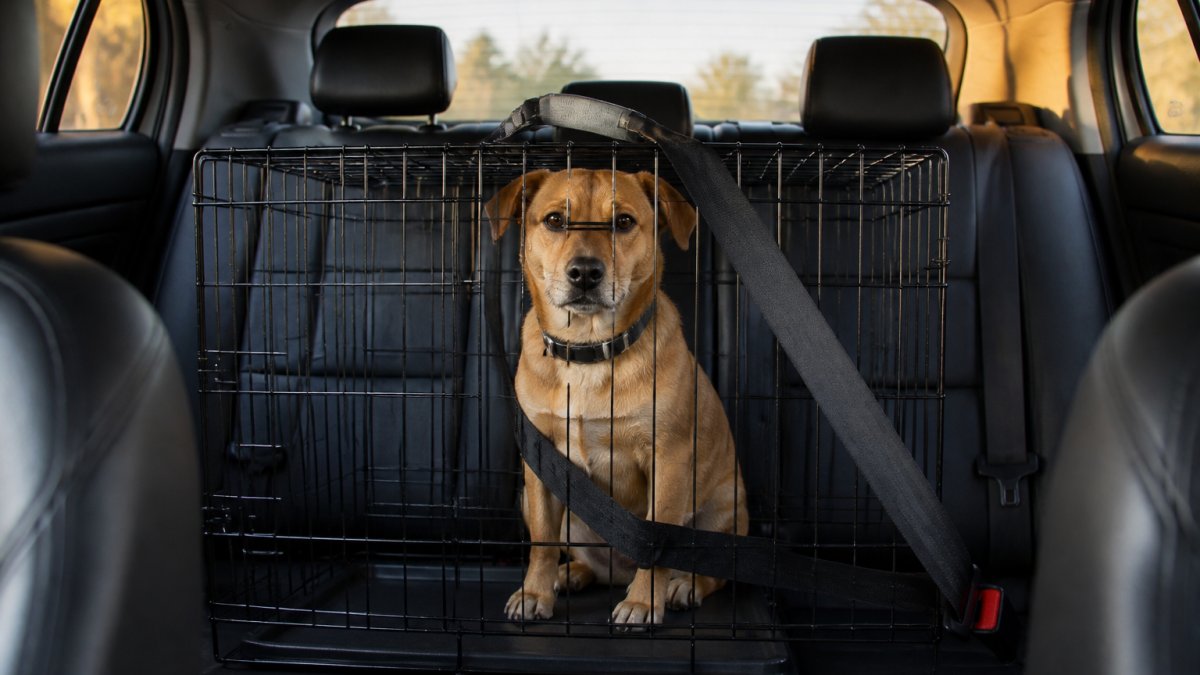
The correct method:
- Place the crate on the back seat or in the cargo area, never in the front passenger seat.
- Route a seat belt through the crate's handle or a dedicated tie-down point, then buckle it.
- For larger crates, use a cargo-area tie-down strap anchored to the vehicle's built-in anchor points.
- Push the crate against the seat back so it cannot slide forward.
- Test it: grab the crate and try to shift it. If it moves more than an inch or two, tighten the restraint.
Crates work best for dogs already comfortable in them. If your dog is not crate-trained, a seat-belt harness is the more realistic option, paired with a harness, never attached to a collar.
Dog Car Travel Safety Tips for Every Road Trip
Good travel habits reduce stress for the dog and distraction for the driver, and most cost nothing.
- Feed a light meal two to three hours before departure, not right before you leave, to reduce motion sickness.
- Keep the cabin cool and crack a window for airflow, but never let your dog ride with its head fully out an open window.
- Take a break every two to three hours so your dog can drink, relieve itself, and stretch.
Choosing the Right Restraint for Your Dog's Size
Small dogs do well in a secured carrier or a padded seat-belt harness sized to their chest.
Our ASPCA pet travel safety guidance recommends acclimating your dog to any new restraint at home before relying on it in the car.
For owners who want a straightforward, adjustable option, our 2 Pack Adjustable Dog Seat Belt for Car connects to your car's seat belt buckle and your dog's harness, adjusts from 16.5 to 27.6 inches to fit small through large dogs, and comes as a two-pack for households with more than one pet.
If your dog rides in the back seat regularly, a Dog Bed Mat for Car Back Seat Extenders gives them a stable, comfortable base and helps protect your interior from claws, dirt, and drool.
Common Mistakes Drivers Make With Dogs in the Car
The same handful of errors show up again and again, each turning a manageable risk into a serious one.
- Letting the dog ride on a lap. This blocks steering and is a distracted driving violation in most jurisdictions.
- Clipping a seat belt to a collar. A collar attachment can injure the dog's neck in a sudden stop. Always use a harness.
- Leaving the dog loose in a truck bed. This is the most common trigger for a pet restraint citation.
One more owners rarely consider: driver visibility. A dog between the front seats or pressed against the windshield blocks your view of mirrors and blind spots.
Conclusion
The state-by-state picture is uneven, and that unevenness is the real risk. Some states write pet restraint into law, most do not, and enforcement varies from officer to officer. Relying on the gaps is a gamble you do not need to take.
At Paw Fit Gears, we build gear for the trips where the law is silent but the physics is not.
Frequently Asked Questions
Should dogs sit in the front or back of a car?
The back seat is safer for dogs because front-seat airbags can injure or kill a dog during deployment. Airbags are designed for adult humans and deploy at speeds that can cause serious harm to a dog's neck and spine. If your dog must ride in the front, deactivate the passenger airbag and use a crash-tested harness. Most dog car travel laws in states with restraint requirements specify the back seat or a secured crate.
Which states require dogs to be restrained in a car?
Several states have laws that require dogs to be restrained in cars, though the specifics vary. Some states address dogs in the driver's lap, others cover dogs in truck beds, and a few require restraint in any moving vehicle. Because these laws change, check your state's current vehicle code or department of transportation website before traveling. A dog seat belt attached to a harness or a secured crate meets most restraint requirements.
Can you get a ticket for driving with an unrestrained dog?
Yes, in states with dog restraint laws, law enforcement can issue a ticket for an unrestrained dog. Penalties range from a small fine to misdemeanor charges, especially if the unrestrained dog causes an accident or injury. Even in states without a specific dog restraint law, an unrestrained dog can lead to distracted driving citations. Keeping your dog secured with a seat belt harness or crate prevents both safety risks and legal trouble.
How do you restrain a dog in the back of an SUV?
In an SUV, use a harness attached to the seat belt or a secured crate. For a crate, thread the seat belt through the crate's handle or use a tie-down strap anchored to the cargo rings. The crate should not slide or tip during sudden stops. A back-seat extender with a dog bed mat can also keep your dog comfortable while the harness keeps them in place. Always place the crate or harness in the back seat or cargo area, not the front.
What is the safest way for a dog to travel in a car?
The safest way is a harness attached to the seat belt in the back seat, or a secured crate that is properly tied down. Avoid letting your dog ride with their head out the window, as debris can cause eye injuries. Keep the dog in the back seat away from airbags. For added comfort on long trips, a back-seat extender with a dog bed mat reduces motion sickness and anxiety. Always secure your dog before starting the engine.
How to tie down a dog crate in a car?
To tie down a dog crate, place it in the back seat or cargo area. Thread the seat belt through the crate's handle or around the frame. For SUVs, use tie-down straps connected to the cargo rings to anchor the crate. The crate should not move more than an inch in any direction when you push it. A crate that slides can become a projectile in a crash. Check the straps each time before you drive.
The law in your state may not require a restraint, but your dog still needs one. Paw Fit Gears offers durable harnesses, adjustable seat-belt restraints, and back-seat mats built for real road trips. Browse our catalog and gear up before your next drive.