

Table of Contents
- Quick Comparison: Top Dog Car Booster Seats at a Glance
- How We Evaluated These Booster Seats
- Dog Car Seat Safety Standards: What Actually Matters
- 1. Hard Bottom 6-in-1 Dog Back Seat Cover: Best Overall Value
- 2. Dog Bed Mat for Car Back Seat Extenders: Best for Orthopedic Support
- 3. 2 Pack Adjustable Dog Seat Belt for Car: Best Safety Tether
- How to Secure a Dog Booster Seat in a Car
- Dog Car Seat Covers for Travel: Protection and Practicality
- Frequently Asked Questions
Last Updated: September 16, 2026
Quick Comparison: Top Dog Car Booster Seats at a Glance
Finding dog car booster seats that actually keep a small dog contained on a sharp turn is harder than it should be. Most listings promise "safety" without explaining what holds the seat in place or how your dog stays put. This guide from Paw Fit Gears cuts through the marketing and focuses on three products, plus the installation and safety details that matter more than any product photo.
| Product | Price | Best For | Key Feature |
|---|---|---|---|
| Hard Bottom 6-in-1 Dog Back Seat Cover | $79.99 | Full back-seat protection | Waterproof, non-slip, includes free bed and safety belt |
| Dog Bed Mat for Car Back Seat Extenders | $39.99 | Orthopedic support | Cushioned mat for extended back seats |
| 2 Pack Adjustable Dog Seat Belt | $14.51 | Simple restraint | Adjusts 16.5" to 27.6", fits most vehicles |
How We Evaluated These Booster Seats
We judged each product against four criteria: installation stability, restraint method, material durability, and how well it protects your vehicle's interior. Price mattered, but only after the safety basics.

Dog Car Seat Safety Standards: What Actually Matters
No federal standard in the United States specifically certifies dog car booster seats the way crash testing certifies child seats. The National Highway Traffic Safety Administration (NHTSA) sets Federal Motor Vehicle Safety Standard 213 for child restraint systems, but there is no equivalent rule for pet restraints. That gap puts the responsibility on you to read construction and restraint design yourself.
'Crash-Tested' vs. Independently Certified
Most booster seat listings use the phrase "crash-tested" loosely. In practice, the term covers three very different situations:
- Self-reported testing. The maker ran its own test or commissioned one and published the result. There is no outside reviewer.
- Third-party laboratory testing. An independent lab, such as a facility that follows the same sled-test methodology used for child seats, ran the test. The maker usually names the lab and the test speed.
- Certification against a published standard. The product is tested to a written specification, for example, a center-pull or sled test at a stated speed, and the certificate is available on request.
What Actually Protects Your Dog
What matters most is a pet restraint system that connects your dog's harness to the vehicle, not just a seat that raises them up. A booster height that improves visibility is useful, but visibility alone does not equal safety. The securing mechanism, whether a tether, harness attachment, or seat belt path, is what prevents your dog from becoming a projectile in a sudden stop.
Features to Check Before You Buy
- A named testing lab or a certificate you can request, not just the words "crash-tested"
- A safety tether or harness attachment point rated for your dog's weight
- A non-slip base to reduce sliding on leather or vinyl
- A seat belt path that routes the vehicle belt through the seat, not around it
- Machine washable or removable liner for easy cleaning
- Water-resistant fabric that holds up to muddy paws
If a listing cannot answer the lab question, it can still be a useful comfort product, just do not count it as a safety product. The restraint, not the cushion, is what protects your dog.
1. Hard Bottom 6-in-1 Dog Back Seat Cover: Best Overall Value
This is a great pick for owners who want one product to protect the whole back seat and contain a small dog. At $79.99, it costs more than a basic mat, but it replaces several items at once.
Pros:
- Covers the full back seat, protecting upholstery from fur, mud, and accidents
- Waterproof and non-slip construction
- Includes a free bed mat and safety belt
Cons:
- Higher upfront cost than a standalone mat
- Bench-style design is not built for a single bucket seat
2. Dog Bed Mat for Car Back Seat Extenders: Best for Orthopedic Support
Small dogs, especially seniors, often need more cushioning than a flat cover provides. This mat at $39.99 is built to sit on a back seat extender and add a layer of support for longer drives.
Pros:
- Cushioned surface suited to senior or joint-sensitive dogs
- Fits extended back seats
- Lower price point than the full cover
Cons:
- Provides comfort, not restraint, so you still need a separate tether
- No built-in waterproof layer described
3. 2 Pack Adjustable Dog Seat Belt for Car: Best Safety Tether
If you already have a booster seat or cover, the missing piece is usually the restraint. This two-pack at $14.51 solves that for multi-dog households.
Pros:
- Two belts for households with more than one dog
- Adjustable to fit most harness sizes
- Fits standard seat belt clips in cars, SUVs, and trucks
Cons:
- Requires a harness; not for use with a collar
- Provides restraint only, no seat or padding
How to Secure a Dog Booster Seat in a Car
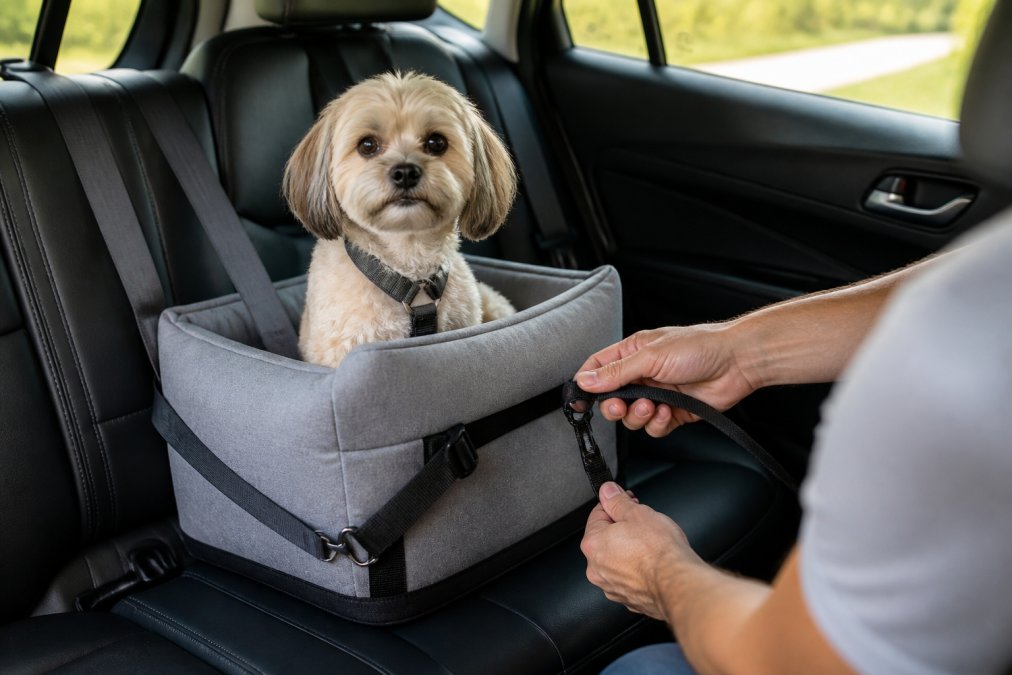
Securing a booster seat comes down to three things: a stable base, a snug harness connection, and a tether length that stops your dog reaching the front seat.
Why Vehicle Type Changes the Install
Most guides treat every back seat the same. They are not. Seat belt geometry, where the buckle stalk sits, how the belt retracts, and whether the seat is a bench, split, or captain's chair, determines whether a booster seat stays put.
- Sedans and hatchbacks. The buckle stalk is usually short and recessed into the seat cushion. A booster with a narrow base sits flat, but a wide base can cover the buckle and force you to twist the belt.
- SUVs and crossovers. Many have a 60/40 split bench with a center buckle that floats on a flexible stalk. A booster placed in the center can shift because the stalk moves; the outboard positions are usually more stable.
- Trucks. Rear seats are often narrower with a shallow cushion and a belt that comes from the cab wall rather than the seat. A booster with a hard bottom and a low profile fits better than a tall, padded bucket.
- Captain's chairs (minivans, some SUVs). These have no bench to brace against, so a booster must rely entirely on the seat belt path and its own non-slip base. A tether to the seat's LATCH-style anchor, if one is available, adds stability.
Step-by-Step Install
- Place the seat or cover on the back seat and press down to seat the non-slip base. If the cushion is contoured, check that the base does not rock.
- Route the seat belt or anchor strap through the designated seat belt path and buckle it. The belt should pass through the path, not over the top of the seat.
- Pull the belt all the way out to engage the locking retractor, then let it retract. This locks the belt so the seat cannot slide forward.
- Pull the adjustable strap until the seat no longer shifts when you push it side to side. A seat that moves more than an inch is not secure.
- Clip the tether to your dog's harness, not the collar.
- Shorten the tether so your dog can sit or lie down but cannot reach the driver's seat.
- Test it: push the seat and check the tether before every trip.
When the Seat Belt Path Does Not Fit
Some vehicles, older trucks, certain two-door cars, and seats with recessed buckles, do not give you a clean belt path. In those cases, you have three options: use a booster that anchors to the seat's built-in child seat anchors (often called LATCH-style anchors) with a strap, use a back-seat cover with a hard bottom that the belt can route over, or skip the booster and use a harness-and-tether setup that buckles directly into the seat belt.
Dog Car Seat Covers for Travel: Protection and Practicality
Good dog car seat covers for travel do two jobs: they protect your interior and they make cleanup fast. Fur, mud, drool, and accidents are part of traveling with a dog, and a cover that wipes clean or goes in the wash saves hours over a car's lifetime.
Frequently Asked Questions
What is the best dog booster car seat for small dogs?
The best option depends on your priorities. The Hard Bottom 6-in-1 Dog Back Seat Cover ($79.99) offers versatility with a waterproof mesh window and non-slip base. For orthopedic support, the Dog Bed Mat for Car Back Seat Extenders ($39.99) provides foam padding. Pair either with the 2 Pack Adjustable Dog Seat Belt ($14.51) for a complete dog car booster seat setup that keeps your small dog secure and visible.
How do I choose the right size booster seat for my small dog?
Measure your dog from the base of the tail to the front of the chest while standing, and check the weight limit. Most small dogs under 20 pounds fit standard booster seats. Look for interior dimensions that give your dog room to sit, stand, and lie down. The booster height should let your dog see out the window without blocking your rearview mirror. Adjustable straps help fit different vehicle seat shapes.
Are dog booster seats safe for car travel?
Yes, when used with a crash-tested harness and safety tether. A booster seat alone is not a restraint system. You need a pet restraint system that connects to your car's seat belt or LATCH anchors. The 2 Pack Adjustable Dog Seat Belt clips to your dog's harness and your car's seat belt buckle, preventing your dog from becoming a projectile during sudden stops. Always attach the tether to a harness, never a collar.
How do I secure a dog booster seat in a car?
Place the booster seat on the back seat, ideally in the center or behind the passenger seat. Thread the vehicle's seat belt through the booster's designated seat belt path or use LATCH anchors if available. Pull the belt tight to eliminate slack. Then attach your dog's harness to the safety tether. Check installation stability by pushing the seat side to side; it should move less than an inch for a secure fit.
What is the safest car restraint for small dogs?
A crash-tested harness paired with an adjustable seat belt tether is a safe restraint for small dogs. The 2 Pack Adjustable Dog Seat Belt is made from 2.5cm wide high-strength nylon with sturdy metal clips and adjusts from 16.5 to 27.6 inches. It connects to your dog's harness and your car's seat belt buckle, keeping your dog contained and reducing distraction while allowing comfortable movement.
Traveling with a small dog should not mean choosing between a clean car and a safe one. At Paw Fit Gears, we built our travel lineup around that exact problem, from the waterproof, non-slip Hard Bottom 6-in-1 Dog Back Seat Cover to the adjustable 2 Pack Dog Seat Belt that keeps your dog harnessed and secure. Explore the full Paw Fit Gears collection and find gear that protects your interior and your pet on every drive.