

Table of Contents
- Quick Comparison: Best Comfortable Harnesses for Anxious Dogs
- What Makes a Harness Comfortable for Anxious Dogs
- Front-Clip vs Back-Clip Harness for Anxiety: Which Works Best?
- Escape-Proof Dog Harness Features for Nervous Dogs
- How to Measure a Dog for a Harness (Step-by-Step)
- Desensitization Training: Helping Your Dog Accept the Harness
- Top Picks from Paw Fit Gears
- Conclusion
- Frequently Asked Questions
Last Updated: September 12, 2026
Quick Comparison: Best Comfortable Harnesses for Anxious Dogs
Finding comfortable harnesses for anxious dogs starts with understanding what "comfortable" actually means for a nervous animal. It is not just soft fabric. It is a combination of fit, padding, weight distribution, and how the gear interacts with your dog's body language on a walk.
This guide from Paw Fit Gears breaks down the features that matter, how to measure your dog correctly, and which harness designs reduce stress instead of adding to it. Below, we compare two harnesses built for anxious dogs and explain exactly how to help your dog accept one.
| Feature | No-Pull Harness with 2 Leash Clips | No-Pull Front-Clip Heavy Duty Harness |
|---|---|---|
| Price | $27.09 | $36.48 |
| Leash attachment | Chest and back clips | Front and back metal clips |
| Padding | Soft padding and breathable mesh | No-rip nylon with padding |
| Adjustment points | 4 straps | 4 points |
| Reflective strips | Yes | Yes |
| Control handle | Built-in | Heavy-duty |
| Best for | Anxious dogs new to harnesses | Strong pullers who need extra control |
What Makes a Harness Comfortable for Anxious Dogs
A harness is comfortable for an anxious dog when it distributes pressure across the chest instead of the throat, stays snug without pinching, and does not rub against sensitive skin. Fit matters more than any single feature.

Padding, Breathable Mesh, and Sensory-Friendly Materials
Anxious dogs often have heightened tactile sensitivity, so the material touching their skin matters. Breathable mesh keeps air moving and reduces heat buildup, which matters on longer walks. Padding around the chest plate and under the front legs prevents the chafing that turns a nervous dog off harnesses entirely.
A common mistake is buying a harness that fits in the store but rubs after twenty minutes of movement. Check the armpit area and the chest plate first. Those are the two spots where friction shows up fastest.
Front-Clip vs Back-Clip Harness for Anxiety: Which Works Best?
Most guides answer this question with a single rule: front clip for pullers, back clip for calm walkers. That rule is correct but incomplete, because it ignores why your dog is anxious. The right attachment point depends on the anxiety trigger, not just on whether your dog pulls.
Match the Clip to the Trigger
Reactivity (lunging or barking at other dogs, people, or bikes). Front clip. When a reactive dog lunges, a front-clip leash redirects the forward momentum sideways and turns the dog's body back toward you. That interrupts the lunge before it becomes a full-throttle pull, and it does so without adding pressure to the throat, which can amplify a fear response.
Separation anxiety or general nervousness on walks. Back clip, paired with a front clip for backup. A dog that is anxious but not reactive does not need redirection, it needs to feel unencumbered. A back clip keeps the leash out of the dog's line of sight, which matters for dogs that startle at movement near their face. Keep the front clip available for the moment a trigger appears.
Fear of loud noises (traffic, construction, thunder). Front clip with a short traffic handle. When a noise-spooked dog bolts, a front clip gives you leverage to stop the bolt without a hard jerk. A traffic handle near the chest lets you hold the dog close to your body while you move away from the noise source.
Head-shy or handling-sensitive dogs. Whichever clip lets you avoid reaching over the head. For most of these dogs that means a step-in or back-clip design, because the leash clips behind the shoulders rather than near the neck.
The Biomechanics Behind the Rule
A back-clip harness puts the leash attachment over the strongest part of the dog's body, the shoulders and back (akc.org). When a dog pulls against a back clip, it leans into the pressure and pulls harder. That is why back-clip harnesses can increase pulling in a dog that already lunges.
A front-clip harness puts the attachment at the chest, ahead of the dog's center of gravity. When the dog moves forward, the leash tension rotates the dog's front end sideways. The dog cannot pull straight ahead without turning itself. This is a mechanical redirection, not a training correction, which is why it works on anxious dogs that would shut down under a leash pop.
Why Many Anxious Dogs Need Both
A harness with both a front and a back attachment point lets you switch without changing gear. Use the front clip on training walks and around known triggers. Switch to the back clip on quiet, low-stress routes once your dog is relaxed. This is not indecision, it is matching the tool to the moment, and it is the setup most behavior-focused trainers recommend for nervous dogs.
Escape-Proof Dog Harness Features for Nervous Dogs
An escape-proof dog harness is one your dog cannot back out of when startled. For anxious dogs, this is not a nice-to-have. A dog that slips a harness during a panic moment is a dog running loose near traffic.
The reason most harnesses fail is mechanical, not material. When a dog plants its front paws and reverses, its ribcage compresses and its shoulders narrow. A harness with only two adjustment points cannot follow that compression, so the neck opening widens and the dog slides backward out of it. Escape-proof design is really about eliminating that widening neck opening.
The Four Features That Actually Prevent Backing Out
A third belly strap (sometimes called a third-point or anti-escape strap). This is the single most effective feature. A strap that runs behind the ribcage closes the loop a dog would otherwise back through. Without it, a determined dog can slip almost any two-strap harness.
Four or more adjustment points. Two points (neck and chest) fit one body shape. Four points let you tighten the ribcage independently of the neck, which is what stops the compression-and-reverse escape.
A snug ribcage fit, not a snug neck fit. Owners instinctively tighten the neck strap. That is the wrong move, it creates pressure on the throat and still leaves the ribcage loose enough to slip. The ribcage strap should sit snug enough that you can fit two fingers flat under it, no more.
Locking metal buckles, not plastic side-release snaps. Plastic snaps can pop open under a hard lunge or when a dog rolls. Metal buckles with a locking mechanism stay closed. Check that the D-ring is welded, not just bent wire, a bent-wire D-ring can straighten under load.
Three-Point Security and Reinforced D-Rings
Three-point security means the harness contacts the dog at the chest, the shoulders, and the back of the ribcage, so no single point of pressure can be exploited. Reinforced D-rings at the leash attachment points prevent the metal from bending or pulling free under a hard yank.
The No-Pull Dog Harness with 2 Leash Clips from Paw Fit Gears uses dual attachment points and four adjustment straps to hold this kind of secure fit, which makes it a solid pick for dogs that have slipped out of lesser harnesses.
American Kennel Club guide to choosing a dog harness
How to Measure a Dog for a Harness (Step-by-Step)
Measuring a dog for a harness takes about two minutes and requires only a soft measuring tape. Measure the widest part of the ribcage, just behind the front legs, then measure the neck and chest length.
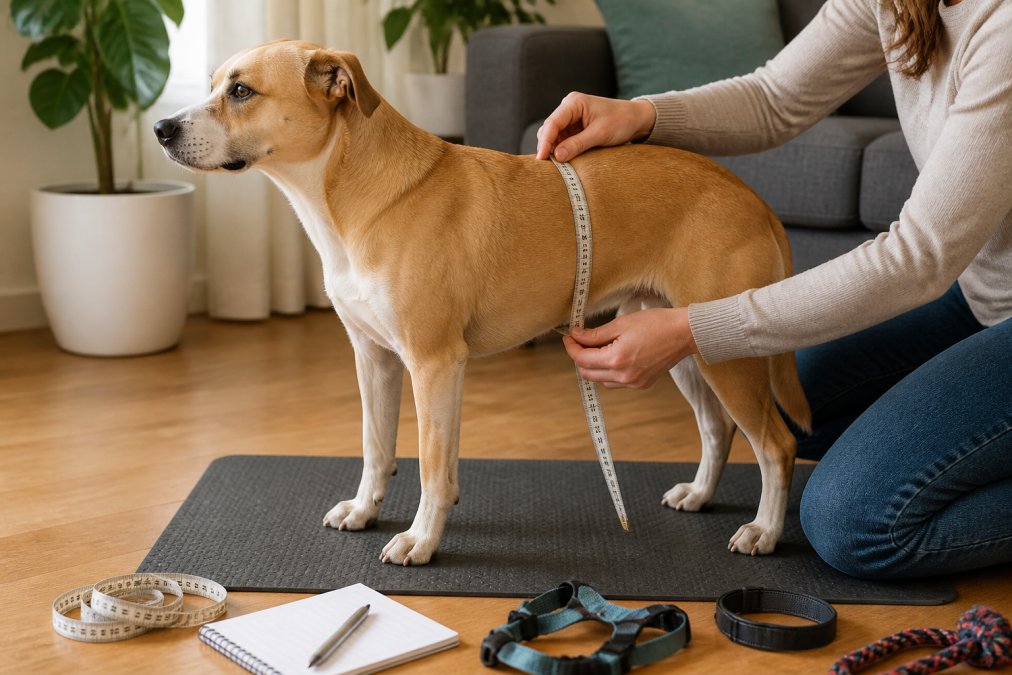
- Stand your dog on a level surface and keep them still with a treat.
- Wrap the tape around the widest part of the ribcage, behind the front legs.
- Record that number as the girth measurement.
- Measure from the base of the neck to the base of the ribcage for chest length.
- Compare both numbers against the harness sizing chart, not your dog's weight.
- Re-measure after fitting, since padded harnesses sit differently than tape alone.
If your dog sits between two sizes, size up and use the adjustment straps to tighten. A harness that is slightly too large can be adjusted. One that is too small cannot.
Desensitization Training: Helping Your Dog Accept the Harness
Desensitization training means introducing the harness slowly, in short sessions, before you ever clip a leash to it. Most anxious dogs do not hate the harness itself. They hate the sudden overhead motion of putting it on.
Here is a protocol that works:
- Session 1: Leave the harness on the floor near your dog's bed. Reward any sniffing.
- Session 2: Touch the harness to your dog's back for one second, then treat.
- Session 3: Slide the harness over the head without buckling, then remove and treat.
- Session 4: Buckle the chest strap only, treat, then unbuckle.
- Session 5: Fully buckle the harness, treat, and remove after ten seconds.
- Session 6: Buckle the harness and clip a light leash. Walk three steps indoors.
- Session 7: Take the first real walk.
Pair every step with positive reinforcement, and never rush a step your dog is not ready for. If your dog freezes or backs away, drop back one step and repeat it.
Top Picks from Paw Fit Gears
Both harnesses below are built for anxious dogs that need secure, padded gear. The right choice depends on how much control you need on a walk.
No-Pull Dog Harness with 2 Leash Clips - Adjustable, Reflective, Padded Vest
This is the best harness for anxious dogs that are new to wearing gear. The soft padding and breathable mesh keep it comfortable for long walks, and the four adjustment straps let you dial in a snug fit that will not shift.
The dual leash clips give you options. Use the chest clip for training walks where your dog pulls, and the back clip for relaxed walks once they settle. The built-in control handle helps you steady your dog near triggers without grabbing the leash.
At $27.09, it is the more affordable of the two, and the lighter build suits dogs that are still getting used to a harness. The one drawback: the padding is softer, so a determined chewer could wear through it faster than a heavier build.
No-Pull Dog Harness - Front Clip, Reflective, Heavy Duty with Handle
For strong pullers that need maximum control, this heavy-duty harness is the better pick. The front chest clip redirects forward motion, and the two metal leash clips give you a training setup on the front and a casual setup on the back.

The no-rip nylon and padding handle daily wear well, and the heavy-duty handle gives you a firm grip for lifting or steadying your dog in busy areas. Reflective strips keep your dog visible on low-light walks, which matters if your anxious dog is calmer in the early morning or evening.
At $36.48, it costs more than the padded vest, but the heavier build suits large, strong dogs that have destroyed lighter harnesses. The tradeoff is weight. On a small or senior dog, the extra material can feel bulky.
ASPCA guide to dog anxiety and stress signals
Conclusion
Getting the gear right is only half the work. The other half is helping your dog feel safe in it, and that takes patience, the right fit, and a harness that does not fight back.
Paw Fit Gears builds harnesses with padded chest plates, breathable mesh, four-point adjustability, and dual leash clips, so you can find a fit that works for a nervous dog instead of against them. If your dog is new to harnesses, start with the padded 2-clip vest. If your dog is strong and needs firm control, the heavy-duty front-clip harness is the better match.
Get started with Paw Fit Gears and give your anxious dog a walk that feels calm, secure, and comfortable from the first step.
Frequently Asked Questions
What type of harness is best for a fearful dog?
A padded, escape-proof harness with a front-clip attachment works best for fearful dogs. The front-clip design redirects pulling without putting pressure on the throat, while breathable mesh and soft padding prevent rubbing. Look for a harness with multiple adjustment points and a snug, secure fit. Paw Fit Gears' No-Pull Dog Harness with 2 Leash Clips ($27.09) offers front and back attachment points, reflective strips, and a built-in control handle, making it a solid choice for nervous dogs.
Should I use a front-clip or back-clip harness for an anxious dog?
A front-clip harness is generally better for anxious dogs because it discourages pulling by redirecting motion sideways rather than forward. This reduces leash pressure and helps your dog stay calm. Back-clip harnesses work for dogs that do not pull, but they can encourage a dog to lean forward, which may increase anxiety. Many harnesses, like the Paw Fit Gears No-Pull Dog Harness ($36.48), offer both front and back clips so you can switch based on your dog's behavior and training progress.
How do I keep my anxious dog from backing out of their harness?
Choose an escape-proof dog harness with a three-point design that includes a chest strap and a snug fit around the girth. Adjust all straps so you can fit two fingers under the harness, no more. A harness with a belly strap or a second connection point prevents backing out. Desensitization training also helps: practice putting the harness on for short periods with treats and praise before heading outside. This builds positive associations and reduces escape attempts.
What features make a dog harness comfortable for sensitive pets?
Padding around the chest and under the front legs, breathable mesh lining, and lightweight webbing all improve comfort for sensitive dogs. Avoid rough nylon edges that can cause chafing. Adjustability at four or more points ensures a custom fit that does not restrict movement. Reflective strips add visibility for evening walks. The Paw Fit Gears No-Pull Dog Harness with 2 Leash Clips ($27.09) combines soft padding, breathable mesh, and four adjustment straps for a comfortable, secure fit.
How can I help my dog feel more secure on walks?
Start with a well-fitted, comfortable harness that does not rub or shift. Use positive reinforcement: reward calm behavior with treats and praise. Keep early walks short and in low-traffic areas. Pair the harness with a calming collar if your dog has high anxiety. The Natural Pheromone Calming Collar ($49.99) releases pheromones within one hour and lasts up to 30 days per collar, which can help your dog relax during walks and training sessions.
This article is for general informational purposes and is not a substitute for professional veterinary or behavioral advice. Consult your veterinarian or a certified behavior consultant for dogs with severe anxiety or aggression.