

Table of Contents
- Why Dog Seat Belt Harnesses Matter for Road Trips
- Crash-Tested Dog Car Harness Standards: What the Tests Actually Prove
- How to Secure a Dog in a Car: Attachment Methods and Best Practices
- Top Dog Seat Belt Harness Options for Road Trips
- Fit, Sizing, and Adjustability for Comfort on Long Drives
- Dog Car Safety Tips for Road Trips: Inspection, Breaks, and Acclimation
- Vehicle Compatibility and Installation
- Frequently Asked Questions
Last Updated: October 12, 2026
Why Dog Seat Belt Harnesses Matter for Road Trips
Every year, unrestrained dogs cause thousands of accidents. A dog sliding across the back seat during sudden braking is dangerous for everyone in the vehicle, which is where quality dog seat belt harnesses become essential.

Road trips with your dog require actual restraint equipment. Unlike neighborhood walks, highway travel exposes your dog to forces that can cause serious injury without proper protection.
The stakes are real. An unrestrained 50-pound dog in a car traveling at 30 mph experiences the impact equivalent of a 1,500-pound object in a collision.
Beyond safety, the right harness gives your dog freedom of movement, shifting position, lying down, or looking out the window without the stress of being trapped. That comfort matters on long drives, where anxiety and restlessness distract you from the road.
Crash-Tested Dog Car Harness Standards: What the Tests Actually Prove
When shopping for a crash-tested dog car harness, understanding what "crash-tested" means is critical. Many products claim safety credentials without explaining what those tests measure or their limitations.
Crash testing typically involves dropping a weighted dummy dog at various speeds and angles to measure impact force and restraint effectiveness.
What crash tests do prove: a quality harness prevents your dog from being thrown forward violently during emergency braking, and the data shows how well it absorbs impact energy.
What crash tests don't prove: comfort during normal driving, long-term wear patterns, or how your specific dog reacts to restraint.
Crash-test performance is one layer of safety; proper fit, secure attachment, and regular inspection are equally important.
How to Secure a Dog in a Car: Attachment Methods and Best Practices
How you attach your dog's restraint system directly affects how well it works in an emergency. Two methods dominate the market.
Seat-Belt Buckle Attachment
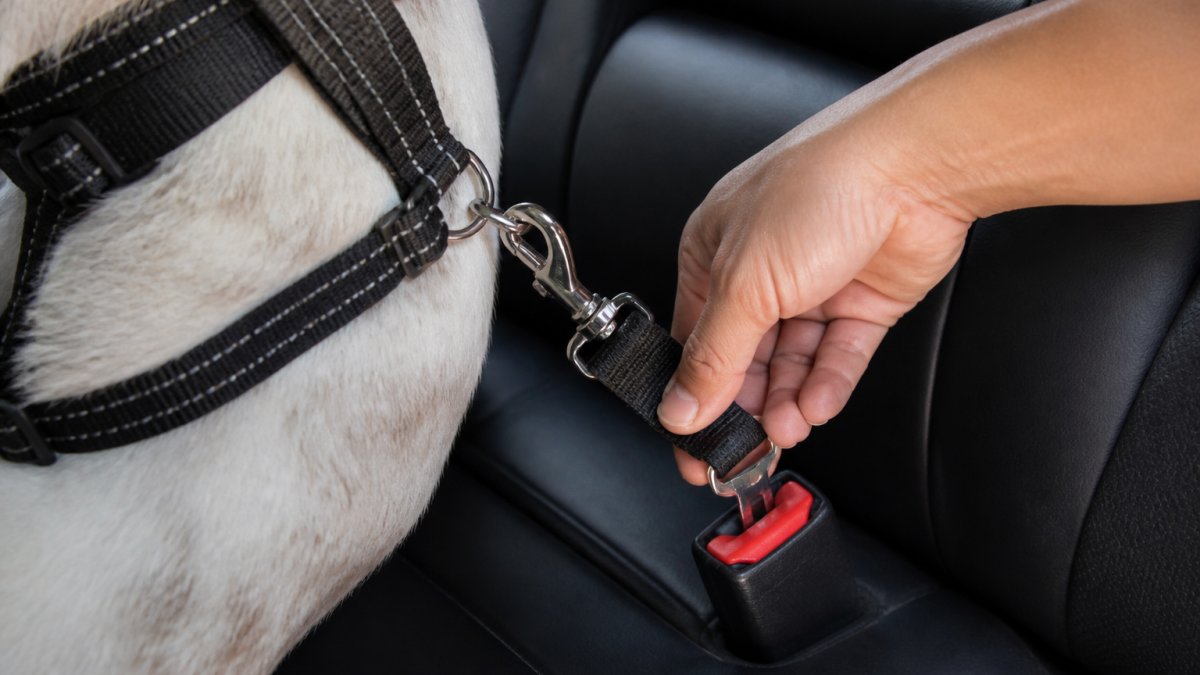
This is the most common method for road-trip travel: your dog wears a harness, and a tether or seat belt connects it to your car's existing seat belt buckle. The advantage is simplicity, no special installation, and it works in almost any vehicle.
The Paw Fit Gears 2 Pack Adjustable Dog Seat Belt for Car uses this approach with heavy-duty nylon straps and sturdy metal clips. The tether adjusts from 16.5 to 27.6 inches, and because it connects to the existing seat belt system, your dog's restraint tightens during sudden stops, just like a human seat belt.
The limitation: this method relies on your vehicle's seat belt strength. Older cars with weaker buckle systems may not hold as securely under extreme impact.
Dog Seat Belt Tether Options
Beyond basic nylon tethers, some harnesses include specialized dog seat belt tether systems with shock-absorbing materials or dual-point attachment, distributing restraint force more evenly and reducing sudden jerking.
The best tether design includes a buffer zone between the harness and the anchor point, preventing the "snatch" effect when you brake hard.
Top Dog Seat Belt Harness Options for Road Trips
2 Pack Adjustable Dog Seat Belt for Car
This is our top recommendation for most road-trip situations: clip the seat belt to your dog's harness, insert the metal buckle into your car's seat belt slot, and drive.
What stands out is the 2-pack value: multi-dog households get one restraint system per dog, eliminating constant swapping between vehicles or adjusting during stops. The high-strength nylon withstands repeated use without fraying or weakening.
The tangle-free design matters more on long drives than you'd expect, a twisted tether restricts movement and creates anxiety. This system's flat design prevents that while still letting your dog sit, stand, or lie down comfortably.
Pricing: Starting at $15.08 per 2-pack makes this the most affordable option for multi-pet households.
Best for: Budget-conscious owners, multi-dog families, and anyone who values simplicity over advanced features.
Pros:
- Universal fit across cars, SUVs, and trucks
- Adjustable length accommodates small to large dogs
- Tangle-free design prevents twisted straps
- Two-pack value for multiple pets
- Quick setup with no tools required
Cons:
- Basic design lacks shock absorption
- Relies on car's existing seat belt system strength
- No built-in padding for extra comfort
No-Pull Dog Harness with 2 Leash Clips
This harness bridges car restraint and everyday walking gear. The dual leash clips, one on the chest, one on the back, give you flexibility: use the back clip for car attachment, and the front clip to control pulling during rest-stop walks.
The padded vest distributes pressure across your dog's chest and shoulders rather than the neck, which matters for large breeds during sudden stops. Breathable mesh padding keeps your dog comfortable on multi-hour drives.
The reflective strips add a safety layer you won't think about until you're parked on a dark highway shoulder.
Pricing: $27.09 for the large size.
Best for: Owners who want one harness that works for both car travel and daily walks, particularly those with large or strong-pulling dogs.
Pros:
2 Pack Adjustable Dog Seat Belt for Car →
- Dual attachment points for versatility
- Padded design increases comfort on long drives
- Reflective strips enhance safety
- No-pull front clip helps during rest-stop walks
- Easy on/off with two buckles
Cons:
- Higher price point than basic tethers
- Vest style may feel bulky for small dogs
- Requires proper fitting for effectiveness
No-Pull Dog Harness - Front Clip, Heavy Duty with Handle
This is the premium option for serious road-trippers. Heavy-duty nylon and reinforced stitching, along with the built-in control handle, give extra grip when loading a tired or excited pet after hours of driving.
The front-clip design addresses a common problem: dogs that panic during car rides. When your dog pulls, the front clip gently redirects forward motion rather than allowing a lunge.
Quick-release buckles let you remove the harness in seconds at rest stops without fumbling with clips, relief for your dog and no wrestling with complicated fasteners for you.
Pricing: $36.48 for the large size.
Best for: Frequent travelers, large or anxious dogs, and owners who prioritize durability and control features over basic functionality.
Pros:
- Heavy-duty construction withstands extended use
- Front clip reduces pulling and panic
- Quick-release buckles for easy removal
- Built-in control handle for loading/unloading
- Multiple adjustment points for custom fit
- Reflective strips for visibility
Cons:
- Most expensive option in this comparison
- Vest design requires proper fitting
- Overkill for dogs that travel calmly
| Harness Option | Price | Best For | Key Feature | Durability |
|---|---|---|---|---|
| 2 Pack Adjustable Seat Belt | $15.08 | Budget-conscious, multi-dog households | Tangle-free design | Standard |
| No-Pull with 2 Leash Clips | $27.09 | Dual-purpose (car + walks) | Padded vest, reflective | Good |
| Heavy Duty Front Clip | $36.48 | Frequent travelers, anxious dogs | Control handle, quick-release | Excellent |
Fit, Sizing, and Adjustability for Comfort on Long Drives
The difference between a harness that works and one that causes problems comes down to fit. Too loose and your dog shifts around or slips partially out during sudden stops; too tight and it restricts breathing and causes chafing after hours of wear.
Start by measuring your dog's chest girth at the widest point, just behind the front legs. The Paw Fit Gears adjustable models accommodate a wide range thanks to multiple adjustment straps, important when your dog wears the harness 4-8 hours straight.
The fit should allow one finger to slide between the harness and your dog's body. Tighter than that and you're restricting movement. Looser than that and the harness won't provide proper restraint during impact.
For dogs with unusual body shapes, deep chests, narrow waists, short legs, adjustability is critical. Standard harnesses often don't fit, no matter the size, so look for four or more adjustment points to customize the fit.
Dog Car Safety Tips for Road Trips: Inspection, Breaks, and Acclimation
A harness that passes inspection before the trip is only half the battle. Your dog's safety during the actual drive depends on how you manage the journey.
Inspect your harness before every road trip: check for frayed stitching, weakened clips, or cracked plastic buckles, and make sure metal hardware moves freely but isn't loose.
Take breaks every 2-3 hours so your dog can stretch, urinate, and move around. These breaks also let you check harness fit, inspect for rubbing, and ensure your dog hasn't worked partially free.
Acclimate your dog to the harness before the trip: short periods around the house, then short car rides to the park.
Never leave your dog unattended in the car while wearing a harness.
Vehicle Compatibility and Installation
Not all vehicles accommodate restraint systems equally. Understanding your car's seat belt system before buying prevents frustration on the road.
Standard seat belt buckles in most cars, SUVs, and trucks work with tether-style attachments.
Older vehicles with lap-belt-only systems (no shoulder belt) may not provide enough restraint force during impact.
Newer vehicles with advanced seat belt tensioners are ideal for pet restraints: they tighten during sudden deceleration.
Test your attachment system before the trip. Clip the harness to your dog while parked and simulate a sudden stop by pulling gently, your dog should be held firmly without choking or being yanked.
Road trips with your dog don't have to mean constant worry.
Frequently Asked Questions
What is the safest way to secure a dog in a car during a road trip?
The safest method uses a crash-tested dog car harness attached to your vehicle's seat belt system via a tether. The harness clips to your dog's body (never to a collar alone, which risks neck injury), and the tether connects to the seat belt buckle. This dual-point restraint keeps your dog stable during sudden stops or impacts. Always position your dog in the back seat, away from airbags. Adjust the harness so your dog can sit, stand, or lie down but cannot reach the front seat or jump between seats.
Are dog seat belt harnesses safe for road trips, and what crash-test standards should I look for?
Quality dog seat belt harnesses reduce injury risk significantly, but no federal safety standard mandates crash testing for pet restraints. Look for products tested by independent third parties or manufacturers who publish impact-performance data. Crash tests measure how well a harness prevents forward motion and distributes force during a 30-40 mph impact. A tested harness won't guarantee zero injury, but it dramatically improves outcomes compared to unrestrained travel. Always verify that the tether hardware is rated for your dog's weight.
Can I attach a dog seat belt to a regular walking harness, or do I need a car-specific harness?
You can attach a dog seat belt tether to most standard walking harnesses, provided the harness has sturdy attachment points and the hardware is rated for your dog's weight. If using a walking harness, inspect the stitching and metal D-rings regularly, as walking harnesses aren't built to withstand crash-level stress.
How do I choose the right size dog car harness for a comfortable fit on long drives?
Measure your dog's chest girth (around the widest point behind the front legs) and weight, then compare to the harness sizing chart. A proper fit allows one finger to slide under the straps without bunching the material. For road trips, choose a harness with four or more adjustment points so you can fine-tune the fit as your dog shifts positions. Padded or breathable harnesses prevent rubbing during multi-hour trips. Test the harness on shorter drives first to confirm your dog moves comfortably without chafing before committing to a long journey.
What dog car safety tips should I follow for road trips beyond just using a harness?
Inspect your harness and tether before every trip for tears, loose stitching, or corroded hardware. Take breaks every 2-3 hours to let your dog stretch, hydrate, and relieve themselves. Never leave your dog unattended in the car, even with the windows down. Acclimate your dog to the harness and car environment with short practice drives before a long trip. Keep the car temperature comfortable and provide water access. Position your dog in the back seat, and if your dog has anxiety, consult your veterinarian about calming strategies before traveling.