

Table of Contents
- How Dog Car Seat Belts Work With Harnesses
- Step 1: Fit Your Dog's Harness Correctly
- Step 2: Attach the Tether and Buckle In
- Step 3: Set the Right Tension and Mobility Range
- Crash-Tested Dog Harnesses: Why the Label Matters
- Dog Car Safety Standards: What to Look For
- Dog Car Seat Covers for Travel: Pairing Protection With Restraint
- Common Mistakes to Avoid
- Frequently Asked Questions
Last Updated: September 23, 2026
How Dog Car Seat Belts Work With Harnesses
Dog car seat belts work by connecting a dog's harness to the vehicle's seat belt system, creating a secure anchor point that limits movement during sudden stops. The setup is simpler than most people expect. This guide walks through every step, from fitting the harness to setting the right tether length. Below, we'll show you exactly how to secure your dog for any trip.
What You'll Need Before You Start
Gather these items before you begin:
- A dog harness with a back D-ring
- A dog seat belt tether with a carabiner clip
- Your vehicle's seat belt buckle
- A treat pouch for positive reinforcement
Check that your harness fits snugly but allows full shoulder movement. The D-ring should sit on your dog's back, not the chest.

Step 1: Fit Your Dog's Harness Correctly
A loose harness defeats the entire restraint system. The harness must sit tight against your dog's body so impact force spreads across the chest and shoulders, not the neck.
Follow these fitting steps:
- Place the harness over your dog's head or step-in style, depending on the design.
- Adjust the four straps so two fingers fit under each one.
- Check that the back D-ring sits centered between the shoulder blades.
- Test the fit by gently tugging upward on the D-ring.
Step 2: Attach the Tether and Buckle In
Attaching the tether takes seconds once the harness is on. Clip the carabiner to the back D-ring, then insert the seat belt buckle into the car's receiver until it clicks.
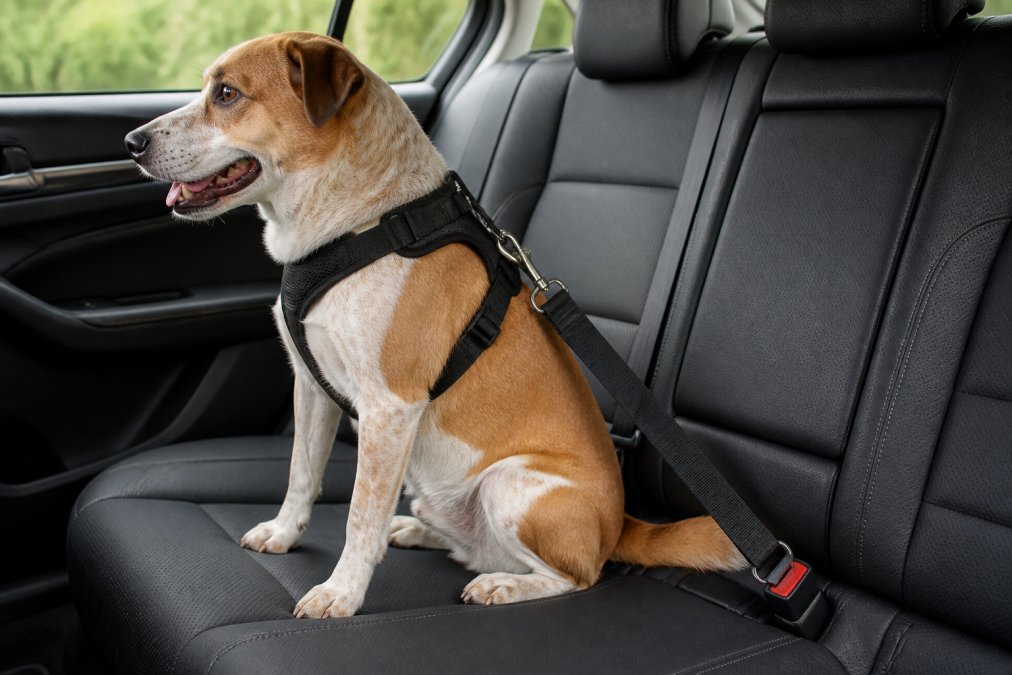
Before you buckle: check your vehicle's receiver
Most guides assume every seat belt buckle is a flat, open slot. Many are not. Modern vehicles increasingly use recessed receivers set into a molded plastic well, and some use a rigid buckle stalk that sits at an angle. A standard tether tongue may not seat fully in these receivers, or it may click but sit loose enough to release under load.
Walk through this check before your first drive:
- Look at the receiver. If the buckle slot is recessed more than about half an inch into a plastic well, a thick tether tongue may not fully engage.
- Test the click. Insert the tether tongue and pull up firmly. If it releases with light pressure, the receiver and tongue are not compatible.
- Check the stalk angle. A rigid stalk that angles forward or sideways can put the tether under constant tension, which wears the webbing.
- Try a different seating position. Second-row outboard seats usually have the most accessible receivers. Third-row and center seats are the most likely to be recessed or buried under a fold-down armrest.
Acclimate your dog to the tether before you drive
A dog that has never been tethered will often panic the first time the tether stops them from moving. That panic is a bigger safety risk than the tether itself, because a struggling dog can twist the webbing or back out of a loose harness.
A short acclimation sequence most trainers use:
- With the car parked and off, clip the tether to the harness and let your dog wear it for two or three minutes. Feed treats. Unclip.
- Repeat once a day for three to five days, extending to five minutes.
- Start the engine with the dog tethered but the car in park. Treats. Engine off. Unclip.
- Do a single loop around the block. Treats at the end.
- Build to normal trips.
Step 3: Set the Right Tension and Mobility Range
The right tether length lets your dog sit or lie down but stops them from reaching the front seat. Adjust the strap so your dog has enough room to be comfortable but not enough to climb into your lap.
Use this quick reference:
| Tether Length | Dog Size | Mobility Allowed |
|---|---|---|
| Short (16-18 in) | Small dogs | Sit and lie down only |
| Medium (19-23 in) | Medium dogs | Sit, stand, lie down |
| Long (24-28 in) | Large dogs | Full range in back seat |
Crash-Tested Dog Harnesses: Why the Label Matters
A dog harness designed for car safety should hold a dog in place under impact force. Not every harness sold as "safety gear" has been rigorously tested. Look for these markers:


- A specific test speed and dog weight range on the label
- A named testing facility or standard
- A load-bearing D-ring, not a plastic loop
Dog Car Safety Standards: What to Look For
Pet restraints are not covered by a single federal safety standard the way child seats are. The National Highway Traffic Safety Administration (NHTSA) regulates child restraint systems under Federal Motor Vehicle Safety Standard 213, but there is no equivalent FMVSS for dog harnesses or tethers. That means the label, not the government, is your main guide, and you have to know what a credible label actually claims.
What a real crash-test claim includes
A meaningful crash-test claim names four things. If any are missing, treat the claim as marketing:
- The test speed. Independent pet-restraint testing typically runs a simulated frontal crash at 30 mph. A label that says "crash tested" without a speed is not verifiable.
- The dog weight range tested. A harness validated for a 25 lb dog is not validated for a 75 lb dog, even if it is the same model in a larger size.
- The test dummy used. Look for a weighted, instrumented canine dummy rather than a sandbag or a stuffed form.
- The testing body. Either an independent lab or a named standard. The Center for Pet Safety publishes its own crash-test protocol and results for pet travel products, and it is the reference most manufacturers cite when they want third-party validation.
The federal angle that does apply
Two federal agencies touch this category even without a pet-specific standard:
- The U.S. Consumer Product Safety Commission (CPSC) tracks recalls and safety alerts on pet products, including travel gear. Before you buy a new harness or tether, search the CPSC recall database for the brand and model.
- NHTSA publishes guidance on securing pets in vehicles and on airbag risk. NHTSA's position is that an unrestrained pet becomes a projectile in a crash, and that pets should never ride in the front seat of a vehicle with an active passenger airbag.
Post-accident replacement: the rule nobody publishes
Human car seats carry an explicit replacement rule: after any moderate or severe crash, the seat is replaced, even if it looks fine. Dog harnesses and tethers have no such mandated rule, but the same physics applies. Nylon webbing stretches and weakens at the stitch points under a single high-load event, and metal clips can deform without visible cracks.
A reasonable working rule most safety-focused owners follow:
- After any collision where the airbags deployed or the vehicle was towed, replace both the harness and the tether.
- After a hard stop where the dog was thrown against the tether but no collision occurred, inspect the webbing at every stitch line and the carabiner gate. If the webbing is stretched, fuzzy, or the clip does not snap shut cleanly, replace it.
- Never reuse a tether that was involved in a crash on a different dog or in a different vehicle, you have no way to know its remaining strength.
How to verify before you buy
- Check the manufacturer's site for a downloadable test report, not just a badge image.
- Confirm the tested weight range brackets your dog's actual weight, not the size chart's range.
- Cross-check the brand against the CPSC recall list.
- If the product page says "crash tested" and nothing else, assume it was not independently tested.
Dog Car Seat Covers for Travel: Pairing Protection With Restraint
Dog car seat covers for travel protect your seats from dirt, hair, and scratches, but they don't restrain your dog on their own. The cover and the seat belt tether work as a pair: one protects the car, the other protects the dog.
Here's how to pair them:
- Install the seat cover first and secure the anchors.
- Fit your dog's harness.
- Clip the tether to the harness D-ring.
- Buckle the tether into the seat belt receiver.
Common Mistakes to Avoid
Most restraint failures come down to a few repeat errors. Watch for these:
- Clipping to a collar instead of a harness. This puts deadly pressure on the throat.
- Leaving too much slack. A long tether lets your dog reach the front seat or get tangled.
- Skipping the harness fit check. A loose harness can let your dog slip out during braking.
- Using a worn tether. Check the nylon webbing and clips for fraying or bent metal each month.
- Skipping behavioral training. A dog that panics in the car needs slow, treat-based practice before longer trips.
Frequently Asked Questions
How do dog seatbelt harnesses work?
A dog seat belt harness works by connecting two points: the harness on your dog and the seat belt buckle in your car. The harness distributes force across your dog's chest and shoulders, while a tether with a carabiner clip attaches to the harness D-ring and clicks into the seat belt buckle. This setup limits your dog's mobility range during sudden stops, keeping them from launching forward or distracting you while driving.
Can I use my dog's existing harness with a seatbelt?
You can, but check the harness construction first. A daily walking harness with thin nylon webbing and plastic buckles may not be suitable for car safety. Look for a harness with wide, load-bearing straps, metal hardware, and a reinforced D-ring. Paw Fit Gears' No-Pull Dog Harness has dual leash clips, four adjustment straps, and padded mesh, making it a suitable option for car rides when paired with a seat belt tether.
What is the difference between a seat belt tether and a crash-tested harness?
A seat belt tether is the connecting strap that links your dog's harness to the car's seat belt buckle. A harness designed for car safety is the body gear your dog wears, and it should be robust enough to hold up under impact. The tether alone does not protect your dog; it only restrains them. For optimal impact protection, you need both a well-designed harness and a properly attached tether working together.
Should I use a collar or a harness with a dog seat belt?
Always use a harness, never a collar. A collar concentrates force on your dog's neck during a sudden stop, which can cause serious injury to the trachea or cervical spine. A harness spreads that force across the chest and shoulders. The 2 Pack Adjustable Dog Seat Belt from Paw Fit Gears is designed to clip directly to a harness D-ring, not a collar, so your dog stays secure without neck pressure.
Traveling with a dog takes the right gear and a little patience. Paw Fit Gears builds harnesses, seat belts, and seat covers designed to keep your pet safe and your car clean on every trip. Our adjustable seat belt fits most vehicles, and our no-pull harness gives you a secure anchor point for the tether. Get started with Paw Fit Gears and make every drive safer for your dog.