

Table of Contents
- Reflective vs LED Dog Collars: How They Actually Work
- Reflective Dog Collar vs LED Collar: Side-by-Side Comparison
- Nighttime Dog Walking Safety Tips for Every Environment
- How to Keep Your Dog Visible at Night: Distance, Coat Type, and Conditions
- Best Light-Up Dog Collars and Hybrid Visibility Options
- Durability, Battery Life, and Weather Resistance Compared
- Conclusion
- Frequently Asked Questions
Last Updated: September 26, 2026
Reflective vs LED Dog Collars: How They Actually Work
Night walks put your dog in the path of drivers who may not see them until it's too late. A reflective dog collar vs LED collar for night walks comes down to two visibility systems: one bounces light back at its source, the other generates its own. This guide from Paw Fit Gears breaks down how each works, what it costs in battery life and durability, and which setup fits your walking environment.
Passive Reflection: How Reflective Material Bounces Light Back
Reflective material returns light directly to its source. Tiny glass beads or prismatic micro-structures embedded in the fabric catch a beam, such as a car's low beams, and send it straight back toward the driver. That's why reflective gear looks dull in daylight and blazes when headlights hit it.
- Entrance angle. Retroreflective tape is brightest when the light hits it close to straight-on and the driver's eyes are near the beam's axis. As the angle between the headlights and the driver's line of sight widens, the return dims. That's why a collar facing sideways to an oncoming car can look almost black even though the tape is rated highly.
- Beam height and aim. Low beams throw light lower and closer to the road than high beams, so gear mounted low on a small dog may catch less of the beam than gear on a taller dog's chest or shoulders.
- Surface condition. Mud, road salt film, and heavy rain scatter the return. A reflective strip that's caked in grime behaves like plain nylon.
Active Illumination: What LED Diodes Add to the Equation
An LED collar carries its own light. A small rechargeable battery powers LED diodes that glow steadily or flash, making your dog visible from the side, from behind, and to pedestrians with no headlights involved.
Why the Two Systems Aren't Mutually Exclusive
Most comparison articles frame this as a binary choice. In practice, the two systems fail in opposite conditions, which is why layering them works:
| Condition | Reflective Only | LED Only | Both |
|---|---|---|---|
| Car headlights aimed at dog | Strong | Strong | Strong |
| No headlights (sidewalk, trail) | None | Strong | Strong |
| Battery dead or forgotten | Strong | None | Strong |
| Rain, fog, or heavy grime | Weakened | Depends on sealing | Weakened but covered |
| Driver approaching from behind | Weak (angle) | Depends on LED placement | Strong |
Reflective Dog Collar vs LED Collar: Side-by-Side Comparison
The short answer: reflective gear wins on reliability because it never needs charging, while LED collars win on standalone visibility because they glow without any external light source. Most safety-conscious owners use both.
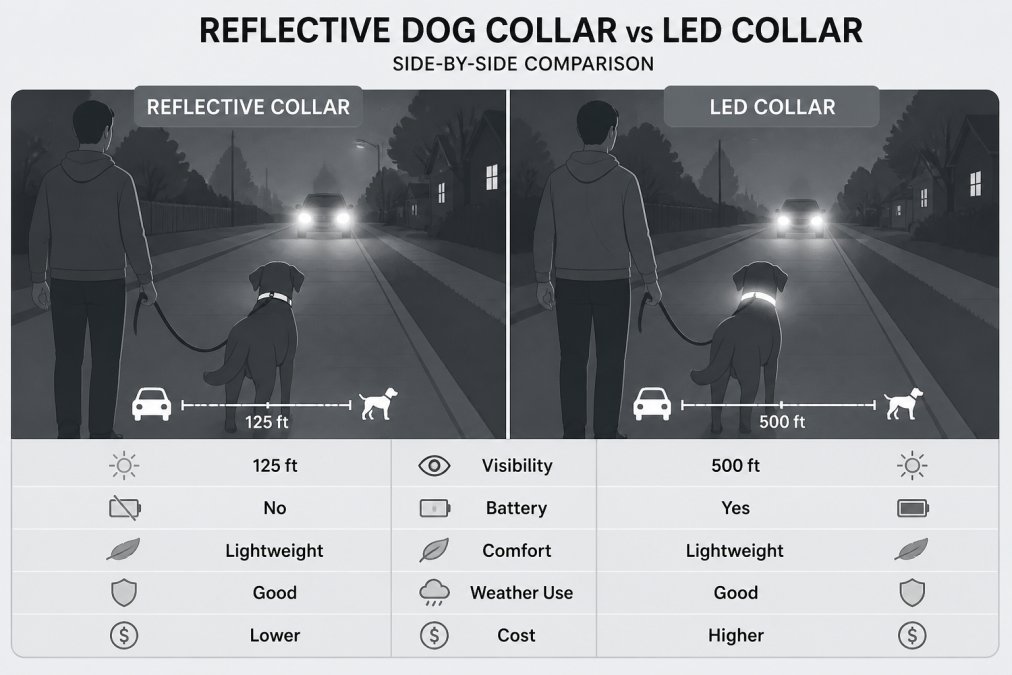
| Feature | Reflective Collar | LED Collar |
|---|---|---|
| Light source | Bounces back external light | Emits its own light |
| Works without headlights | No | Yes |
| Power needed | None | Rechargeable battery |
| Visibility range | Depends on beam angle | Consistent in all directions |
| Best conditions | Streets with traffic | Sidewalks, trails, dusk and dawn |
Neither option covers every scenario alone.
Nighttime Dog Walking Safety Tips for Every Environment
Nighttime dog walking safety tips start with one rule: assume you are invisible until proven otherwise. Drivers' reaction time drops in low light, and a dog at the end of a leash is a small, fast target.
A few habits that consistently reduce risk:
- Walk facing traffic so you can see approaching vehicles and step aside.
- Cross only at lit intersections, never mid-block on a dark stretch.
- Keep your dog on a short leash near roads, even if they're reliable off-leash elsewhere.
- Add a light to your own body, not just your dog. Drivers see you first, then the dog.
- Stick to familiar routes where you know the sidewalk and driveway hazards.
How to Keep Your Dog Visible at Night: Distance, Coat Type, and Conditions
How to keep your dog visible at night depends on three variables most owners never think about: how far away drivers need to spot your dog, your dog's coat color, and the weather.
Distance: How Far Is Far Enough?
There's no single published number for how far a driver can see a reflective collar versus an LED collar, because it depends on beam aim, tape grade, LED brightness, and ambient light. But a driver at typical residential speeds needs several seconds of reaction time to slow or stop, which translates to tens of feet. If your dog only becomes visible in the last car length or two, the driver has already run out of time.
Coat Type and Breed: Where Gear Actually Shows
Dark-coated dogs, black Labs and dark Shepherds especially, blend into shadows in a way light-coated dogs don't. Their silhouette disappears long before a driver registers a shape, making active illumination close to essential.
Breed-specific placement matters more than most guides admit:
No-Pull Dog Harness with 2 Leash Clips →
- Double-coated and long-haired breeds (Huskies, Malamutes, Collies, Samoyeds): a collar can disappear entirely under the ruff. Move visibility to a harness with reflective chest straps, or to a leash with reflective tape that stays outside the coat.
- Short-coated breeds (Boxers, Beagles, Greyhounds, most terriers): a collar reads clearly, and a full-circumference LED collar is often enough on its own.
- Dark short-coated breeds (black Labs, black and tan Shepherds): the highest-risk combination. Pair a bright LED collar with a reflective harness so the dog has both an active glow and a passive backup.
- Small breeds and puppies: gear sits low to the ground, where headlight beams may not reach. A clip light on the harness or leash, positioned higher, often outperforms a collar alone.
Conditions: Rain, Fog, Dusk, and Dawn
Rain and fog scatter light and cut visibility distance, so a steady glow beats a flashing one in poor conditions. Wet roads also throw glare back at drivers, washing out a weak reflective return even as a bright LED stands out more.

A Simple Decision Framework
Match the setup to where you actually walk:
| Walking environment | Recommended setup |
|---|---|
| Busy streets with traffic | Reflective harness + steady LED collar |
| Quiet sidewalks, no traffic | LED collar or clip light |
| Trails, parks, off-leash areas | LED collar + reflective leash |
| Rain or fog | Steady LED + reflective backup |
| Dusk or dawn | LED primary, reflective secondary |
The through-line: reflective gear is your baseline because it never needs charging, and LED gear is your active layer for conditions reflection can't reach. Choose based on environment, not on which sounds better in a product listing.
Best Light-Up Dog Collars and Hybrid Visibility Options
The best light-up dog collars pair active illumination with reflective backup, so you're covered whether the battery is charged or not. That hybrid approach is what most experienced night walkers land on.
Durability, Battery Life, and Weather Resistance Compared
Battery life is where LED collars earn or lose their place in your rotation. Most rechargeable LED collars run several hours on steady glow and longer on flashing, then recharge over USB. A common routine is to plug the collar in after every few walks, like charging a phone.
| Concern | Reflective Gear | LED Collar |
|---|---|---|
| Charging | Never | Every few walks |
| Lifespan | Years | Battery degrades over time |
| Rain | Unaffected | Depends on sealing |
| Failure mode | Wears out slowly | Dies without warning |
Conclusion
The real challenge with night walks isn't choosing between reflective and LED. It's building a setup where your dog stays visible even when one system fails. Paw Fit Gears designs gear with that redundancy in mind, from reflective harnesses with no-pull control to leashes with reflective nylon tape. Get started with Paw Fit Gears and give your dog gear built for safety on every walk, day or night.
Frequently Asked Questions
What is the best dog collar for nighttime use?
The best choice depends on your walking environment. Reflective collars work well on lit streets where car headlights can hit the reflective material and bounce light back to drivers. LED collars produce their own light, so they stay visible even on unlit paths where no external light source exists. Many owners pair both: a reflective collar for passive backup and an LED collar for active illumination. If your route mixes lit and unlit areas, a hybrid setup gives you the most consistent nighttime visibility.
Do LED dog collars provide enough visibility for cars to see them?
LED collars emit their own light, which makes them visible to drivers even when no headlights are pointed directly at the dog. However, visibility distance depends on the LED brightness and the driver's reaction time. On roads with speed limits above 35 mph, a driver needs more advance warning, so an LED collar alone may not be enough. Combining an LED collar with reflective strips on a harness or leash increases the total visible surface area and gives drivers more time to react.
Are reflective collars good for dogs?
Reflective collars are lightweight, require no batteries, and never run out of power. They rely on external light sources like car headlights or street lamps to create that bright bounce-back effect. The main limitation is that they only work when light hits them at the right angle. On a completely dark trail with no ambient light, a reflective collar stays invisible until a light source shines on it. For dogs who walk mostly on lit streets, a reflective collar is a simple, reliable choice.
What is the best light for walking a dog at night?
The best light setup combines active and passive visibility. An LED collar or clip-on light provides active illumination that drivers can see from a distance. Reflective piping on a harness or leash adds passive reflection that catches headlights. A flashlight or headlamp for the handler also helps illuminate the path and makes the dog-handler pair more noticeable. For dogs under 50 lbs, a reflective retractable leash paired with an LED collar covers both active and passive visibility needs.
How does dog coat type affect collar visibility at night?
Dark-coated dogs like black Labs or Rottweilers absorb light and blend into shadows, making them harder to see at night. Light-colored dogs reflect more ambient light naturally but still need added visibility gear. For dark-coated breeds, an LED collar with a steady glow or flashing mode provides the strongest contrast against the coat. For fluffy or double-coated breeds, make sure the collar sits high enough on the neck that fur does not cover the light source or reflective strips.