

Table of Contents
- What Makes a Leash Chew-Proof for Puppies
- Best Leash Material for Teething Puppies
- Top Durable Dog Leash Options for Chewers
- Safety Features for Heavy-Duty Leashes
- How to Stop Puppy from Biting Leash During Walks
- Puppy Leash Training Tips for Better Walks
- Frequently Asked Questions
Last Updated: September 17, 2026
What Makes a Leash Chew-Proof for Puppies
A chew-proof leash resists a puppy's teeth through teething, roughly 12 weeks to 6 months. Three things matter: material hardness, internal reinforcement, and hardware that survives sudden tension.
- Material hardness: Teeth slide off coated cable and stiff biothane. They sink into soft nylon.
- Internal reinforcement: A braided wire or cable core keeps the leash intact even if the outer layer is punctured.
- Hardware strength: A rustproof swivel hook and locking brake hold up better than thin stamped clips.
Best Leash Material for Teething Puppies
The best leash material for teething puppies is coated stainless steel cable or biothane: both resist puncturing and don't absorb saliva like nylon. Nylon webbing is the most common choice for comfort and low cost, but the least chew-resistant of the four materials worth considering.
What Actually Determines Chew Resistance
Four properties decide whether a material survives puppy teeth:
- Surface hardness. Teeth need purchase to cut. A smooth, hard coating gives molars nothing to grab; soft, textured webbing frays at the same spot every time.
- Core continuity. A leash fails when its load-bearing layer breaks. A braided wire core keeps carrying load after the jacket is punctured; a solid nylon strap loses strength the moment a bite severs fibers.
- Coating thickness and adhesion. A thin jacket peels away and exposes bare wire; a thick, bonded jacket absorbs the bite and stays put.
- Saliva and moisture behavior. Nylon absorbs moisture, degrading fibers and holding the smell that makes some puppies chew harder. Non-porous materials wipe clean and dry fast.
Stainless Steel Cable vs. Nylon Webbing vs. Biothane vs. Leather
| Material | Chew Resistance | Comfort in Hand | Weight | Weather Behavior | Best For |
|---|---|---|---|---|---|
| Coated stainless steel cable | Highest | Moderate (needs a padded handle) | Heaviest | Rustproof, unaffected by rain | Determined chewers, strong pullers |
| Biothane | High | High | Light | Waterproof, wipes clean | Wet weather, muddy trails, frequent chewers |
| Leather | Moderate to high | Very high (softens with use) | Medium | Degrades if soaked and dried repeatedly | Calm walkers whose dogs don't target the strap |
| Nylon webbing | Lowest | High | Light | Absorbs water, holds odor | Calm walkers, short training sessions |
Coated stainless steel cable is the top pick for a puppy that has already destroyed a leash. The trade-off is weight and stiffness: a cable leash feels rigid and can tangle around legs if you don't manage slack.
Matching Gauge to Your Puppy's Weight
Cable leashes are sold by diameter, and the right gauge scales with the dog. A thin cable kinks under a large puppy's pull; a heavy cable rated for 100 lbs is overkill for a 10 lb puppy. Choose the lightest cable rated above your puppy's expected adult weight, not current weight, so it still fits when they finish growing. Between sizes, size up on hardware strength and down on cable stiffness.
The Bottom Line
For a puppy that chews, buy coated stainless steel cable or biothane and treat nylon and leather as fair-weather options for dogs that have outgrown the behavior. The material buys time; training ends the chewing.
Top Durable Dog Leash Options for Chewers
The two strongest picks for puppy training both come from Paw Fit Gears, each suited to a different size dog. Both use tangle-free retractable designs with one-hand braking, which matters when a puppy lunges mid-walk.

26ft Retractable Dog Leash - Heavy Duty for Dogs up to 110 lbs
This is the pick for large-breed puppies headed toward serious weight, or households with a strong adult dog and a chewing puppy.
Mighty Paw Retractable Dog Leash 2.0 - 16ft Reflective Nylon
For small to medium puppies up to 50 lbs, this is the better match. It costs $24.42 and solves a problem the larger leash doesn't: visibility.
Safety Features for Heavy-Duty Leashes
Safety on a heavy-duty leash comes down to four features: a locking brake, a swivel snap hook, a safety clip, and a handle that won't slip under sudden force. Miss one and a strong pull can end the walk early.
Safety clip or backup collar attachment.
How to Stop Puppy from Biting Leash During Walks
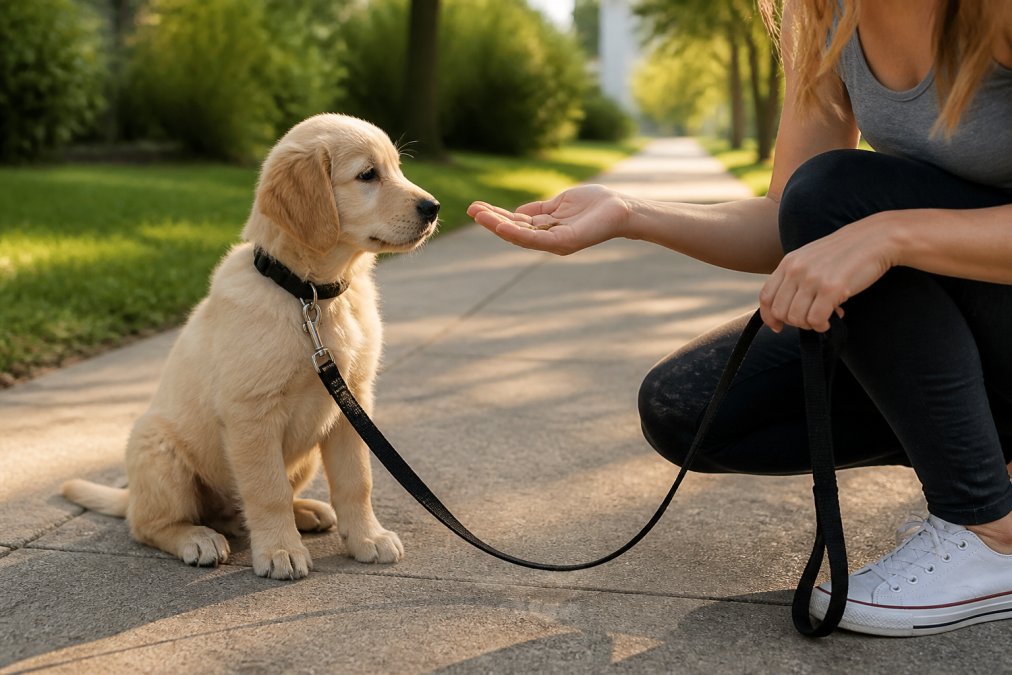
Read the Trigger Before You Correct the Bite
Leash biting rarely comes out of nowhere. It clusters around predictable moments, and naming the trigger tells you which fix to use:
- Transition biting. The puppy grabs the leash the instant you clip it on, before the walk starts. This is excitement, not aggression, the leash predicts the walk.
- Frustration biting. Mid-walk, usually when the puppy wants to go faster or farther than the leash allows. The bite is a protest against restraint.
- Over-arousal biting. Late in a walk, when the puppy is tired and overstimulated. The bite is a release valve.
- Attention biting. The puppy bites, you react, the puppy learns that biting makes you engage. This is the pattern that gets accidentally reinforced most often.
Use the Leash as a Training Tool, Not Just a Tether
The leash itself gives you three levers most owners never use deliberately:
- Slack as a reward. A loose leash is the reward for calm walking. The moment your puppy pulls or bites, stop and hold the leash still, no tugging, no talking. Movement and slack return only when the mouth leaves the strap, teaching the puppy that a tight leash is the consequence and slack is the payoff.
- The brake as a pause button. On a retractable leash, the lock freezes length instantly without jerking the dog. Use it to interrupt a bite mid-motion, then release the moment the puppy disengages, the brake becomes a communication tool, not just a restraint.
- A second connection as a safety net. Clip the leash to both a collar and a harness during the chewing phase. If the puppy severs one connection, the second holds, and you avoid the panic that teaches a puppy biting the leash ends the walk.
The Freeze-Redirect-Reward Sequence
- Freeze the moment teeth touch the leash. Stop walking. Hold the leash still. No tugging, no talking, no eye contact.
- Redirect to an approved toy. Carry a tug toy or plush toy on every walk. The instant your puppy releases the leash, offer the toy.
- Reward the release, not the bite. Mark and treat the second your puppy's mouth leaves the leash. Timing is everything.
- Resume walking only when the leash is ignored. Movement is the reward. A puppy learns fast that biting stops the walk and calm walking restarts it.
- Keep sessions short. Five to ten minutes of focused practice beats a 45-minute battle.
A durable dog leash for chewers puppy training sessions gives you the time this process needs. A leash that frays on day two forces you to stop training and buy a replacement, which resets your puppy's progress.

Prevent the Behavior Before It Starts
The cheapest fix is a walk where the puppy never gets bored enough to bite. A few habits cut leash biting dramatically:
- Burn energy before the walk. A quick game of fetch or tug in the yard takes the edge off, so the walk isn't the puppy's only outlet.
- Carry a high-value chew. A stuffed food toy or a durable tug gives the puppy something legal to mouth when the urge hits.
- Vary the route. The same boring sidewalk invites the same bored behavior. New smells reset attention.
- End before the meltdown. Stop while the puppy is still succeeding. A puppy that finishes calm wants to walk again tomorrow.
When to Get Help
If a puppy is drawing blood, biting you instead of the leash, or escalating despite weeks of consistent training, that's beyond a gear-and-redirect fix. Puppies in the teething window are mouthing, not aggressing, but a certified trainer or veterinarian can rule out pain, teething discomfort, or a behavior issue no leash will solve.
Puppy Leash Training Tips for Better Walks
Better leash manners come from consistency, not equipment. The gear keeps your puppy safe while the training does the actual work.
Frequently Asked Questions
What material is best for a chew-proof dog leash?
Stainless steel cable and biothane are the most chew-resistant options. Stainless steel cable resists even determined chewers because the metal strands are difficult to bite through. Biothane combines a polyester core with a waterproof coating that holds up well against teeth. Nylon webbing is comfortable but can fray under persistent chewing. For puppies in the teething stage, a cable-reinforced or biothane leash paired with training to redirect biting behavior works best.
How do I stop my puppy from chewing on their leash during training?
Start by teaching a 'drop it' cue using treats and praise. When your puppy grabs the leash, stop walking immediately and stand still. The walk resumes only when the leash is released. Carry a tug toy or the Durable Dog Tug Toy Kit from Paw Fit Gears to redirect chewing urges onto an appropriate item. Consistent positive reinforcement and short training sessions keep puppies engaged without frustration.
Are chain leashes safe for puppy training?
Chain leashes are durable but heavy for small puppies. For teething puppies, a lighter option like a cable-reinforced leash or a biothane leash provides durability without the weight. Always pair any leash with a well-fitted harness to distribute pressure evenly.
What is the most durable leash for a teething puppy?
Leashes with stainless steel cable cores or biothane construction rank highest for durability during teething. The 26ft Retractable Dog Leash from Paw Fit Gears uses heavy-duty nylon tape rated for dogs up to 110 lbs, making it a strong choice for larger breeds. The Mighty Paw Retractable Leash 2.0 offers reflective nylon tape for puppies up to 50 lbs. Matching the leash's weight rating to your puppy's expected adult size ensures long-term durability.
Are cable leashes better than nylon for chewers?
Cable leashes outperform nylon for determined chewers because the steel strands resist biting and fraying. Nylon webbing is softer and more comfortable to hold, but a persistent puppy can chew through it over time. Cable leashes also handle abrasion better when dragged across pavement or rough terrain. The trade-off is weight: cable leashes are heavier, so they suit medium to large breeds better than toy breeds.
Leash chewing tests your patience and your gear at the same time. Paw Fit Gears builds leashes designed to survive that phase, from the 26ft heavy-duty retractable leash for large breeds to the reflective 16ft Mighty Paw 2.0 for smaller puppies. Both feature tangle-free designs, one-hand braking, and anti-slip handles that hold up to strong pullers. Get started with Paw Fit Gears and give your puppy the durable gear that makes training easier.