

Table of Contents
- Quick Comparison: Crate Alternatives for Sedan Travel
- Why Sedans Need Different Dog Travel Gear
- Crash-Tested Dog Car Harnesses and Seat Belt Systems
- Dog Car Seat Covers for Travel: Protecting Sedan Interiors
- Dog Car Safety Standards: What Actually Matters
- Sedan Trunk and Backseat Setups for Large Breeds
- DIY and Non-Crate Containment Alternatives
- How to Pick the Right Setup for Your Dog and Sedan
- Frequently Asked Questions
Last Updated: September 30, 2026
Quick Comparison: Crate Alternatives for Sedan Travel
Most dog travel gear is designed for SUVs and hatchbacks, which is why dog travel crate alternatives for sedans are a practical necessity. This guide from Paw Fit Gears breaks down five approaches that fit a sedan's footprint, ranked by how well each protects your car and secures your dog.
| Alternative | Typical Setup | Best For | Price Range |
|---|---|---|---|
| Crash-tested harness + seat belt | Backseat, buckled to harness | Daily drives, anxious dogs | $15-$80 |
| Hard-bottom seat cover | Backseat hammock | Interior protection, shedding | $40-$80 |
| Door guards | Rear door panels | Scratch prevention | $30-$40 |
| Trunk/backseat bed mat | Trunk floor or seat extender | Large breeds, comfort | $40-$50 |
| DIY containment | Backseat barrier + straps | Budget setups | Varies |
Why Sedans Need Different Dog Travel Gear
Sedans have shallower trunks, lower rooflines, and shorter rear doors than SUVs, which changes what actually fits. A crate that slides into a hatchback often won't clear a sedan's trunk lip or rear seat pass-through, the core problem most generic guides ignore.

How to Measure Your Sedan Before You Buy
- Rear seat width, measure cushion edge to cushion edge where the dog will sit. Most midsize sedans land between 48 and 56 inches.
- Seat-to-front-seatback depth, with the front passenger seat set where it normally rides, measure from the rear seatback to the back of the front seat. This is your usable floor length; 28 to 34 inches is common.
- Door aperture height, measure the clear opening at the tallest point of the rear door. This tells you the biggest dog or crate that can pass through.
- Trunk pass-through width and height, if your sedan has a folding rear seat or a ski pass-through, measure the opening. Many are only 10 to 14 inches tall, which rules out crates but can work for a bed mat or a folded soft carrier.
Once you have those four numbers, the decision narrows fast: if your rear seat width and floor depth clear the product's listed footprint, it fits, no "universal fit" marketing will save it otherwise.

Crash-Tested Dog Car Harnesses and Seat Belt Systems
A crash-tested harness paired with a seat belt is the closest thing to crate-level protection that fits a sedan: the harness spreads force across the chest and shoulders, and the belt stops the dog becoming a projectile in a sudden stop.
How to Choose a Crash-Tested Harness for a Sedan
Look for three things: a CPS or independently crash-tested rating, a fit that keeps the sternum plate centered on the chest, and a tether that connects to the seat belt rather than the headrest. A harness that shifts during a stop won't protect your dog the way a properly fitted one will.
Dog Car Seat Covers for Travel: Protecting Sedan Interiors
A waterproof seat cover is the most effective way to protect a sedan's upholstery from mud, shedding, and drool. Unlike a crate, it installs in seconds, folds flat, and doesn't eat up backseat legroom.

Backseat Covers vs. Door Guards vs. Bed Mats
Each protects a different part of the sedan, and most owners eventually want all three: covers handle the seat, door guards protect scratched panels, and bed mats add comfort for large breeds.
Dog Car Safety Standards: What Actually Matters
No federal law requires dogs to be restrained in a moving vehicle, so "safety-certified" is a marketing term unless backed by a specific testing standard from an independent body, not the product label.
Sedan Trunk and Backseat Setups for Large Breeds
Large breeds are the hardest fit for a sedan, and the trunk is usually a dead end, but not for the reason most guides give. The real obstacle is lifting a 60-pound dog over a 30-inch-plus lip while keeping your balance, often alone in a parking lot. Most owners can't do it safely, and many dogs won't tolerate it.
When the Trunk Actually Works
There are two cases where a sedan trunk is viable for a large dog:
- A folding rear seat with a wide pass-through. Some sedans open to a 60/40 split that creates a usable tunnel. Measure the opening height and width; if it clears roughly 20 inches tall and 24 inches wide, a soft-sided carrier or a low-profile bed mat can ride in the trunk with the dog entering through the cabin.
- A dog that already loads into the trunk on command. If your dog jumps in on its own, the lifting problem disappears. This is rare but worth testing before you rule the trunk out.
For everyone else, the backseat is the answer.
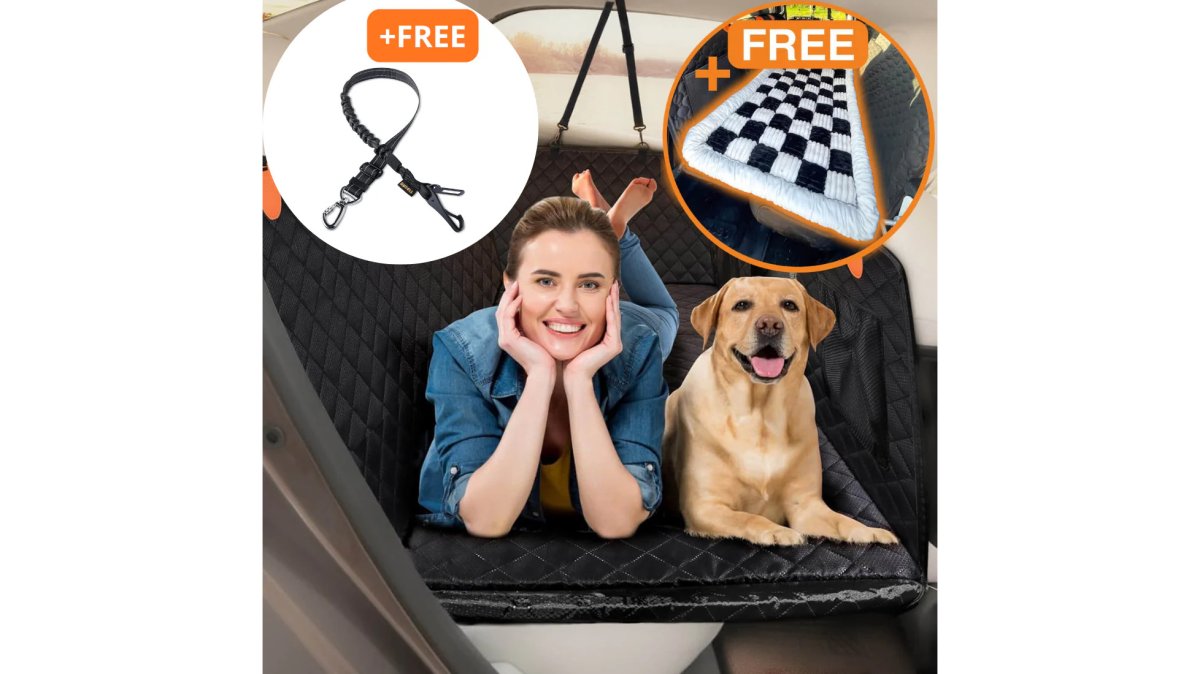
Hard Bottom 6-In-1 Dog Back Seat Cover →
The Backseat Setup That Works for a 60-Pound-Plus Dog
The workable setup is a backseat extender paired with a bed mat and a harness tether: the extender bridges the footwell gap into a flat platform, the mat adds cushioning and grip, and the harness keeps the dog anchored, giving a large breed room to lie down without the crate that won't fit.
- Platform length. A 60-pound dog lying down needs roughly 36 to 40 inches of flat surface. A backseat extender plus the seat cushion usually gets you there in a midsize sedan; a compact sedan may not.
- Weight rating. Check the extender's listed capacity. Most are rated for 100 to 200 pounds, but the anchoring straps are the weak point, look for straps that wrap around the headrest posts, not clips that snap to plastic trim.
- Entry path. A large dog entering the backseat through a narrow rear door may need the front seat moved forward and the door opened fully. Practice the load before a long trip so it isn't a struggle at the trailhead.
DIY and Non-Crate Containment Alternatives
A backseat barrier made from a rigid panel or fitted net keeps a dog out of the front seat without any crate. These setups cost less than a certified harness system and suit dogs that need a boundary rather than full restraint.
A few DIY-friendly approaches that hold up in practice:
- A fitted backseat hammock with side flaps, which doubles as a barrier
- A rigid cargo divider sized to the sedan's rear seat width
- A non-slip bed mat with raised edges to define the dog's space
- A seat belt tether clipped to a well-fitted harness for a hybrid setup
How to Pick the Right Setup for Your Dog and Sedan
Match the setup to your dog's size, your car's rear cabin dimensions, and how much crash protection you want. There's no single best answer, but the decision narrows fast once you know your priorities.
Use this checklist to work through it:
- Measure your sedan's backseat width and the distance from seat to front seat back
- Weigh your dog and confirm the harness is rated for that weight
- Decide whether you need crash-tested restraint or just containment
- Check whether your dog needs a flat platform (large breeds usually do)
- Confirm the cover or mat is waterproof if your dog sheds or gets muddy
- Test the setup on a short drive before a long trip
Frequently Asked Questions
What can I use instead of a dog crate in a sedan?
A crash-tested harness paired with a dog seat belt is the most secure crate alternative for sedans. The Paw Fit Gears 2 Pack Adjustable Dog Seat Belt ($14.51) clips to your dog's harness and your car's seat belt buckle, keeping your dog restrained without a bulky crate. A back seat cover with a hard bottom adds stability and protects your upholstery. Together, these give you containment and interior protection in a space a crate simply will not fit.
Are dog seat belts safe for sedan travel?
Yes, when used with a crash-tested harness rather than a collar. A seat belt attached to a collar can strain the neck during sudden stops. The Paw Fit Gears Adjustable Dog Seat Belt adjusts from 16.5 to 27.6 inches and uses sturdy metal clips on high-strength nylon. It connects to your dog's harness and your sedan's seat belt buckle, reducing distraction and keeping your dog from sliding into the front seat.
Is it safer to use a harness or a crate in a sedan?
For sedans, a crash-tested harness with a seat belt is often the safer and more practical choice. A crate that fits in a sedan trunk or backseat may not leave enough room for proper anchoring, and an unsecured crate can shift during a crash. A harness keeps your dog in place using the car's existing restraint systems.
Can I use a dog hammock in a sedan?
Yes. The Paw Fit Gears Hard Bottom 6-In-1 Dog Back Seat Cover ($79.99) works in sedans and includes a non-slip base, waterproof lining, and mesh window. It converts between hammock and flat seat cover configurations. The hard bottom gives your dog a stable surface, which matters in sedans where the back seat may be smaller. It also comes with a free car backseat dog bed and a free dog safety belt.
How do I keep my dog comfortable on a long sedan ride?
Start with a stable, familiar surface like the Dog Bed Mat for Car Back Seat Extenders ($39.99). Add a seat belt to prevent pacing. For anxious dogs, the Natural Pheromone Calming Collar ($49.99) releases pheromones within one hour and lasts up to 30 days per collar. Keep the cabin cool, stop every two to three hours, and bring water. A dog that feels secure and has a consistent spot is far less likely to whine or pace.