

Table of Contents
- Why Shock-Free Training Collars Work for Small Dogs
- Choosing a Vibration Dog Training Collar for Small Dogs
- How to Stop Dog Barking with Training Tools
- Comparing Contact Points: Prongs vs. Flat
- Troubleshooting Common Training Failures
- Range, Battery Life, and Signal Interference
- Frequently Asked Questions
Last Updated: September 21, 2026
Why Shock-Free Training Collars Work for Small Dogs
Dog training collars without shock for small dogs use vibration and sound to interrupt unwanted behavior without an electrical correction. This guide covers how they work, what to look for, and how to use them responsibly.
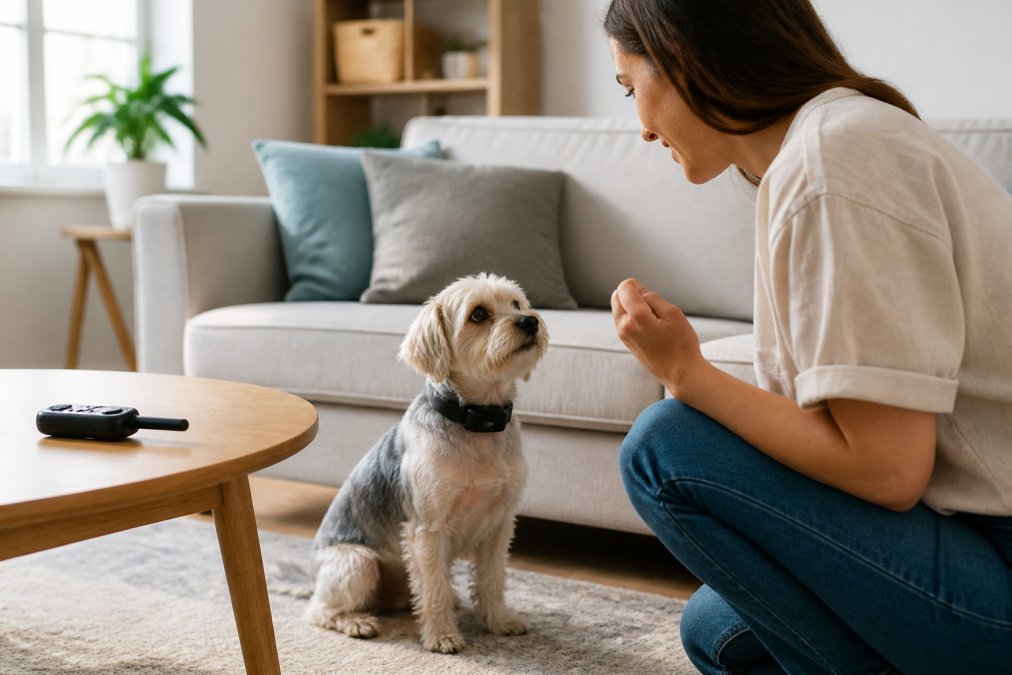
Vibration and Sound Modes Explained
Vibration mode delivers a gentle buzz through the receiver collar, like a phone notification. Audible beep is a tone the dog associates with a command or boundary. Neither causes pain.
Safety Considerations for Small Dog Necks
A toy breed's trachea can be narrower than a pencil. Pressure from a poorly fitted collar, not the vibration, causes most injuries, a collar that slides or sits too high creates constant friction against the throat.
Choosing a Vibration Dog Training Collar for Small Dogs
Match the device to your dog's weight first, then your training goals. A collar rated for dogs over 15 pounds hangs loose on a 6-pound Chihuahua and delivers inconsistent contact.
Weight, Size, and Neck Circumference Requirements
Measure your dog's neck at its widest point before buying. Most small-breed receivers fit necks between 8 and 15 inches; weigh your dog on a kitchen scale if unsure.
| Dog Size | Typical Weight | Neck Circumference | Receiver Weight |
|---|---|---|---|
| Toy | 3-6 lbs | 8-10 in | Under 1 oz |
| Small | 6-15 lbs | 10-13 in | 1-2 oz |
| Small-medium | 15-25 lbs | 13-15 in | 2-3 oz |
Waterproof Ratings and Durability Features
An IPX7 rating means the receiver survives 30 minutes in about a meter of water, rain, puddles, an accidental dunk. Anything IPX6 or lower should come off before swimming.
How to Stop Dog Barking with Training Tools
Barking is communication, not defiance. A training tool works only when it interrupts the bark and redirects your dog toward a rewardable behavior. Timing, not intensity, does the heavy lifting.
Why Vibration Works as a Cue (and When It Doesn't)
A vibration collar is a marker, not a punishment, a neutral signal that consistently predicts a reward, like a clicker. The dog learns the buzz means "stop and check in with my person, because something good is coming."
That only holds if three conditions are met:
- The cue comes before the reward, every time. If you buzz and then forget the treat, the buzz becomes noise, or worse, a threat.
- The cue lands inside the behavior window. For barking, that window is roughly the first one to two seconds. Buzz after the dog has already stopped and you are marking the silence, not the bark.
- The reward is worth more than the bark. A dry biscuit will not beat a squirrel. Use real chicken, cheese, or freeze-dried liver, cut to pea size.
Step-by-Step Conditioning Guide
Total time: 2-3 weeks of short daily sessions Difficulty: Beginner Session length: 3-5 minutes, two to three times per day
What you'll need:
- A vibration collar fitted to your dog's neck
- High-value treats cut into pea-sized pieces
- A quiet room with few distractions
- A clicker (optional)
Phase 1, Charge, fit, and desensitize (Days 1-3)
- Charge the collar fully and let your dog wear it with the device off for 20 minutes. Reward calm behavior. Repeat twice daily.
- Check the fit. Two fingers should slide under the strap, no more. A loose collar shifts the contact points off the skin and the cue never lands.
- Pair the tone with treats. Press the beep, then immediately treat. Repeat 10 times per session; your dog should look at you on the tone within two or three sessions.
Phase 2, Layer in vibration (Days 4-7)
- Add the vibration on its own. Press vibration, then treat. Keep sessions under 5 minutes. If your dog flinches, drop back to the tone for a day, then retry at lower intensity.
- Alternate tone and vibration so the dog does not lock onto one mode. Both should predict the same reward.
Phase 3, Introduce the real trigger (Days 8-14)
- Set up a controlled bark. Have someone knock or ring the doorbell. The moment your dog barks, press vibration once, then reward the instant it stops. One buzz per bark episode, never hold or repeat the button.
- Practice the replacement behavior. Teach "quiet" and reward silence for 3 seconds, then 5, then 10. Build duration slowly; jumping from 3 to 30 seconds makes the dog fail.
Phase 4, Generalize (Weeks 3-4)
- Move sessions to the yard, then the sidewalk. New environments reset difficulty; expect the dog to act like it never heard the cue. That is normal.
- Fade the treats to intermittent. Once reliable, reward every second or third correct response, this makes the behavior stick when the collar comes off.
Common Timing Mistakes
- Buzzing after the bark stops. You are punishing silence. The dog cannot tell what it did wrong.
- Buzzing repeatedly during one bark episode. One cue per event. A stream of buzzes is nagging, not marking.
- Skipping the reward because the dog "already knows." Known behaviors still need payment. Intermittent reinforcement keeps them alive.
- Training when you are frustrated. Dogs read tone and posture. A tense session teaches the dog that the collar predicts stress.
When to Bring In a Certified Trainer
If your dog freezes, shuts down, hides, or shows any sign of fear at the sight of the collar, stop. Some dogs are not good candidates for remote-cue training, and forcing it can create a lasting negative association with the equipment. Look for a trainer who uses least intrusive, minimally aversive (LIMA) principles and has experience with small breeds.
Comparing Contact Points: Prongs vs. Flat
This detail decides whether your dog tolerates the collar. Prong contact points reach through a thick coat and keep steady skin contact. Flat contact points sit closer to the strap and suit short-coated breeds.
Troubleshooting Common Training Failures
Most failures trace back to fit, timing, or consistency, not the device. Work through these before assuming the collar does not work.
- Dog ignores the cue: The collar is too loose or the contact points are not touching skin. Tighten by one notch and retest.
- Dog seems startled, not redirected: You are pressing the button after the behavior instead of during it. Catch the bark in the first second.
- Progress stalls after a week: Sessions are too long or too frequent. Cut to two 5-minute sessions per day.
- Behavior returns when the collar is off: You skipped the reward step. The cue must predict a treat, not just interrupt a bark.
- Dog freezes or shuts down: Stop and consult a certified trainer. Some dogs need a different approach entirely.
Range, Battery Life, and Signal Interference
Spec sheets list range and battery life under ideal conditions; real yards, walls, and dogs change both numbers. Here is what matters when you are in the kitchen trying to reach a dog at the back fence.
How Transmitter Range Is Actually Measured
Transmitter range on most small-dog systems is quoted from 100 to 400 yards, measured line-of-sight in open space with the remote at chest height. In a typical suburban yard, expect roughly half; indoors through two or three walls, a quarter or less.
What cuts range the most, in order:
- Concrete and brick walls, masonry blocks signal far more than drywall.
- Metal fencing and appliances, chain-link, refrigerators, and HVAC units act as shields.
- Dense foliage, a hedge is not a wall, but wet leaves absorb signal.
- Body blocking, holding the remote against your chest or in a pocket puts your own body between the antenna and the dog.
Battery Life in Real Use
Rechargeable battery life varies by unit, but the pattern is consistent:
- Receiver collar: 1-2 weeks per charge with daily use. Vibration drains faster than tone; a dog triggering 40 times a day needs charging twice as often as one triggering 10.
- Remote transmitter: 2-4 weeks per charge. The screen backlight and remote vibration feedback are the biggest draws.
- Standby drain: even powered off, most receivers lose charge slowly. A collar in a drawer for two months needs charging before the first session.
Signal Interference: What It Looks Like and How to Fix It
Signal interference rarely shows as a total dropout. More often a cue arrives a half-second late, or a buzz fires twice when you pressed once. Both are training problems, because a dog cannot learn an inconsistent cue.
Common causes and fixes:
- Other wireless devices. Wi-Fi routers, baby monitors, and garage door openers share spectrum with many collar systems. Move the remote away from the router and retest.
- Thick concrete walls. Step into the same room as the dog, or move to a doorway. Signal passes through openings far better than through walls.
- Holding the remote against your body. Keep it in your hand, antenna up, pointed toward the dog. This alone fixes a surprising number of "range" complaints.
- Low battery in either unit. Weak batteries reduce transmit power before they die completely. If cues get flaky, charge both units first.
- Multiple collars on the same frequency. If you train two dogs, check that the system supports separate channels. Cross-talk between collars is confusing for both dogs.
Matching Range to Your Actual Training Space
You do not need the longest-range system, just one that covers where you actually train.
| Training space | Realistic range needed |
|---|---|
| Indoor only (apartment, single room) | 30-50 yards |
| Small fenced yard (under 1/4 acre) | 100-150 yards |
| Large yard or open field | 300+ yards |
Range and battery specs are starting points, not promises. Test your system in the exact spot you plan to train, at the exact distance, before you rely on it. Five minutes of testing saves weeks of confusing sessions.
Frequently Asked Questions
Do no shock training collars actually work for small dogs?
Yes. Vibration and audible beep modes work through consistent conditioning. You pair the cue with a command your dog already knows, then reward compliance. Small breeds respond well because vibration is noticeable without causing pain. The key is timing: the cue must arrive within one second of the unwanted behavior. Most owners see reliable responses within two to four weeks of daily five-minute sessions.
What is the best training collar for tiny dogs under 10 pounds?
Look for a collar weighing under 2 ounces with an adjustable strap that fits necks as small as 8 inches. Vibration-only or sound-only models suit tiny breeds best because the receiver is lighter. Check that contact points are flat rather than pronged to reduce pressure on delicate neck tissue. A waterproof rating of IPX7 adds durability for outdoor use.
How do I stop dog barking with training tools without causing stress?
Start by identifying the trigger, then use a vibration collar or an ultrasonic trainer to interrupt the barking at the first woof. Immediately redirect to a known command like sit, and reward calm behavior with treats or praise. Keep sessions under five minutes, and never use the tool when your dog is already panicked. Pairing the interruption with positive reinforcement builds lasting behavior change.
Are vibration collars safe for small dogs with sensitive necks?
Vibration collars are safe when fitted correctly. The strap should sit snug but allow two fingers to slide underneath. Flat contact points distribute pressure better than prongs. Check the neck daily for redness or irritation, and remove the collar for at least 12 hours each day. Dogs with known tracheal collapse or neck injuries should be evaluated by a veterinarian before use.
Correcting barking in a small breed takes patience, the right fit, and a tool that respects a delicate neck. Paw Fit Gears builds gear for exactly this kind of careful, humane training, from adjustable collars to ultrasonic trainers that skip shock entirely. Browse the full catalog to find durable, pet-first equipment that supports your dog's daily life and training routine. Get started with Paw Fit Gears and give your small dog a training setup built around comfort, not correction.