

Table of Contents
- How to Secure a Dog Crate in an SUV
- Crash-Tested Dog Harness vs Crate: Which Protects Better
- Dog Car Safety Standards: What Certifications Actually Mean
- Crash Tested Dog Crate for SUV Reviews: What Separates the Best
- Vehicle Compatibility: Which Crates Fit Which SUVs
- Multi-Dog and Post-Accident Logistics
- Conclusion
- Frequently Asked Questions
Last Updated: October 3, 2026
How to Secure a Dog Crate in an SUV
A crash tested dog crate only protects your dog if it stays put during impact. Most SUV owners buy a solid crate, then set it loose in the cargo area with nothing holding it down.
The crate itself becomes a projectile. A 32 kg crate plus a 30 kg dog generates forces no latch was designed to absorb alone.
Here is how to secure a dog crate in an SUV properly:
- Route two independent securing straps through the crate's frame, not the door
- Anchor each strap to a separate factory tie-down point or cargo D-ring
- Tighten until the crate cannot shift more than 2 cm in any direction
- Add a non-slip base mat underneath to stop lateral creep
- Re-check tension after the first 30 minutes of driving
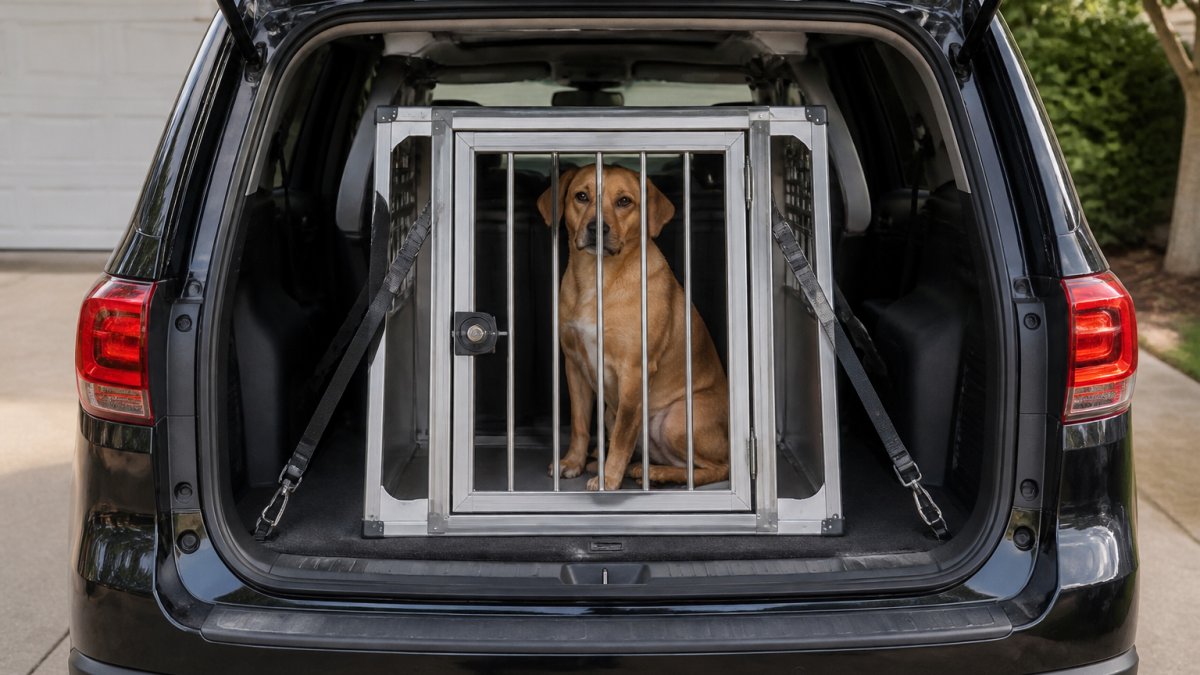
Tie-Down Points and Securing Straps That Hold
Factory tie-down points are rated for luggage, not for a dog crate under deceleration. Cargo D-rings hold steady loads, but a crash produces a sudden kinetic energy spike that tests the whole restraint system at once.
A common mistake is running one strap across the top, which lets the crate rotate forward in a sudden stop. Two straps, crossed diagonally and anchored to four separate points, resist rotation far better.
Matching Crate Size to Your Cargo Area
Crate sizing for an SUV is a two-part problem: the dog needs room to stand, turn, and lie down flat, and the crate needs a footprint that leaves strap clearance on all four sides.
For most mid-size SUVs, a crate that fills 70-80% of the cargo floor works best. Leave at least 10 cm of gap on each side for strap routing.
Crash-Tested Dog Harness vs Crate: Which Protects Better
A crash-tested dog harness restrains the dog against a seat, while a crash tested dog crate contains the dog inside a rigid structure that is itself restrained to the vehicle.
A harness transfers deceleration force into the dog's chest and torso through webbing and a buckle, relying on the seat belt pretensioner and seat structure. A crate transfers force into its own frame, hinges, and latches, then into whatever straps tie it to the cargo floor.

Where Each System Actually Fails
Harness failure modes are almost always fit-related:
- Loose webbing: A harness that lets the dog rotate or slide forward loads the throat and neck instead of the ribcage.
- Wrong anchor point: Clipping to a collar, a headrest post, or a cargo hook instead of the seat belt buckle changes the geometry the harness was tested with.
- Seat belt slack: A standard seat belt has several inches of give before it locks. A harness tested on a rigid sled does not see that slack.
Crate failure modes are structural and installation-related:
- Latch pop: The door latch is usually the first component to fail under forward deceleration.
- Weld or seam deformation: Thin aluminum and molded plastic crack or bend at joints before the panels themselves fail.
- Anchor pull-out: Factory cargo D-rings are rated for luggage retention, not for the kinetic energy of a crate plus dog at highway speed.
Side-by-Side Decision Factors
| Factor | Crash-Tested Harness | Crash Tested Crate |
|---|---|---|
| Space needed | Minimal, one seat | Large cargo footprint |
| Best for | Sedans, small SUVs, one dog, shared vehicles | SUVs, trucks, multi-dog, dedicated cargo area |
| Installation | Clip into seat belt buckle | Four-point strap or bracket to tie-downs |
| Protects from flying cargo | No | Yes |
| Fit sensitivity | High, sizing is critical | Low, dog fits inside, crate fits vehicle |
| Failure mode | Webbing slip, wrong anchor, slack | Latch pop, weld deformation, anchor pull-out |
| Reusability after a crash | Replace webbing and hardware | Retire the crate if any structure is deformed |
| Dog behavior fit | Calm dogs that lie down | Dogs that pace, stand, or need containment |
The Cargo-Shift Problem Nobody Mentions
A harness does nothing about the rest of your cargo. In a hard stop, a cooler or suitcase becomes its own projectile and can strike a dog belted to a seat. A crate shields the dog from loose cargo, but only if the crate itself is restrained, crate restraint and cargo restraint are one system.
When a Harness Is the Right Call
A harness wins when the crate cannot. If you split driving time between vehicles, if your cargo floor has no usable tie-down points, or if your dog is small enough that a crate would be unstable on the seat, a harness paired with a seat belt attachment is the practical choice. Our 2 Pack Adjustable Dog Seat Belt for Car adjusts from 16.5" to 27.6" and clips into a standard seat belt buckle.
For SUV owners with a dedicated cargo area and a dog that travels regularly, a crate is the stronger containment system. For anyone splitting time between vehicles or driving a sedan, a harness is more realistic. The mistake is assuming one replaces the other.
Dog Car Safety Standards: What Certifications Actually Mean
There is no single government standard for pet crates in vehicles, which is why "crash tested" gets used loosely.
A legitimate crash test follows a defined protocol: a weighted test dummy, a set speed, a fixed deceleration profile, and a pass or fail threshold. Without those four elements, "crash tested" is marketing language.
Dynamic Testing and Collision Simulation
Dynamic testing puts a loaded crate on a sled and fires it into a controlled stop, reproducing the deceleration forces of a real collision rather than just pushing weight against the structure.
What separates a real test from a claim:
- The crate is loaded with a weighted dummy, not left empty
- The sled reaches a defined speed before the sudden stop
- The crate is secured the same way a buyer would secure it
Ask a manufacturer for the test speed and the securing method used. If they cannot answer, treat the certification as unverified.
Crash Tested Dog Crate for SUV Reviews: What Separates the Best
The best crash tested dog crate for SUV use balances three things: structural integrity under load, a footprint that fits your cargo area, and a restraint system you can actually install.
2 Pack Adjustable Dog Seat Belt for Car →
Aluminum, Plastic, or Steel: Material Trade-Offs
Aluminum dominates the high-impact category: light enough for one person to lift, with a powder-coated finish that resists scratching and rust.
Plastic crates are the lightest and cheapest. They handle everyday travel but crack under high impact, and the latch is usually the first failure point.
Steel is the heaviest and strongest, resisting deformation better than anything else, but installation becomes a two-person job and it eats into payload.
| Material | Weight | Impact Resistance | Best For |
|---|---|---|---|
| Aluminum | Light | High | Frequent travel, one-person handling |
| Plastic | Lightest | Low | Short trips, calm dogs |
| Steel | Heavy | Highest | Large dogs, permanent installs |
Whichever material you choose, pair it with proper interior padding and a non-slip base. Our Dog Bed Mat for Car Back Seat Extenders adds a cushioned, grippy layer that reduces sliding and gives your dog something familiar to settle on, which helps with travel anxiety.

Vehicle Compatibility: Which Crates Fit Which SUVs
Crate fit is vehicle-specific, and most buying guides skip it. Two SUVs with nearly identical cargo volume can have very different floor shapes, wheel well intrusions, liftgate rake, and tie-down layouts. A crate that fits one mid-size SUV may not fit another.
Measure These Five Numbers Before You Buy
Use a tape measure, not the spec sheet, with the rear seats in the position you actually drive with:
- Cargo floor length, from the back of the rear seat to the inside of the liftgate, measured at floor level.
- Width between wheel wells, the narrowest point across the cargo floor, which is almost always the limiting dimension.
- Floor-to-ceiling height, measured at the liftgate opening, not the deepest part of the cargo area, because the roofline slopes.
- Liftgate opening height and width, the crate has to pass through the opening, not just sit behind it.
- Tie-down point positions, count them and note where they sit relative to the crate footprint.
Then compare those numbers against the crate's exterior dimensions, not the interior. Add clearance for straps: at least 4 inches on each side you plan to anchor, and 2 inches of vertical clearance so the crate does not contact the ceiling under load.
Fitment Math: A Worked Example
Say your cargo floor is 38 inches long, 42 inches wide between the wheel wells, and 30 inches tall at the liftgate. A crate at 36" L x 24" W x 28" H leaves 2 inches of length, 18 inches of width, and 2 inches of height, tight on length and height but generous on width, enough for two straps per side to four tie-down points.
The pattern to internalize: length and height are usually the binding constraints in SUVs, and width is usually where you find strap room.
Vehicle-Class Patterns
- Compact SUVs: Cargo height at the liftgate is usually the limiting factor. Look for low-profile crates and expect to give up length. Measure the liftgate opening before anything else.
- Mid-size SUVs: The sweet spot for most crash-tested crates. Watch the width between wheel wells, which can drop 6-10 inches below the widest part of the floor.
- Full-size SUVs: Plenty of room, but a long, flat floor lets the crate slide. A non-slip base mat plus four-point restraint is not optional here.
Tie-Down Layout by Vehicle Type
Where the anchors sit changes how you strap the crate:
- Four corner D-rings: Ideal. Run two straps per side, crossed diagonally, anchored to four separate points.
- Two rear D-rings only: Add a forward anchor using the seat mounting bolts or a manufacturer-approved bracket. Do not rely on rear-only restraint, the crate will rotate forward.
- Sliding track rails: Use track-specific anchor fittings rather than clipping to the rail itself, which can deform under shock loading.
Door and Interior Protection
A crate you load and unload repeatedly will scuff your interior trim, and the liftgate sill takes the worst of it. Our DoorGuard (2-Pack) uses reinforced Oxford diamond-quilt fabric that is waterproof and machine washable, and fits trucks and SUVs with a universal install. Pair it with a non-slip base mat under the crate to stop lateral creep on long, flat cargo floors.

Multi-Dog and Post-Accident Logistics
Two dogs in one SUV changes the math: each crate needs its own four-point restraint, and stacking is only safe when the manufacturer rates it. Side-by-side placement on the cargo floor is the safer default.
Post-accident protocol is the other topic nobody covers. After any collision, even a minor one:
- Do not open the crate until the scene is safe and the vehicle is stable
- Check the crate frame, welds, and latch for cracks or deformation
- Inspect straps and tie-down points for stretching or bent hardware
- Replace any component that shows damage rather than reusing it
- Have a vet check your dog, since injuries are not always visible
Conclusion
Choosing a crash tested dog crate for SUV travel comes down to fit, restraint, and honest testing claims. Most buyers focus on the crate and skip the installation, exactly where protection is won or lost.
At Paw Fit Gears, we build gear for the parts of the trip around the crate: the seat belt that keeps your dog restrained, the mat that stops sliding, and the door guards that protect your interior.
Frequently Asked Questions
Is there a crash-tested dog crate suitable for an SUV?
Yes, but the crate must be both crash tested and properly secured to count. A crate that passes dynamic testing on its own can still move around if it is not strapped to your SUV's tie-down points or anchored behind the seats. Look for a crate rated for your dog's weight, then confirm it fits your cargo area with enough room for airflow. Without a restraint system holding it in place, even a well-built crate slides forward during hard braking.
What makes a dog crate crash-tested for vehicle use?
A crash-tested crate has survived dynamic testing, meaning it was strapped down and subjected to collision simulation at real driving speeds. During testing, engineers measure whether the crate holds its structural integrity, whether the latch mechanism stays shut, and whether the crate stays attached to its restraint system. Static load tests alone do not count. If a manufacturer cannot show you dynamic test results, treat the crate as a travel kennel, not a crash-tested one.
How do I secure a dog crate in an SUV cargo area?
Route heavy-duty securing straps through the crate's frame and attach them to your SUV's tie-down points or cargo anchors. Pull each strap tight so the crate cannot shift more than an inch in any direction, then check the latch mechanism and re-tighten after the first 30 minutes of driving. For dogs that need extra restraint, pair the crate with a crash-tested harness attached to a seat belt. Never rely on the crate's own weight to hold it in place.
Can a crash-tested dog harness replace a crate for SUV travel?
They solve different problems. A crash-tested dog harness restrains the dog directly and works well for dogs that travel calmly, but it leaves the cargo area open to fur, scratches, and drool. A crate contains the mess and gives anxious dogs a den-like space, but only protects if it stays secured. Many owners use both: a harness for short trips and a secured crate for highway driving. Paw Fit Gears' 2 Pack Adjustable Dog Seat Belt for Car ($14.51) pairs with any harness for a quick restraint setup.
Are wire dog crates safe for car travel?
Wire crates are not built for high-impact scenarios. Their frames bend under deceleration forces, and the wire panels can collapse inward on the dog during a collision. They also lack a latch mechanism rated for crash loads. If you already own a wire crate, use it at home, not in the car.