

Table of Contents
- Quick Comparison: Top Anti Anxiety Harnesses
- How an Anti Anxiety Harness Calms Your Dog
- Key Features to Look for in an Anxiety Harness
- How to Stop Dog Pulling on Leash with a Front-Clip Harness
- Dog Anxiety Vest vs Harness: Which One Does Your Dog Need?
- How to Train a Fearful Dog to Wear a Harness
- Breed-Specific Fit Challenges and Calming Tool Integration
- Frequently Asked Questions
Last Updated: September 18, 2026
Quick Comparison: Top Anti Anxiety Harnesses
The best anti anxiety harness for dogs is one that combines a front-clip no-pull design, breathable padding, and a secure adjustable fit. At Paw Fit Gears, we built our harness line around exactly that combination, because a harness that rubs or shifts adds stress instead of removing it.
Here is how our two harness options compare:
| Feature | No-Pull Harness with 2 Leash Clips | Heavy Duty Front-Clip Harness |
|---|---|---|
| Price | $27.09 | $36.48 |
| Leash attachment points | Front chest clip + back clip | Front chest clip + back clip |
| Adjustment points | 4 straps | 4 points |
| Padding | Soft padding with breathable mesh | No-rip nylon with padding |
| Handle | Built-in control handle | Heavy-duty handle |
| Best for | Labs, Huskies, Shepherds, daily walks | Hiking, running, strong pullers |
How an Anti Anxiety Harness Calms Your Dog
An anti anxiety harness is a vest-style walking tool that applies gentle, even pressure across a dog's chest and torso, similar to the swaddling effect used for infants. That pressure is thought to trigger a calming response in many dogs, which is why trainers often pair it with behavior work rather than using it alone.

Key Features to Look for in an Anxiety Harness
The features that matter most are fit adjustment, padding, and leash attachment options. Everything else is secondary.
Fit and Adjustment Points
Look for at least four adjustment points: two at the chest and two at the girth. Our No-Pull Harness with 2 Leash Clips uses four straps for this reason. More adjustment means a secure fit on deep-chested breeds and narrow-chested dogs alike, which is where most off-the-shelf harnesses fail.
Padding, Mesh, and Chafing Prevention
Breathable mesh under the chest plate prevents the moisture buildup that leads to chafing. Padding over the sternum distributes pressure from the leash so a hard pull never lands on one small spot. For dogs with fear-based reactivity, a harness that rubs once is a harness the dog refuses to wear again.
Check these boxes before you buy:
- Front and back leash attachment points
- Four or more adjustment straps
- Padded chest plate with breathable mesh
- Reflective safety strips for evening walks
- Quick-release buckles for fast on and off
How to Stop Dog Pulling on Leash with a Front-Clip Harness
Learning how to stop dog pulling on leash starts with a front-clip harness. The chest clip redirects forward motion sideways, so when your dog lunges, their body turns back toward you instead of driving ahead. It is a no-pull mechanism that works with the dog's physics rather than against it.

Here is the sequence we recommend:
- Clip the leash to the front chest ring for training walks
- Hold the leash loose with both hands at waist height
- Stop walking the instant the leash goes tight
- Wait for the dog to turn back toward you, then mark and reward
- Resume walking only on a slack leash
- Switch to the back clip for casual sniff walks once pulling fades
Dog Anxiety Vest vs Harness: Which One Does Your Dog Need?
The dog anxiety vest vs harness question comes down to purpose, construction, and where the dog spends most of its anxious hours. A vest is a calming garment worn indoors during storms, fireworks, or travel. A harness is walking equipment built to attach a leash and manage pulling. Some products blur the line, but they solve different problems.
How Each Tool Actually Works
An anxiety vest applies continuous, evenly distributed pressure across the torso. The wrap mimics the swaddling effect used for infants, and most practitioners find it lowers arousal enough that a dog can settle instead of pacing. A harness applies pressure only when the leash goes tight, and a front-clip design redirects forward motion sideways so a lunging dog turns back toward the handler.
Decision Criteria by Situation
| Situation | Best Tool | Why |
|---|---|---|
| Pulls on walks | Front-clip harness | Redirects forward motion |
| Storm or fireworks fear | Anxiety vest or calming collar | Steady pressure at home |
| Both | Harness plus collar | Walk control and home calm |
| Car travel anxiety | Calming bed plus collar | Familiar scent and pressure |
| Senior dog with joint pain | Padded harness with a wide chest plate | Distributes leash pressure off the throat |
When to Use One, the Other, or Both
If your dog panics during thunderstorms but walks fine, a vest plus our Natural Pheromone Calming Collar covers the indoor hours. If your dog pulls, lunges, or freezes on walks, you need a harness first. If both apply, layer them: harness for the walk, vest or collar for the house.
No-Pull Dog Harness with 2 Leash Clips →

Fit Notes That Change the Answer
A vest that is too loose slides and startles the dog; one that is too tight restricts breathing. Measure the dog's girth behind the front legs and compare against the manufacturer's chart before ordering. For harnesses, the same girth measurement plus chest width at the widest point is the reliable pair. Deep-chested breeds often need a longer chest plate, and broad-chested breeds need a wider girth strap, which is why a vest that fits a Labrador may not fit a Bulldog.
How to Train a Fearful Dog to Wear a Harness
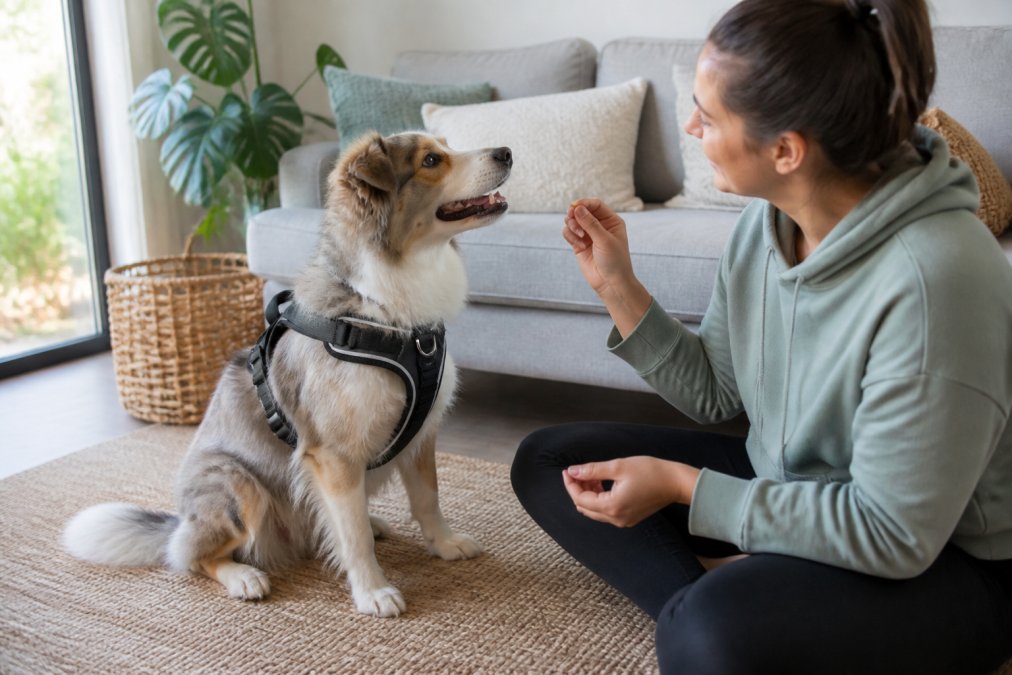
Training a fearful dog to wear a harness takes one to two weeks of short sessions, not one afternoon. The goal is desensitization: the harness goes from scary object to neutral object to predictor of good things. Most articles stop at the product; this protocol covers the behavior work that makes the product usable.
Why Desensitization Works
Fearful dogs learn by association. If the harness predicts treats, walks, and calm attention, the dog's emotional response shifts from avoidance to anticipation. Counter-conditioning pairs the harness with something the dog loves, usually high-value treats like boiled chicken or freeze-dried liver. Desensitization lowers the intensity of the exposure so the dog never crosses into panic. Run the two together and the harness stops being a threat.
Step-by-Step Protocol
- Day 1-2: Harness on the floor, treats dropped nearby
- Day 3-4: Touch the harness to the dog's chest, treat immediately
- Day 5-6: Slide the harness over the head without buckling, treat, remove
- Day 7-8: Buckle loosely for ten seconds, treat, remove
- Day 9-10: Wear buckled indoors for two minutes, treat, remove
- Day 11-14: Wear on a short walk, reward calm behavior throughout
Troubleshooting Common Setbacks
If the dog freezes when the harness touches their chest, drop back to Day 1 and rebuild the positive association. If the dog bolts when the buckle clicks, practice the click sound separately with treats before pairing it with the harness. If the dog shuts down on the first walk, shorten the walk to the driveway and end on a win.
Pairing the Harness With Other Calming Tools
Once the dog wears the harness calmly, layer in one additional tool at a time. A common combination is a front-clip harness for walks, our Washable Donut Dog Bed for crate and rest time, and a pheromone collar for continuous low-level support. For noise-sensitive dogs, our Ultrasonic Dog Training Device gives you a humane way to interrupt barking without a shock collar.
Breed-Specific Fit Challenges and Calming Tool Integration
Breed shape changes everything about harness fit. Deep-chested dogs like Greyhounds and Boxers need a longer chest plate or the front clip rides into the armpit. Broad-chested breeds like Bulldogs and Pugs need a wider girth strap. Short-legged, long-backed dogs like Dachshunds need a harness cut higher on the belly to avoid dragging.
Frequently Asked Questions
What is the 3-3-3 rule for dogs with anxiety?
The 3-3-3 rule says a rescue or anxious dog needs about 3 days to decompress, 3 weeks to settle into a routine, and 3 months to feel fully at home. During the first phase, keep things quiet and predictable. Introduce a pressure-wrap harness, calming collar, or donut bed slowly so your dog associates new gear with safety rather than stress. Rushing any phase can set back progress.
Do dog anxiety vests really work?
Many owners report that pressure-wrap vests and harnesses help with thunderstorm anxiety, separation anxiety, and stress-induced panting. The swaddling effect applies gentle, constant pressure that some dogs find grounding. Results vary by dog. Pair the vest or harness with behavioral modification, positive reinforcement, and a predictable routine for the best outcome. If your dog shows severe fear-based reactivity, talk to your vet about a full plan.
How can a harness help a dog with leash reactivity?
A front-clip no-pull harness redirects forward motion sideways when your dog lunges, giving you more control without choking or neck pressure. This matters for reactive behavior because pain or restriction around the throat can worsen fear-based reactivity. Look for adjustable straps, a chest plate, breathable mesh, and quick-release buckles. Pair the harness with leash training and desensitization work for lasting results.
How do I measure my dog for an anti anxiety harness?
Use a soft tape measure. Measure the widest part of the ribcage just behind the front legs for the chest girth, then measure the neck base. Add roughly two fingers of slack so the harness sits snug but not tight. Check that the chest plate rests below the throat and the straps do not rub the armpits. Recheck the fit after a few walks, since padding compresses over time.
When should I use an anxiety vest instead of a standard harness?
Use an anxiety vest or pressure-wrap harness for noise-sensitive dogs during thunderstorms, fireworks, or travel. A standard no-pull harness works better for daily walks, leash training, and reactive behavior on the street. Some dogs benefit from both: the vest at home during stressful events, the harness outside for walks. Watch your dog's body language and calming signals to see which setup helps most.